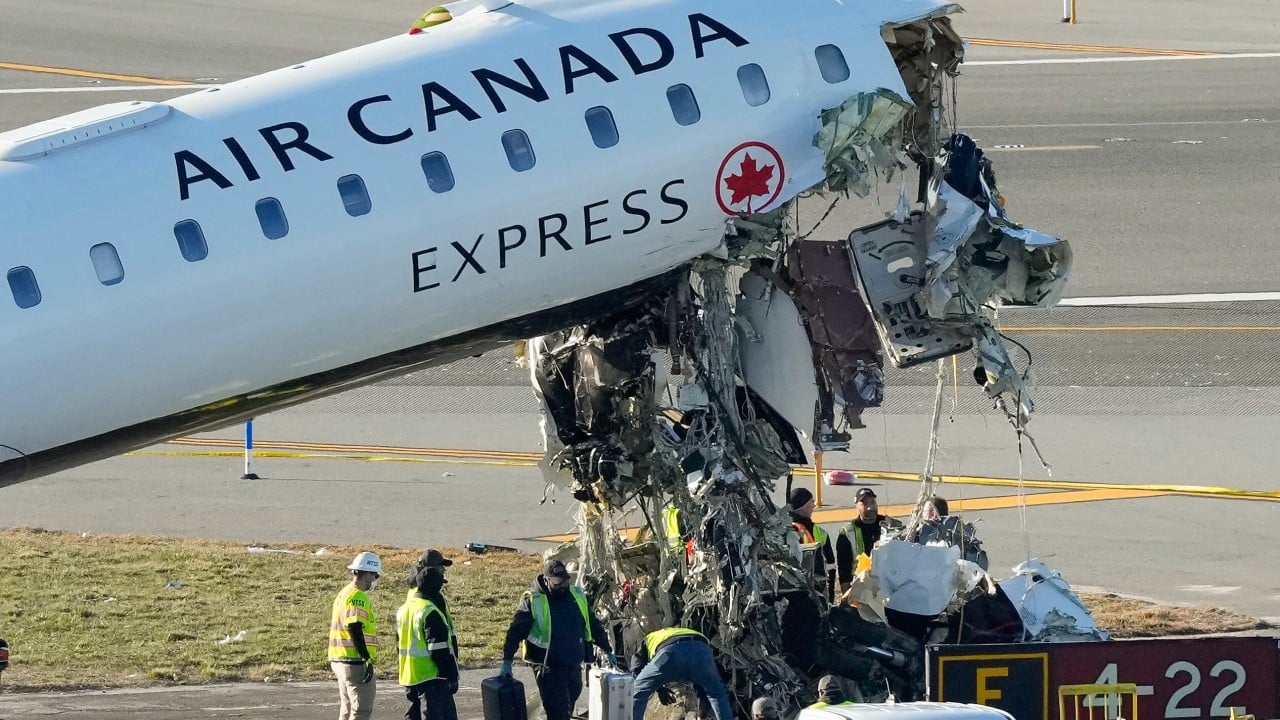
The margin between a routine landing and a hull loss at New York’s LaGuardia Airport (LGA) is measured in milliseconds of cognitive processing and meters of friction-limited deceleration. When a flight crew fails to maintain the aircraft within the longitudinal limits of the runway—a runway excursion—the post-incident discourse typically gravitates toward "distraction" or "human error." These terms are analytically hollow. To understand the structural risks inherent in high-density terminal environments, we must instead quantify the Triad of Operational Interference: environmental constraints, mechanical arresting systems, and the cognitive load of the Flight Management System (FMS) interface.
The Physical Constraints of LGA Runway 13-31
LaGuardia presents a unique set of geographic and engineering limitations that amplify the consequences of any deviation from stabilized approach criteria. Unlike airports with vast safety buffers, LGA is constrained by the East Bay. This lack of "real estate" necessitates the use of Engineered Materials Arresting Systems (EMAS).
An EMAS consists of high-energy-absorbing blocks of cellular cement placed at the end of a runway. It is designed to crush under the weight of an aircraft, providing predictable deceleration without causing catastrophic structural failure or fire. The physics of an EMAS deployment are governed by the kinetic energy formula:
$$K_e = \frac{1}{2}mv^2$$
In this context, $m$ represents the aircraft’s landing weight and $v$ represents the exit velocity as it leaves the paved surface. The efficacy of the EMAS is a function of the material's compressive strength relative to the aircraft's tire pressure and footprint. When officials downplay "distraction," they are often implicitly pointing to the fact that the safety systems—the EMAS—performed within their designed engineering parameters, regardless of why the aircraft reached the runway end.
The Cognitive Load Architecture of the Modern Flight Deck
The assertion that air traffic controllers or cockpit "distractions" are secondary factors requires a breakdown of the Pilot-in-the-Loop (PITL) Model. In high-stress phases of flight, such as the transition from the base leg to final approach at LGA, the pilot’s bandwidth is consumed by three primary streams:
- Avionic Monitoring: Observing the primary flight display (PFD) and navigation display (ND) to ensure the aircraft tracks the ILS (Instrument Landing System) glideslope.
- Kinetic Management: Adjusting thrust levers and flap configurations to maintain a target $V_{ref}$ (reference landing speed).
- External Communication: Processing rapid-fire instructions from Terminal Radar Approach Control (TRACON) and the LGA Tower.
A "distraction" is not a singular event but a Resource Bottleneck. If a controller issues a late runway change or a speed adjustment, the pilot must re-allocate cognitive cycles from monitoring to re-programming. This shift creates a "latent failure" period. If the aircraft’s energy state is high—meaning it is flying faster or higher than the stabilized profile—the time required to correct that state is compressed.
The Stabilized Approach Variable
The aviation industry utilizes the Stabilized Approach Criteria as the definitive benchmark for landing safety. An approach is considered unstable if, by 1,000 feet (in instrument conditions) or 500 feet (in visual conditions), the aircraft does not meet specific parameters:
- The aircraft is on the correct flight path.
- Only small changes in heading and pitch are required to maintain that path.
- The airspeed is not more than $V_{ref} + 10$ knots and not less than $V_{ref}$.
- The aircraft is in the correct landing configuration (flaps, gear, and spoilers armed).
When investigators downplay a specific interaction—such as a brief exchange with a controller—they are looking at the Energy State Gradient. If the aircraft was already 15 knots above $V_{ref}$ and 200 feet above the glideslope, the distraction is a symptom, not the cause. The root cause is the failure to execute a missed approach (go-around) once the stabilized criteria were breached.
Automation Surprises and Mode Confusion
The transition from automated flight to manual landing is a high-risk inflection point. "Mode Confusion" occurs when the flight crew believes the aircraft’s automated systems (Autothrottle or Autopilot) are performing one task while they are actually performing another.
For instance, if the Autothrottle is in a "RETARD" or "HOLD" mode prematurely, the engines may not provide the expected thrust during a flare or a late-stage correction. Conversely, if the throttles remain powered when the pilot expects them to idle, the aircraft will "float" down the runway, consuming valuable stopping distance.
The relationship between runway length ($L$) and required stopping distance ($D_s$) can be expressed as:
$$D_s = \frac{v^2}{2g(\mu + \sin\theta)}$$
Where:
- $v$ is the touchdown speed.
- $g$ is the acceleration due to gravity.
- $\mu$ is the coefficient of friction (impacted by rain or rubber deposits).
- $\theta$ is the runway slope.
At LGA, where runways are approximately 7,000 feet, a delay in touchdown of just 3 seconds at 140 knots consumes 700 feet of runway. This reduces the safety margin by 10%. If a "distraction" causes a 5-second delay in deploying ground spoilers or reverse thrust, the stopping distance increases exponentially beyond the remaining pavement.
Structural Vulnerabilities in Communication Protocols
The verbal exchange between a controller and a pilot is a low-bandwidth, high-criticality data link. The "Read-back/Hear-back" loop is designed to catch errors, but it is vulnerable to Expectation Bias. Pilots often hear what they expect to hear (e.g., a landing clearance) rather than what was actually said (e.g., a "continue" instruction or a different runway assignment).
The argument that officials "downplay" these interactions suggests a shift in focus toward Systemic Resilience. If a single radio transmission can "distract" a crew to the point of a crash, the system lacks sufficient redundancy. Modern safety analysis identifies this as a failure of Crew Resource Management (CRM).
CRM is the effective use of all available resources—information, equipment, and people—to achieve safe flight operations. A breakdown in CRM typically follows a specific sequence:
- Inquiry: A crew member fails to voice a concern.
- Advocacy: A crew member fails to insist on a corrective action (like a go-around).
- Conflict Resolution: The crew focuses on the interpersonal or external stimuli rather than the aircraft’s state.
The Mathematical Reality of Overruns
The probability of a runway overrun ($P_{ro}$) is not a static number. It is a dynamic probability influenced by the Deceleration Delta.
On a short runway like LGA 13-31, the landing must occur within the "Touchdown Zone"—the first 3,000 feet or one-third of the runway. If the aircraft touches down long, the kinetic energy that must be dissipated by the brakes and thrust reversers exceeds the thermal capacity of the equipment. This leads to Brake Fade, where the friction coefficient $\mu$ drops precipitously as the brake components overheat.
Officials focusing on the mechanical outcomes (the EMAS performance) are prioritizing the Survivability Envelope. While the distraction may have initiated the chain of events, the physics of the overrun were determined the moment the aircraft crossed the threshold too fast or too high. The data from the Flight Data Recorder (FDR) will likely show a deviation in the vertical profile long before the "distracting" communication occurred.
Operational Redundancy and Safety Management Systems (SMS)
A robust Safety Management System (SMS) does not seek to eliminate distraction—which is a biological certainty—but to mitigate its impact through Procedural Hardening.
- Sterile Cockpit Rule: Prohibiting non-essential conversation below 10,000 feet.
- Call-out Requirements: Mandatory verbalization of airspeed and sink rate deviations.
- Automatic Ground Spoilers: Reducing the reliance on manual pilot action to "dump" lift and transfer weight to the wheels for braking.
The investigation must move beyond the "who said what" and analyze the Interface Reliability. If the cockpit layout or the FMS logic required excessive "head-down" time during the most critical phase of flight, the fault lies in the Human-Machine Interface (HMI) design.
Tactical Requirement for Terminal Operations
To prevent a recurrence of the LGA incident, operators and regulators must move away from qualitative assessments of "distraction" and toward quantitative Energy Management Training.
The strategic imperative for flight crews is the adoption of a "Gate-Based" approach logic. If specific energy parameters are not met at the 1,000-foot, 500-foot, and 50-foot "gates," a go-around must be mandatory and non-punitive. This removes the "distraction" variable from the equation entirely by making the decision binary: if the gate is missed, the landing is aborted.
Airlines should integrate high-fidelity simulator sessions that specifically replicate the high-density, low-visibility environment of LaGuardia, focusing on late-stage changes in landing clearance. This builds the "muscle memory" required to prioritize the flight path over the radio, ensuring that the kinetic energy of the aircraft remains within the dissipative capacity of the runway and its arresting systems.
Implement a mandatory review of Cockpit Voice Recorder (CVR) data from the 120 seconds preceding the threshold crossing to map the specific moment the cognitive bottleneck occurred, then update CRM training modules to include "Communication Rejection" techniques for pilots under high workload.