The Democratic Republic of Congo is a graveyard of failed ideologies and broken interventions. For decades, the international community has thrown billions of dollars and thousands of peacekeepers at a conflict that seems immune to traditional diplomacy. Yet, in the heart of this chaos, a home-grown movement known as Kimbanguism operates with a level of discipline and social cohesion that the Congolese state can only envy. While Western analysts focus on mineral wealth and rebel factions, they often overlook the spiritual infrastructure that actually keeps millions of people from falling into total despair.
This is not just another religious sect. It is a massive, self-sustaining society within a society. Founded by Simon Kimbangu in 1921, the movement began as a non-violent challenge to Belgian colonial rule. Kimbangu spent thirty years in prison for his "crime" of preaching, but his message survived. Today, his followers have built a holy city, Nkamba, which they call "New Jerusalem." They did this without World Bank loans or IMF structural adjustment programs. They did it with manual labor and a radical commitment to self-reliance.
The Architecture of Defiance
Nkamba stands as a rebuke to the narrative of African dependency. To reach it, one must navigate the crumbling roads of the Kongo Central province, a journey that tests the suspension of any vehicle. But once you arrive, the chaos of the road disappears. You find a city of gleaming white and green structures, meticulously maintained by volunteers.
The Kimbanguists do not wait for the government to build schools or hospitals. They build them themselves. This is the Kimbanguist Work Ethic, a fusion of spiritual duty and civic necessity. In a country where the "State" is often an abstract concept that only appears to demand bribes, the church provides the only reliable social safety net. They run a vast network of primary and secondary schools, and even their own university.
This independence is their greatest strength, but it also creates a complex tension with the political elite in Kinshasa. Politicians frequently visit Nkamba to court the "Kimbanguist vote," which is estimated to be millions strong. However, the movement’s leadership maintains a guarded stance. They have seen regimes rise and fall—Mobutu, the Kabilas, and now Tshisekedi—while the church remains the only constant.
The Geometry of Order
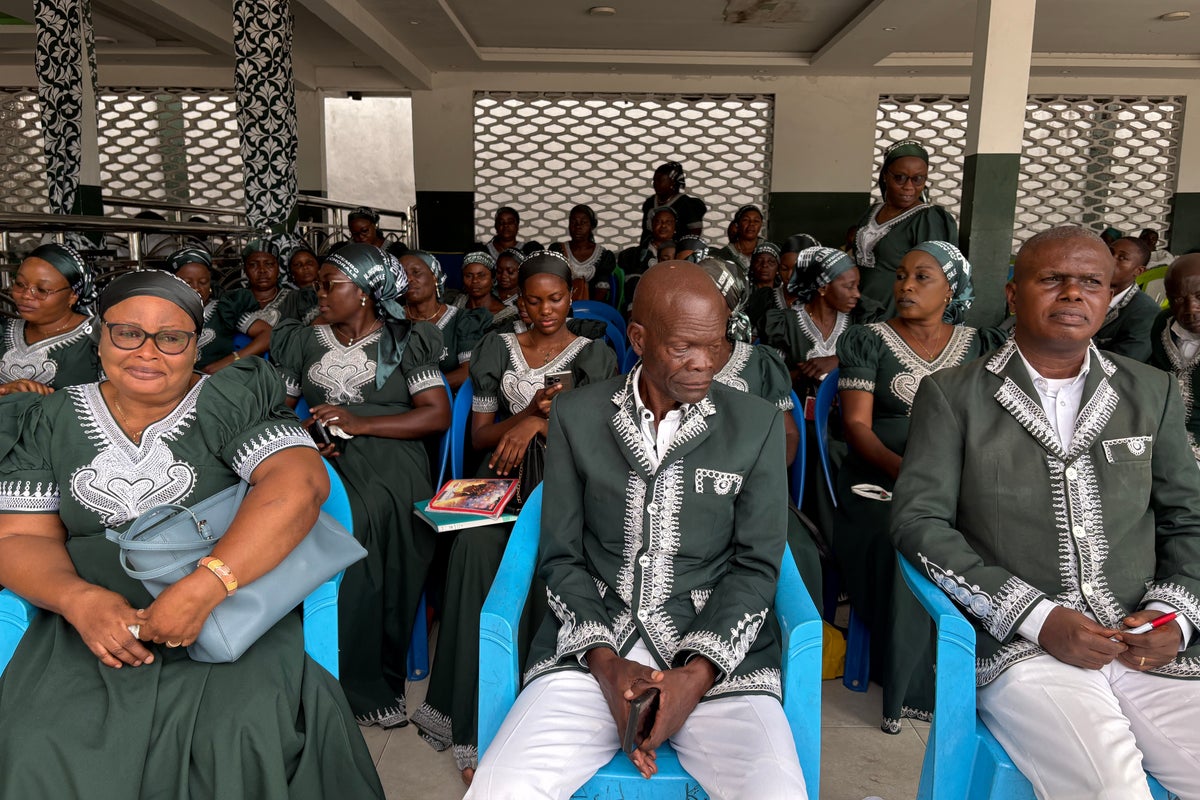
The most striking aspect of the movement is its obsession with order. During a Kimbanguist service, thousands of people move with synchronized precision. Men wear white shirts and green ties; women wrap themselves in green and white fabric. There is no shouting, no frenetic "miracle" seeking that characterizes the Pentecostal "mega-churches" clogging the streets of Kinshasa.
Everything is measured. Everything has a place. In a nation defined by geographical and political fragmentation, this aesthetic of order is a powerful psychological tool. It offers the Congolese person a sense of agency. If you can keep your uniform clean and march in step, you have reclaimed a small piece of territory from the surrounding entropy.
The music is another pillar of this stability. The Kimbanguist Symphony Orchestra is world-renowned, not just for its talent, but for the sheer improbability of its existence. In a city like Kinshasa, where electricity is a luxury and professional instruments are rare, these musicians perform Beethoven and Kimbanguist hymns with professional rigor. They manufacture many of their own instruments by hand. This isn't just art; it is a survival strategy.
The Theological Shield
To understand why Kimbanguism thrives while other movements wither, you have to look at its core claim: Simon Kimbangu was the Holy Spirit personified. This is a theological departure that many mainstream Christian denominations find heretical. For the Kimbanguist, however, it is the ultimate act of decolonization.
By placing a Congolese man at the center of the Trinity, they stripped away the "White Jesus" of the Belgian missionaries. They turned Christianity into a weapon of African identity. This theological shift provides a "shield" against the existential dread that permeates life in the DRC. It tells the believer that they are not a victim of global history, but the chosen subjects of a divine, local plan.
However, this inward-looking focus has a shadow side. The movement’s insistence on obedience to their spiritual leader—currently Simon Kimbangu's grandson, Simon Kimbangu Kiangani—can border on the autocratic. Critics argue that the church’s hierarchy mirrors the very political structures that have failed the country. There is little room for dissent within the ranks. You either march in step or you are out.
The Economic Engine of Nkamba
The church is also an economic powerhouse. They own vast tracts of agricultural land and operate transport companies. Their funding comes from "contributions," which are mandatory for the faithful. In a land of extreme poverty, the sight of millions of dollars flowing into the construction of massive temples can be jarring.
Is this exploitation or empowerment? The answer depends on who you ask. For a farmer in the interior, the church might be the only entity providing a market for his crops or a school for his children. For the cynical observer, it looks like another layer of taxation on people who can least afford it.
Yet, unlike the wealth extracted by mining multinationals, the "Kimbanguist tax" stays in the country. It manifests as bricks, mortar, and medicine. The church has created an internal circular economy that functions regardless of the exchange rate of the Congolese Franc. They have effectively bypassed the failing national economy by creating their own.
Lessons from the Green and White
The "existential lessons" for the rest of Congo are clear, though difficult to implement. The Kimbanguists prove that local ownership is the only path to sustainable development. They demonstrate that when people feel a spiritual and cultural stake in their infrastructure, they will maintain it without external oversight.
But this model is difficult to scale. It relies on a specific, charismatic lineage and a level of religious devotion that cannot be manufactured by a government policy paper. The Kimbanguist "state within a state" works because it is built on a foundation of shared suffering and shared victory over colonial oppression.
The tragedy of the DRC is that the national government has never managed to inspire a fraction of this loyalty. While the soldiers of the national army are often underpaid and prone to desertion, the "soldiers" of the Kimbanguist movement—their scouts and volunteers—work for free, motivated by a vision of a New Jerusalem.
The Future of the Movement
As the DRC faces another cycle of electoral uncertainty and eastern rebellion, the Kimbanguists remain the country's most stable demographic bloc. They are the silent majority that the world ignores at its peril. Their existence proves that the Congolese people are not waiting for a Western savior; they are busy building their own version of the future, one brick at a time.
The real threat to the movement isn't political opposition, but the creeping influence of the globalized internet. As younger Kimbanguists in the cities become more connected to the world, the rigid discipline of Nkamba faces its greatest challenge. Can the movement maintain its isolationist purity in an age of TikTok and instant information?
The church leadership is currently betting on its massive infrastructure projects to keep the youth engaged. They are building more, dreaming bigger, and entrenching their position as the ultimate arbiters of Congolese identity. They aren't just waiting for the kingdom of heaven; they are constructing it on the banks of the Congo River.
If you want to see what a functional Congo might look like, do not go to the government ministries in Kinshasa. Go to the hills of Nkamba. There, amidst the singing and the synchronized marching, you will find a blueprint for survival that the rest of the world has yet to decode. The green and white flags flying over the "New Jerusalem" are a reminder that in the absence of a state, the soul will always find a way to govern itself.
Stop looking for the solution to Congo in peace treaties signed in foreign capitals. The solution is already there, wearing a white shirt and a green tie, marching toward a destiny that no outside force can dictate.