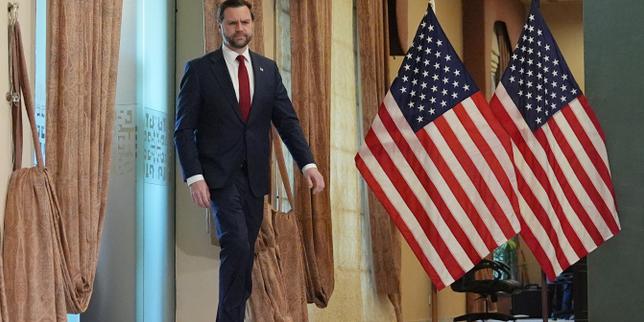
The political theater of "red lines" is a tired performance designed to soothe domestic voters while signaling absolute impotence to international adversaries. When J.D. Vance stands before a microphone to declare that the United States has "clearly made our lines known" regarding Iran, he isn't describing a strategy. He is describing a funeral for American leverage.
The competitor narrative suggests that verbal clarity equals deterrence. It doesn't. In the high-stakes game of Middle Eastern hegemony, words are cheap currency. I have watched administrations for decades play this same game of rhetorical brinkmanship, only to find that every time you draw a line in the sand, the tide moves it for you.
The Illusion of Red Lines
A red line is only effective if the cost of crossing it is higher than the benefit of the transgression. Currently, the math doesn’t add up for the West. We talk about "lines" as if they are physical barriers. They aren't. They are psychological markers that, when ignored without consequence, actually accelerate the very behavior they were meant to prevent.
When Vance or any other official discusses these negotiations, they ignore the fundamental reality: Iran views the negotiation table as a tool for time-acquisition, not a venue for resolution. By defining exactly what we won't tolerate, we are effectively giving Tehran a roadmap of exactly how far they can push without triggering a response. We are providing the boundaries for their expansion.
Why Transparency is a Tactical Failure
In the private sector, if you enter a negotiation and tell the other party exactly what will make you walk away, you have lost. You have capped your upside and exposed your floor. Diplomacy is no different. The obsession with "clarity" in these talks is a symptom of a risk-averse bureaucracy that values PR wins over strategic dominance.
- Predictability creates comfort: If Iran knows the "red line" is $90%$ uranium enrichment, they will sit comfortably at $89.9%$.
- Rhetoric replaces hardware: Every time a politician uses a microphone to threaten, they are usually doing so because they have no intention of using a carrier group.
- The Credibility Gap: Once a line is crossed—and they always are—the failure to act doesn't just reset the clock; it breaks the clock.
The Sanctions Trap
We keep hearing that "tightening the screws" through sanctions is the path to compliance. This is a fundamental misunderstanding of the Iranian economic structure. The Iranian regime has spent forty years building a "resistance economy." They have mapped out the black markets, the back-door banking channels, and the shadow fleets necessary to survive a closed system.
Sanctions are not a "game-changer"—a term bureaucrats love to throw around while doing nothing. Sanctions are a tax. And like any tax, if the goal is important enough, the payer will simply find a way to afford it or evade it.
I’ve seen energy traders in Singapore and Dubai move Iranian crude through three different shell companies before it even hits a refinery. To think that a speech in Washington changes the calculus for a trader looking at a $20 million spread is pure fantasy.
The Misunderstood Role of Proxy Conflict
The "lines" Vance discusses often center on direct Iranian action. This is the wrong question. Iran rarely acts directly. Their genius lies in the distribution of risk through the "Axis of Resistance."
If you draw a red line at the Iranian border, you’ve left the entire Levant open for business. By the time Tehran actually touches a weapon or a trigger, the damage has been done by three different groups with three different names, all funded by the same central bank.
The Problem with "Proportionality"
The most dangerous word in the current diplomatic lexicon is "proportional." It is a recipe for endless, low-level attrition. If an adversary hits you, and you hit them back with exactly the same force, you haven't changed the status quo. You’ve merely validated it.
To actually stop the cycle, the response must be fundamentally disproportionate. It must be so overwhelming that the cost-benefit analysis for the next strike becomes impossible to justify. Washington is currently allergic to this concept because it fears "escalation." But escalation is already happening; we are just the only ones trying to pretend it isn't.
Economic Reality vs. Political Posturing
Let’s look at the actual data of Iranian oil exports. Despite the "maximum pressure" rhetoric often touted by both sides of the aisle, exports have hit multi-year highs recently. Why? Because the world needs the BTUs.
$$E = P \times Q$$
Where $E$ is total export revenue, $P$ is the price per barrel (often discounted in the "shadow" market), and $Q$ is the quantity. Even with a lower $P$, the increase in $Q$ driven by Chinese demand has rendered the "red lines" on Iranian finance largely symbolic. If you want to stop the program, you don't talk to the Iranians; you stop the buyers. But that would mean a trade war with China that no one in the current administration—or the next one—has the stomach for.
The Three Mistakes We Keep Making
- Assuming Rational Actors Value Life Over Legacy: Western negotiators often assume the Iranian leadership prioritizes economic stability. They don't. They prioritize ideological survival and regional hegemony. You cannot bargain with someone who views a shrinking GDP as a badge of religious honor.
- The "One More Deal" Fallacy: There is a persistent belief that we are just one tweak, one sunset clause, or one verification protocol away from a permanent fix. There is no permanent fix. There is only managed tension.
- Ignoring the Domestic Audience: Much of what Vance says is directed at voters in Ohio and Pennsylvania, not the IRGC in Tehran. This creates a dangerous feedback loop where our foreign policy is dictated by 24-hour news cycles rather than 20-year strategic objectives.
How to Actually Win (The Uncomfortable Truth)
If you want to move the needle, you stop talking about red lines and start creating "gray zones" of uncertainty.
The most effective deterrent is the one the enemy can’t see coming. In the 1980s, during Operation Praying Mantis, the U.S. didn't give a televised address about lines. They simply dismantled half of the Iranian Navy in a single day after a mine hit the USS Samuel B. Roberts. That is a language that translates across cultures.
We need to stop asking "What is our line?" and start asking "What is their breaking point?"
- Decouple Energy and Diplomacy: If you want to hurt the regime, you have to flood the market with domestic production to crash the price of crude globally. You don't negotiate the price of their oil; you make their oil worthless.
- Cyber Asymmetry: We spend billions on defensive "robustness" while being hesitant to deploy offensive capabilities that could cripple the infrastructure used for internal repression.
- End the Nuclear Obsession: The nuclear program is a distraction. The real threat is the conventional missile program and the proxy network. By focusing $90%$ of our diplomatic energy on the $10%$ nuclear threat, we give them a free pass on everything else.
The Cost of the Current Path
The "bold" stance J.D. Vance is taking is actually the safest path possible. It’s the path of least resistance. It allows him to look "tough" without actually committing to the hard, messy, and potentially violent work of real deterrence.
We are currently witnessing the managed decline of American influence in the Persian Gulf. Every speech about "clear lines" is another brick in the wall of our own containment. While we argue over the wording of a communique, our adversaries are building factories, launching satellites, and securing the lithium and cobalt supply chains of the next century.
The status quo isn't working because the status quo is built on the lie that words can replace power. You don't negotiate with a fire; you starve it of oxygen. Until we are ready to cut the supply of air—financially, militarily, and geologically—these negotiations are nothing more than a high-stakes hobby for the political class.
Stop listening to what they say at the podium. Watch what they do in the counting house and the shipyard. That’s where the real lines are drawn. Everything else is just noise.
Burn the script. Stop drawing lines. Start taking ground.