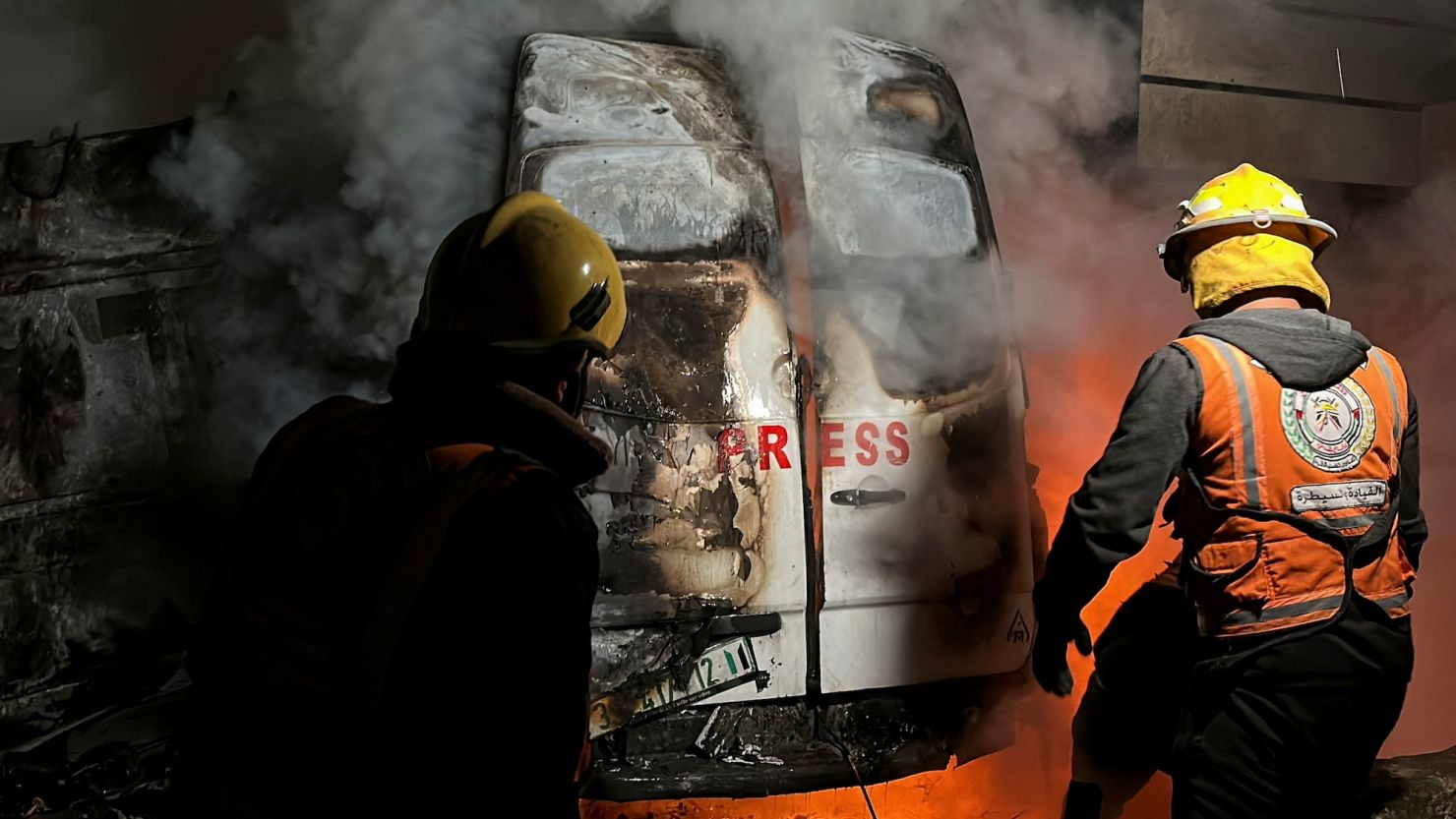
The smoke rising from the targeted government building in southern Lebanon isn't just another statistic in a long-running conflict. It's a signal. When an Israeli strike hits a municipal center and kills Lebanese officers, the thin line between fighting a militia and attacking the state itself starts to vanish. You can’t look at this as just another day of cross-border fire. It’s a shift.
People often ask if Lebanon’s official military or government staff are "fair game" in this mess. They aren't supposed to be. But the reality on the ground is messier than any international law textbook. This strike directly hit the infrastructure of the Lebanese state, killing officials who weren't part of Hezbollah's combat units. That matters. It changes how the Lebanese public views the war and how the international community weighs the risk of a full-scale collapse.
The direct hit on Lebanese civil authority
The strike targeted a municipal building that serves as a hub for local governance. We're talking about civil servants and officers who manage everything from local security to emergency response. These aren't the guys hiding in tunnels. They're the ones trying to keep the lights on and the roads clear while the world burns around them.
When Israel targets these sites, they usually claim it’s because the building was being used by Hezbollah for operational purposes. Maybe. But the cost is the total erosion of the Lebanese state’s already fragile authority. If a government officer can’t feel safe in a government building, then the state effectively doesn’t exist in that region.
This isn't a minor detail. Lebanon is a country held together by Scotch tape and prayers right now. Its economy is in the toilet. Its political system is paralyzed. The municipal governments are often the only things left standing. Taking them out creates a vacuum. History shows us that vacuums in the Middle East are never filled by "the good guys." They're filled by chaos.
Why the distinction between Hezbollah and the Lebanese state is failing
You've probably heard the argument that Hezbollah is the de facto power in Lebanon. It's true. They have more guns, more money, and more discipline than the official Lebanese Armed Forces (LAF). But for years, there’s been a quiet understanding. Israel would fight Hezbollah, and Lebanon as a state would try to stay out of the way.
That's over.
The Israeli military is increasingly treating the Lebanese state as an extension of Hezbollah. From their perspective, if Hezbollah uses a government roof to mount a camera or a basement to store a crate, the whole building is a military target. This creates a terrifying reality for the average Lebanese citizen. You don't have to be a partisan to get caught in the crossfire. You just have to be going to work at a government desk.
I’ve watched these dynamics play out for years. The moment you stop distinguishing between a militant group and the local government, you lose the ability to de-escalate. There's no one left to talk to. There's no neutral ground.
Casualties that the world ignored until now
The officers killed in this strike represent a specific type of loss. They are the link between the civilian population and what's left of the central government in Beirut. Their deaths aren't just personal tragedies; they're structural hits to the Lebanese interior ministry's ability to maintain any semblance of order in the south.
Let's look at the numbers. Since this escalation began, hundreds have died. Most are fighters. But the number of civilians and state employees is climbing. Each time a "government officer" is added to that list, the diplomatic math gets harder. The United States and France have been trying to negotiate a deal based on the Lebanese army taking control of the border. How does that happen if the officers meant to oversee that transition are being killed in their offices?
It’s a contradiction that nobody in the war cabinets seems to want to solve.
The strategic ripple effect of hitting government centers
Military experts often talk about "decapitation strikes." Usually, that means going after top generals. But hitting local government buildings is a form of administrative decapitation. It breaks the "boring" parts of a country—the parts that handle water, food distribution, and local law enforcement.
- Displacement spikes: When local government collapses, people flee faster. They know no one is coming to help.
- Intelligence gaps: Israel argues these strikes disrupt Hezbollah's local intelligence.
- Radicalization: Nothing recruits for a militia faster than seeing your local mayor or police captain killed by a foreign missile.
This isn't just about the immediate tactical gain of hitting a target. It's about the long-term wreckage of a society. If the goal is a stable border, destroying the local government seems like a strange way to get there. You're basically guaranteeing that the only organized force left in the ruins will be the very militia you're trying to defeat.
What happens when the buffer zones disappear
The south of Lebanon was supposed to be a buffer zone under UN Resolution 1701. We all know that resolution is currently a piece of paper with no teeth. Hezbollah didn't leave, and Israel didn't stop overflights. But the presence of Lebanese government officers was the last shred of evidence that 1701 still meant something.
By hitting these buildings, the message is clear: the buffer zone is now a kill zone.
If you’re tracking this conflict, don’t just look at the rocket counts. Look at the targets. When the targets shift from "launcher in a field" to "officer in a city hall," the war has entered a new phase. It’s no longer just a border skirmish. It’s an assault on the infrastructure of a neighboring country.
Managing the fallout on the ground
If you're in Lebanon or have family there, the advice is simple but grim. Avoid any facility that has even a tangential connection to the security apparatus. The rules of engagement have widened. It doesn't matter if you're "just" a clerk or a local coordinator. In the eyes of a drone operator at 30,000 feet, a government building is a node in a network.
The international community needs to decide if it actually wants a Lebanese state to exist. If it does, there has to be a red line around civil infrastructure. Without it, there's no partner for peace. There’s just a pile of rubble and a lot of angry people with nothing left to lose.
Monitor the official statements from the Lebanese Ministry of Interior over the next 48 hours. Their reaction will tell you if the state is going to try to assert itself or if it’s finally rolling over. Watch the movement of the LAF. If they pull back further from these administrative centers, the south is officially a lawless front. Stay informed by following local journalists who aren't tied to the major party mouthpieces; they're the only ones telling the truth about who was actually in those buildings when the missiles hit.