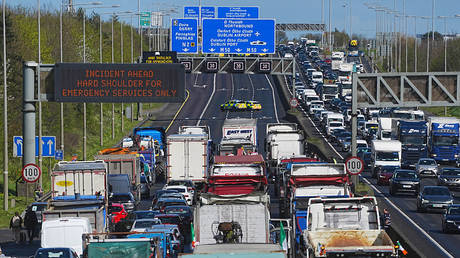
The sight of green uniforms and heavy recovery vehicles clearing Irish motorways isn't a victory for "essential services." It is the final, desperate gasp of a policy class that has lost the ability to govern through persuasion. While mainstream outlets frame the deployment of the Irish Defence Forces as a necessary restoration of order, they are ignoring the fundamental economic rot that made the barricades inevitable. You are being told this is about logistics. It isn’t. It’s about the violent enforcement of a failing energy transition.
Let's stop pretending these protests are just "fringe groups" causing trouble. When a government uses the army to suppress citizens protesting the cost of basic survival, it has already lost the argument. The lazy consensus says the state must maintain flow at all costs. The reality is that the state is using a hammer because it has forgotten how to build a roof. If you enjoyed this piece, you might want to read: this related article.
The Myth of the "Reckless Protest"
Standard reporting paints the hauliers and farmers as the villains of the piece—obstructionists standing in the way of the daily commute. This narrative is a convenient fiction. If you actually look at the overheads of a standard logistics firm in Ireland right now, the math is suicidal.
Fuel prices aren't just "high." They are prohibitive. When the government refuses to budge on the carbon tax—a levy designed for a world of €1.20 diesel, not €2.00 plus—they are effectively legislating these businesses out of existence. Protesting isn't a choice for these drivers; it is a stay of execution. For another perspective on this story, refer to the recent coverage from TIME.
Sending in the army to clear the M50 or the Port Tunnel doesn't lower the price of a liter of fuel. It doesn't fix the supply chain. It simply hides the symptoms of a terminal illness. If a business cannot afford to move its goods, it stops moving them. Clearing the road just ensures the trucks sit empty in a yard instead of blocking a lane. The economic outcome is the same: stagnation.
The Logistics of Despair
I’ve spent years watching governments fumble infrastructure crises. The pattern is always identical. First, they ignore the complaints. Second, they vilify the messengers. Third, they call in the "heavies."
The Irish state’s reliance on the Defence Forces for civil tasks—from driving ambulances to clearing protests—reveals a hollowed-out civil service. We are witnessing the "Securitization of Inflation." Instead of addressing the monetary policy and tax structures that are driving prices into the stratosphere, the state treats the resulting public anger as a security threat.
The technical term for what we’re seeing is Regulatory Capture by Ideology. The Irish government is so committed to its specific, aggressive timeline for climate targets that it has become blind to the physical reality of its own economy. You cannot tax a haulage industry into "going green" when the electric infrastructure for heavy goods vehicles (HGVs) is non-existent. There is no "pivot" for a man with a €150,000 debt on a diesel rig and a family to feed.
The Carbon Tax Fallacy
The "People Also Ask" sections of the internet will tell you that carbon taxes are essential for behavior change. This is a half-truth that masks a lie. Carbon taxes work when there is a viable alternative. If I tax your steak, you buy chicken. If I tax the only fuel that can move 40 tons of food across the country, I am not changing your behavior; I am taxing your existence.
The Irish government argues that the revenue from these taxes is "ring-fenced" for green initiatives. This is cold comfort to the courier who can’t afford to fill his tank today. It is a wealth transfer from the working class to the subsidised middle class who can afford the upfront cost of an EV.
Imagine a scenario where the government actually cared about carbon reduction without the theater of the army. They would scrap the tax at the pump and provide massive, immediate grants for aerodynamic retrofitting or biofuels. Instead, they choose the optics of "strength." They want you to see the army clearing the road so you feel safe. You shouldn't feel safe. You should feel ignored.
The Army is a Band-Aid on a Sucking Chest Wound
The Defence Forces are not trained for civil dispute resolution. They are trained for kinetic action and logistics support. By forcing them into this role, the government is eroding the neutral status of the military in the eyes of the public.
When the army clears a protest, they aren't just moving trucks. They are removing the only leverage the citizenry has left. In a functioning democracy, protests are a pressure valve. When you weld that valve shut with military force, the pressure doesn't go away. It just finds a more volatile way to escape.
We are told that "essential supplies" must reach their destination. True. But who is making those supplies expensive in the first place? The very people ordering the army to clear the way. It is a circular logic that would be hilarious if it weren't so destructive to the social contract.
Stop Asking if the Protests are Legal
The legality of a protest is the least interesting thing about it. History is littered with "legal" atrocities and "illegal" movements that saved nations. The question you should be asking is: Is the current energy policy sustainable for a sovereign nation?
The answer is a resounding no. Ireland is an island at the end of a long, fragile energy tail. Its insistence on being a "global leader" in green taxation while its citizens struggle to heat their homes is a form of vanity that the country cannot afford.
The military deployment is a distraction. It’s a shiny object designed to make the evening news look like the government is "taking charge." In reality, they are flailing. They are out of ideas, out of empathy, and very nearly out of time.
If you think the "clearing" of these protests solves the problem, you haven't been paying attention. The trucks will return. The farmers will return. The costs will continue to rise. And the next time the army is called out, the uniforms might not be enough to keep the peace.
The state didn't clear a path for progress today. It just paved the way for a much larger, more dangerous confrontation. The price of fuel is high, but the price of ignoring your own people is going to be much higher.
Don't look at the road. Look at the man behind the wheel of the recovery vehicle and ask yourself why he's the one doing the government's dirty work.