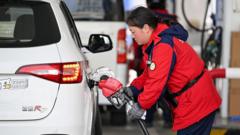
The screen on the gas pump flickers, its digital numbers racing upward with a frantic, mechanical energy. It feels personal. For the woman standing in the damp chill of a Tuesday morning, watching the total climb past fifty, sixty, seventy dollars, it isn't just a market correction. It is a calculated theft of her weekend plans, a tightening cinch around her grocery budget, and a subtle, nagging anxiety about how far she can drive before the world becomes too expensive to navigate.
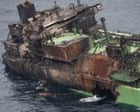
She doesn't see the drones. She doesn't hear the concussive roar of an explosion three thousand miles away in a desert she will never visit. But the fire that bloomed over a sprawling refinery in the Middle East last night has reached out across the globe to touch her wallet.
This is the brutal, beautiful, and terrifyingly efficient nervous system of the global energy market. When an "energy site" is attacked, the media reports on "surging crude futures" and "supply chain volatility." Those words are hushed and clinical. They hide the heat. They ignore the smell of scorched earth and the frantic shouting of engineers trying to bypass a melting valve. To understand why your life just got more expensive, you have to look past the ticker tape and into the fire.
The Fragility of the Flow
Crude oil is the lifeblood of modernity, but we treat it like a ghost. It is hidden in pipelines, buried in tankers, and tucked away in industrial fortresses. We only notice it when the flow stutters.
Imagine a massive, intricate web of glass tubes spanning the entire planet. Every second, millions of gallons of pressurized liquid pulse through these tubes, fueling the trucks that bring oranges to Maine and the planes that carry families to reunions. Now, imagine someone taking a hammer to a single joint in that web.
The vibration doesn't stay local. It screams through the glass.
When news broke of the recent strikes on critical infrastructure, the reaction was instantaneous. Traders in high-rise offices in London and New York didn't wait for a damage assessment. They didn't wait to see if the fire was out. They bought. They bid up the price of every available barrel, terrified that the hammer might strike again. In the span of a few hours, the global price of oil jumped by 4%, then 5%.
To the analyst, that’s a "bullish signal." To the rest of us, it’s a tax on existence.
The Ghost in the Machine
Consider the "risk premium." It is a spectral figure that haunts every barrel of oil.
When the world is at peace, you pay for the cost of pulling the oil out of the ground and shipping it to your local station. But we don't live in a world at peace. We live in a world of "What If."
The risk premium is the extra dollar—or ten—added to the price because of the fear that tomorrow might be worse than today. It is a tax on instability. When a drone strikes a storage tank, the risk premium swells. It’s the market’s way of saying, "We don't trust that the glass tubes won't shatter tomorrow."
This isn't just about supply and demand in the traditional sense. It’s about psychology. Even if not a single drop of oil is actually lost to the flames, the possibility of loss is enough to send prices spiraling. We are paying for the nightmares of billionaires and the strategic gambles of nations.
A Tale of Two Cities
To ground this, look at two hypothetical people separated by an ocean but joined by a single invoice.
In a coastal city near the site of the attack, an engineer named Elias stands on a cooling tower. His ears are ringing. The air tastes like sulfur and burnt rubber. He isn't thinking about the Dow Jones Industrial Average. He is thinking about the three men in his crew who are being treated for smoke inhalation and the fact that the backup generators are failing. For Elias, the "surge in oil prices" is a physical catastrophe. It is a failure of security, a threat to his livelihood, and a literal scar on his landscape.
Meanwhile, in a suburb of Chicago, a delivery driver named Marcus checks his app. He sees the price of diesel has jumped twenty cents overnight. Marcus doesn't know Elias. He doesn't know the name of the refinery or the political grievances of the group that launched the attack.
All Marcus knows is that his profit margin for the day has just evaporated. Every mile he drives to deliver a package of yoga mats or printer ink is now costing him more than it did yesterday. He wonders if he should pick up an extra shift, which means missing his daughter’s basketball game.
Elias faces the fire; Marcus feels the heat.
The Domino Effect
The damage isn't contained to the gas station. That is a common misconception. If oil prices stayed high for a week, we might survive it with a bit of grumbling. But when energy sites are targeted repeatedly, a slow-motion collapse begins to ripple through the economy.
Everything you touch has been moved by oil. The plastic in your phone was birthed from petroleum. The fertilizer that grew your salad was synthesized using natural gas. When the base cost of energy rises, the price of the world rises with it.
- Logistics Chokehold: Shipping companies add fuel surcharges. That $10 shipping fee becomes $15.
- Agricultural Strain: Farmers facing higher costs for tractor fuel and fertilizer are forced to raise the price of wheat and corn.
- Manufacturing Slowdown: Factories that require massive amounts of heat or power see their overhead explode. They don't eat those costs. They pass them to you.
It is a feedback loop of misery. We often talk about inflation as if it’s a weather pattern—something that just happens. In reality, it is often sparked by a single event, a single explosion, a single moment of geopolitical theater that forces the entire world to recalibrate its expectations.
The Illusion of Independence
There is a tempting myth that we can insulate ourselves. We hear talk of "energy independence" and "strategic reserves." But the truth is more sobering. The oil market is a single, global pool.
If a refinery in the Middle East goes offline, the buyers who were supposed to get that oil don't just go home. They go to the next available source—perhaps in the North Sea or the Gulf of Mexico. They outbid the current buyers. Prices rise everywhere. You can't fence off a section of the ocean and claim the waves won't affect you.
We are all tethered to the same volatile anchor.
This reality creates a strange, uncomfortable intimacy between a commuter in a minivan and a soldier in a desert. Their fates are linked by a commodity that is as essential as water and as combustible as resentment. We are participants in a system that prizes efficiency over resilience, leaving us vulnerable to anyone with a drone and a grudge.
The Heavy Price of Certainty
What we are really buying at the pump isn't just fuel. We are buying the privilege of not having to think about where our energy comes from.
When the prices surge, the veil is lifted. We are forced to acknowledge the fragility of our comfort. We realize that our ability to move, to eat, and to stay warm is dependent on a precarious balance of power in corners of the world we often ignore.
The uncertainty is the most expensive part. It forces businesses to hesitate. It makes families pull back on spending. It creates a vacuum of confidence that is far harder to fill than a storage tank.
The fire at the energy site eventually goes out. The smoke clears. The engineers like Elias weld the pipes back together and the flow resumes. But the price doesn't always come back down as quickly as it went up. The "risk" has been proven real. The memory of the flames lingers in the spreadsheets of the traders, a ghost that continues to haunt the woman at the gas pump long after the news cycle has moved on to the next disaster.
She finishes filling her tank. The click of the nozzle is a sharp, final sound. She looks at the total—a number that represents a few hours of her life traded away to cover the cost of a conflict she didn't start and cannot end. She climbs back into her car, turns the key, and the engine roars to life, consuming the very thing that is making her life harder, one invisible drop at a time.
The sun continues to rise over the blackened ruins of a refinery half a world away, where the air still smells of salt and ruin. The web of glass tubes holds for now, vibrating with the silent, expensive pulse of a world trying to keep moving at any cost.
Would you like me to analyze how these specific energy price fluctuations are currently impacting the consumer price index or help you draft a budget strategy to offset rising fuel costs?