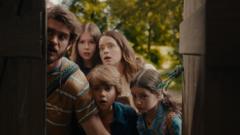
Andrew Garfield is sitting in a room, and he is worried about your soul. Not in a theological sense, necessarily, but in the way a gardener worries about a plot of land that has been paved over by a parking lot. He calls it an "abuse." He calls it a violation. And while he is currently promoting a film titled The Magic Faraway Tree, the conversation he is forcing us to have isn't about whimsy or childhood nostalgia. It is about the war for the three inches of space between your eyes and your screen.
We have reached a point where the most valuable resource on the planet is no longer oil. It is not lithium. It is not even data in the abstract sense. It is the chemical spark that occurs when you decide to look at one thing instead of another.
Your attention.
Consider a hypothetical woman named Sarah. Sarah is sitting on her sofa at 9:00 PM. She intended to read a book, a physical object with weight and a scent. But her phone buzzed. A notification—meaningless, really, just a "like" from someone she hasn't spoken to in three years—acted as the hook. Two hours later, she is still scrolling. She is watching a video of a man cleaning a rug. Then a video of a political argument. Then a recipe for a cake she will never bake.
Sarah feels hollow. She isn't relaxed. She isn't informed. She has simply been harvested.
The Engineering of the Itch
The companies that build these interfaces are not your friends. They are not even "service providers" in the traditional sense. They are architects of addiction. Garfield’s critique hits a specific nerve because he sees the irony in his own profession: he spends his life trying to capture human attention to tell stories that expand the heart, while the devices we use to watch him are designed to shrink it.
These platforms employ thousands of the most brilliant minds on earth—engineers who studied the neurology of gambling—to ensure Sarah doesn't put the phone down. They use variable reward schedules. This is the same psychological mechanism that keeps a person pulling the lever on a slot machine. If you knew exactly what you were going to see next, you might get bored. But because the next swipe might be a joke, or a tragedy, or a bit of validation, you keep swiping.
The itch is the product.
When Garfield speaks about this "abuse," he is referencing a fundamental asymmetry of power. On one side, you have a single human brain with its finite supply of willpower and its ancient, tribal hardwiring. On the other side, you have a supercomputer pointed at that brain, fueled by trillions of data points, designed specifically to bypass the conscious mind and talk directly to the brainstem.
It is not a fair fight. It was never meant to be.
The Cost of a Fragmented Life
We often talk about "screen time" as if it’s a budget item, like a grocery bill. We think, "I spent four hours on my phone today; I should probably do less of that tomorrow." But the damage isn't just the time lost. It’s the degradation of the ability to think deeply.
Imagine trying to build a cathedral while someone throws a pebble at your head every thirty seconds. You might stay on the job site for eight hours, but you will never finish the cathedral. You can’t even get the foundation level. This is what is happening to our collective cognitive ability. We are living in a state of continuous partial attention. We are everywhere and nowhere.
Garfield’s concern stems from the loss of "presence." In acting, presence is everything. If an actor is thinking about their laundry while performing Hamlet, the audience knows. The magic dies. Life is the same way. If you are looking at a sunset through a viewfinder, or scrolling through Twitter while your child tells you about their day, you aren't actually there. You are a ghost in your own life.
The tech companies want us to believe that more "connection" is always better. But they have confused connection with contact. A wire can have contact with a terminal without any electricity flowing through it. We are more "contacted" than any generation in history, and yet, the rates of loneliness and anxiety suggest that the "connection" is a lie.
The Great Reclamation
What does it look like to fight back? It isn't as simple as deleting an app. It requires a fundamental shift in how we value our internal lives.
Garfield suggests that we have to treat our attention as something sacred. If someone walked into your house and started screaming in your ear while you tried to sleep, you would call the police. Yet, we allow these companies to enter our pockets, our bedrooms, and our dinner tables to do exactly that.
There is a physical sensation to reclaiming your focus. It starts with a literal ache. When Sarah finally puts her phone in a drawer and sits in silence, her brain screams for the stimulus. It feels like a withdrawal because it is a withdrawal. The dopamine levels are crashing.
But then, something happens. After twenty minutes, the world starts to look high-definition again. The silence stops feeling like a void and starts feeling like a space. This is the "Magic Faraway Tree" that Garfield is actually talking about—not a fictional place in a book, but the vast, untapped territory of the human imagination that can only be accessed when we stop looking at the glowing rectangles.
The Architecture of Choice
We have been told a story that this is just the way the world is now. That "the genie is out of the bottle." This is a convenient narrative for those who profit from our distraction. It suggests that we are helpless.
We are not helpless.
The design of our digital world is a choice. We could have social networks that don't use infinite scrolls. We could have phones that don't use red, high-alert icons for trivial updates. We could have an economy that doesn't treat the human gaze as a crop to be harvested.
But until those systemic changes happen, the responsibility falls to the individual. It is a grueling, daily act of rebellion. It means choosing the boring over the stimulating. It means choosing the difficult conversation over the easy distraction. It means looking at the person across from you and seeing them, really seeing them, instead of checking to see if anyone else is looking at you online.
The tragedy of the modern age is not that we have these tools. The tragedy is that we have forgotten they are tools. We have allowed them to become our masters. We have become the fuel for the machine we thought we were driving.
Andrew Garfield isn't just an actor playing a part. He’s a man looking at a burning building and wondering why everyone inside is busy taking selfies with the flames. The building is our shared reality. The flames are the algorithms.
The exit is right there. All you have to do is look away.
Think about the last time you were truly bored—the kind of boredom that feels like a heavy blanket. Do you remember what happened next? Usually, that’s when the best ideas arrive. That’s when you remember a song you haven't heard in years, or you finally figure out how to fix that broken shelf, or you realize you’ve been holding your breath for the last hour.
Boredom is the soil of creativity. By eliminating boredom, tech companies have inadvertently sterilized the human spirit. They have paved the garden.
Garfield is asking us to pick up a sledgehammer and start breaking up the asphalt. He is asking us to remember that our eyes belong to us. That our thoughts are private property. That the most revolutionary thing you can do in a world that wants you to look at everything is to choose, with absolute intention, to look at nothing at all.
Put the phone down.
The silence won't kill you. It might actually be the first time you’ve been alive in years.
Look at the dust motes dancing in a shaft of light. Listen to the hum of the refrigerator. Feel the weight of your own body in the chair. This is the world. This is the only thing that is real. Everything else is just a flicker of light on a piece of glass, designed by a stranger who wants to sell you something you don't need.
The war is over your attention. And you are the only one who can win it.