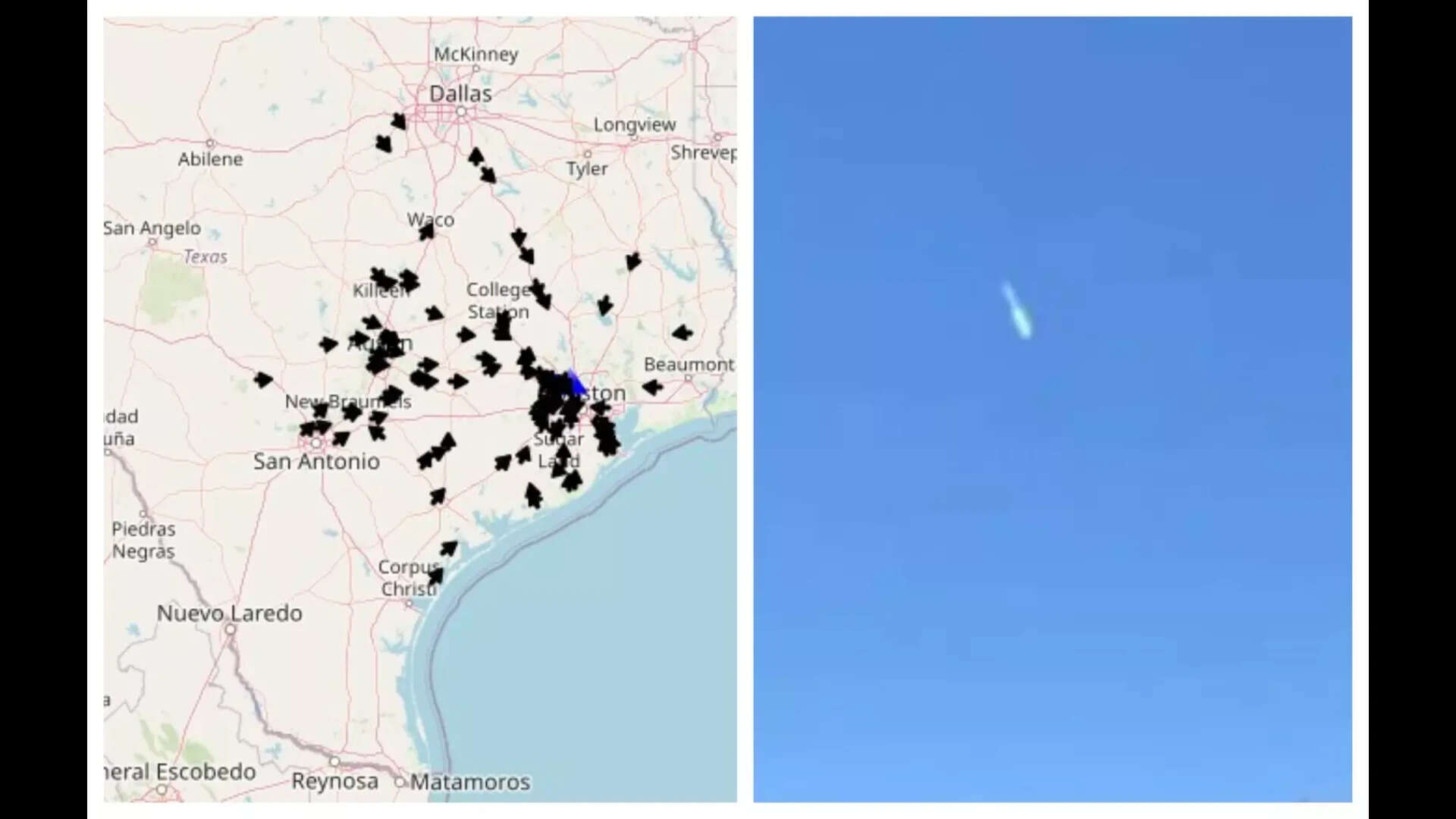
On a quiet evening in Houston, the mundane routine of suburban life was shattered by a sound that defied easy explanation. A local resident reported that a celestial fragment—a piece of the early solar system—had punched a hole through her roof, landing in the heart of her home. While the image of a space rock invading a living room makes for a gripping headline, the scientific reality of such events is governed by brutal ballistics and atmospheric friction. To understand whether a meteor actually struck a Texas home, we have to look past the charred drywall and examine the cold, hard numbers of planetary defense and terminal velocity.
NASA and the American Meteor Society receive thousands of "fireball" reports every year. Most are optical illusions or atmospheric junk. However, the Houston event gained traction because of the physical evidence: a hole in a roof and a heavy, blackened stone. When a meteor enters the atmosphere at speeds exceeding 30,000 miles per hour, it undergoes a process called ablation. The air in front of the rock is compressed so violently that it turns into a glowing plasma. This is the streak of light we see from the ground. But for a rock to actually survive this furnace and hit a house, it must be the right size, the right material, and hit at the right angle.
Most "meteorites" found in backyards turn out to be industrial slag or terrestrial hematite. The Houston case, however, highlights the gap between public perception of space threats and the actual monitoring capabilities of our federal agencies.
The Atmospheric Sieve
The Earth’s atmosphere acts as a high-pressure shield. Any object smaller than a car usually disintegrates before it ever nears the troposphere. When a meteoroid hits the "thick" air, the friction creates a shockwave. If the rock is fragile—like a carbonaceous chondrite—it simply explodes in mid-air. This is known as a high-altitude burst. To reach a roof in Houston, the object must be made of denser material, likely nickel-iron or a stony-iron mix.
Even if a fragment survives the fiery descent, it doesn't stay hot. This is a common misconception that often leads to false reporting. By the time a meteorite reaches the lower atmosphere, it has reached terminal velocity. It is no longer traveling at cosmic speeds; it is falling at the same rate as a dropped brick—roughly 200 to 400 miles per hour.
Because the rock has spent the last few minutes falling through freezing air after losing its cosmic velocity, it is rarely "red hot" when it hits the ground. In fact, some meteorites have been found covered in frost immediately after impact. If a homeowner claims a rock is still glowing or starting fires ten minutes after impact, a seasoned investigator knows to look for a different culprit.
Why NASA Stays Quiet
When these events occur, the public immediately looks to NASA’s Johnson Space Center, located right in Houston’s backyard. Yet, NASA’s response is often perceived as dismissive or overly cautious. There is a bureaucratic reason for this. NASA’s Planetary Defense Coordination Office is tasked with tracking Near-Earth Objects (NEOs) that are large enough to cause regional or global devastation—typically objects larger than 140 meters.
A rock the size of a grapefruit is literally beneath their radar.
Military and weather radar often pick up the debris trails from larger fireballs, but these systems are not designed to track a single falling stone to a specific street address. When NASA "confirms" a sighting, they are usually relying on data from the Geostationary Operational Environmental Satellite (GOES), which carries a Geostationary Lightning Mapper. This sensor can detect the sudden bright flash of a bolide (an exploding meteor), but it cannot tell you if that flash resulted in a hole in a Houston kitchen.
The Forensic Evidence of an Impact
To determine if the Houston stone is the real deal, investigators look for fusion crust. This is a thin, glassy coating—usually less than a millimeter thick—formed during the final seconds of the fireball phase. It looks like a burnt marshmallow skin. If the rock is jagged or shows internal crystals on the outside, it hasn't been through the atmospheric furnace.
The internal structure is the smoking gun. Terrestrial rocks are full of bubbles (vesicles) or layered sediments. Meteorites are dense. They often contain chondrules, which are tiny, spherical grains that formed in the solar nebula 4.5 billion years ago. If you cut the Houston rock open and see these grains, you aren't just looking at a property insurance claim; you are looking at the foundational rubble of our planet.
The Problem of Slag and False Positives
Houston is a hub of industry, construction, and transport. The city is littered with "meteor-wrongs."
- Magnetite and Hematite: Heavy, dark rocks that are magnetic and look "space-y" to the untrained eye.
- Industrial Slag: Byproducts of smelting or welding that often have the pitted, melted appearance of a meteorite but are filled with air bubbles.
- Road Debris: High-speed kicks from truck tires can send rocks through windows or thin roofs with surprising force, mimicking an impact.
The Insurance Nightmare
Beyond the science lies the brutal reality of home ownership. Most standard insurance policies cover "falling objects," which technically includes meteorites. However, the burden of proof is on the homeowner. Without a formal certification from a university or a specialized laboratory, an insurance adjuster is likely to categorize the damage as vandalism or a structural failure.
The homeowner in Houston faces a bizarre Catch-22. To prove the claim, she needs the rock analyzed. But the process of analysis often involves "destructive testing"—slicing a piece of the rock off to see the interior. This lowers the potential resale value of the specimen to collectors, who prize "whole" stones with documented "falls."
The Odds and the Reality
The chances of a meteorite hitting a specific house are astronomical. Records show only a handful of confirmed instances in the last century. The most famous occurred in 1954 in Sylacauga, Alabama, when Ann Hodges was struck by a meteorite while napping on her couch. More recently, in 2021, a woman in British Columbia woke up to a meteorite on her pillow.
These events are rare because the Earth is mostly water and unpopulated land. For a rock to hit a major metropolitan area like Houston, penetrate a roof, and be recovered is a statistical anomaly that draws scientists from across the globe.
The Houston sighting remains in the gray zone of "pending verification." Until the specimen is placed under a microscope at a facility like the Cascadia Meteorite Laboratory or the Smithsonian, it remains an unidentified flying object that has become an identified grounded problem. The investigation isn't just about a hole in a roof; it’s a reminder that the vacuum of space is not as empty as it seems, and occasionally, the universe decides to drop a 4-billion-year-old reminder right through your ceiling.
Check the rock for a thumbprint-like texture called regmaglypts. These indentations are caused by air scooping out the surface of the rock as it melts, and they are the definitive signature of a high-speed atmospheric transit.