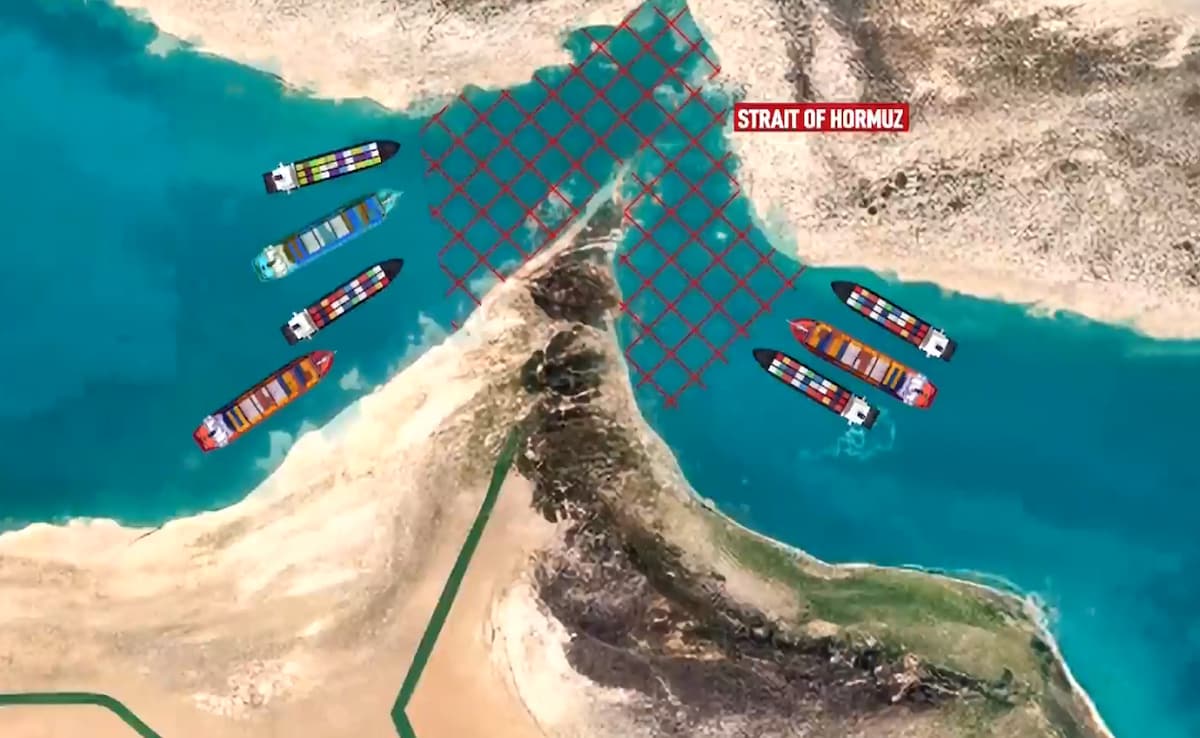
Geopolitics loves a ghost story. The current narrative haunting the shipping industry is that the Strait of Hormuz has become an Iranian lake, where global trade moves only by the grace of Tehran. This "lazy consensus" suggests that every ship hugging the Omani coast or tweaking its transponder is a sign of total capitulation.
It isn't. It is a masterclass in asymmetrical signaling that the West is falling for, hook, line, and sinker.
The idea that ships are "navigating on Iran’s terms" misses the fundamental mechanics of maritime insurance, the physics of modern naval blockades, and the brutal reality of Iranian economic fragility. We are mistaking tactical adjustments for a strategic shift in power. If you believe the Strait is closed or "controlled," you are looking at the map through a lens of 1980s tanker wars rather than 2026 reality.
The Geography Of Fear Is A Marketing Tactic
The standard argument claims that because vessels are shifting their routes toward Omani territorial waters to avoid the Iranian Revolutionary Guard Corps (IRGC) patrol zones, the "rules of the road" have changed.
This is an amateur’s reading of the water.
Shipping lanes have always been fluid. Moving a few nautical miles to the south isn't a surrender; it’s a standard risk-mitigation protocol. I have sat in boardrooms where executives agonize over "war risk premiums." These decisions aren't made because the IRGC is an unstoppable force; they are made because the mere possibility of a boarding increases insurance costs by fractions of a percentage that equate to millions of dollars across a fleet.
Iran doesn't need to control the water. It only needs to control the perception of the water.
When a tanker "hides" its AIS (Automatic Identification System) signal, the media screams about "dark fleets" and "Iranian dominance." In reality, masking a signal is often a collaborative effort between shipowners and local authorities to reduce the noise-to-signal ratio for actual threats. Iran benefits from the PR victory of looking like a maritime gatekeeper, while the global economy continues to pump 20 million barrels of oil through that chokepoint every single day.
If Iran actually controlled the terms, that number would be zero. It isn't. Because Tehran knows that the second they actually "set the terms" by closing the Strait, their own economy—which is already on a ventilator—dies within 72 hours.
The Escapism Of The Escape Route
Let’s dismantle the "Hormuz Escape Route" myth. The competitor piece suggests that the reliance on Omani waters is a "win" for Iran.
Actually, it is a massive failure of Iranian projection.
- Territorial Integrity: If Iran truly dictated the terms, they would be intercepting vessels regardless of which side of the shipping lane they occupied. The fact that ships can find "safety" by simply shifting a few miles proves that Iranian reach is legally and physically constrained.
- The Invisible Escort: Critics point to a lack of visible Western destroyer escorts as proof of abandonment. They’re wrong. Modern maritime security isn’t about 1940s-style convoys. It’s about distributed lethality. A single US or UK asset in the region, linked with satellite tracking and rapid-response air support, provides more "control" than a dozen visible frigates. The "terms" are still being set by those who have the power to sink the entire IRGC navy in an afternoon.
- The Insurance Trap: Lloyds of London and other underwriters are the real "insiders" here. They haven't abandoned the Strait. They’ve just priced the risk. If the terms were truly Iran’s, the Strait would be uninsurable. It’s not. It’s just more expensive. That’s business, not a geopolitical handover.
Why Your Supply Chain Logic Is Flawed
People ask: "How can we rely on a route where the enemy can see every move?"
This question is built on a flawed premise. In the age of pervasive ISR (Intelligence, Surveillance, and Reconnaissance), everyone sees everything. Control isn't about being invisible; it’s about being untouchable.
Imagine a scenario where a major shipping line decides to ignore the "Iranian terms" and sail directly through the most contested zones without hiding their signals. What happens? Usually, nothing. The IRGC targets specific, politically significant vessels—often linked to countries they have active legal or diplomatic disputes with (like the seizing of the Advantage Sweet or the St Nikolas). These are not random acts of maritime dominance; they are highly choreographed, surgical seizures designed to exert leverage in specific negotiations.
When you treat these as "general control of the Strait," you are doing Iran’s PR work for them. You are confusing a kidnapping for a kidnapping's sake with a total blockade.
The Counter-Intuitive Truth: Iran Needs The Strait Open More Than You Do
The status quo is a paradox. Iran uses the Strait as a megaphone to shout at the world, but it uses the same water as a straw to drink.
Over 80% of Iran’s trade—legal and "shadow"—moves through these waters. If they "control" the terms to the point of disruption, they are effectively putting a noose around their own neck.
The "escape routes" through Omani waters aren't just for the West; they are a pressure valve that prevents a total conflict that Iran cannot win. By allowing shipping to continue—even under the guise of "terms"—Iran maintains the illusion of power without the suicidal consequences of actually using it.
The Real Misconceptions We Need To Kill:
- Misconception 1: AIS spoofing is a sign of weakness.
- Truth: It is a tactical tool. Military and commercial vessels have used electronic deception for decades. It’s a sign of a professionalized approach to risk, not a white flag.
- Misconception 2: The Strait of Hormuz is "narrow."
- Truth: While the shipping lanes are only two miles wide in each direction, the actual navigable water is vast. The "chokepoint" is a legal and regulatory construct as much as a physical one.
- Misconception 3: Iran wants to close the Strait.
- Truth: Iran wants the threat of closing the Strait to remain credible. Actually closing it is their "End Game" button. You don't press that button just to make a point about shipping terms.
Stop Reading The Headlines, Start Reading The Charts
If you are a logistics lead or a commodity trader, stop panicking about "Iranian terms."
Look at the throughput. Look at the VLCC (Very Large Crude Carrier) traffic. It remains remarkably consistent. The "nuance" the competitors miss is that the maritime world is incredibly resilient. It absorbs shocks, re-routes, re-prices, and keeps moving.
We’ve seen this before. From the Suez Crisis to the 2021 Ever Given blockage, the "consensus" always predicts the end of global trade as we know it. And every time, the mechanics of the market prove more powerful than the posturing of regional actors.
The IRGC is a coastal force with a penchant for high-speed boats and GoPro footage. They are not a global blue-water navy. They cannot sustain a blockade against a concerted international response. Therefore, any "terms" they set are purely atmospheric.
If you want to understand the Strait, stop looking at the Iranian fast boats and start looking at the Omani radar stations and the Singaporean insurance registries. That is where the real power resides.
The "escape route" isn't a retreat. It's an optimization.
Stop treating tactical flexibility as a strategic defeat. The Strait of Hormuz is open, the oil is flowing, and the terms are exactly what they have always been: the highest bidder gets the barrel, and the most prepared sailor gets home.
The ghost story only works if you’re afraid of the dark. Turn on the lights.