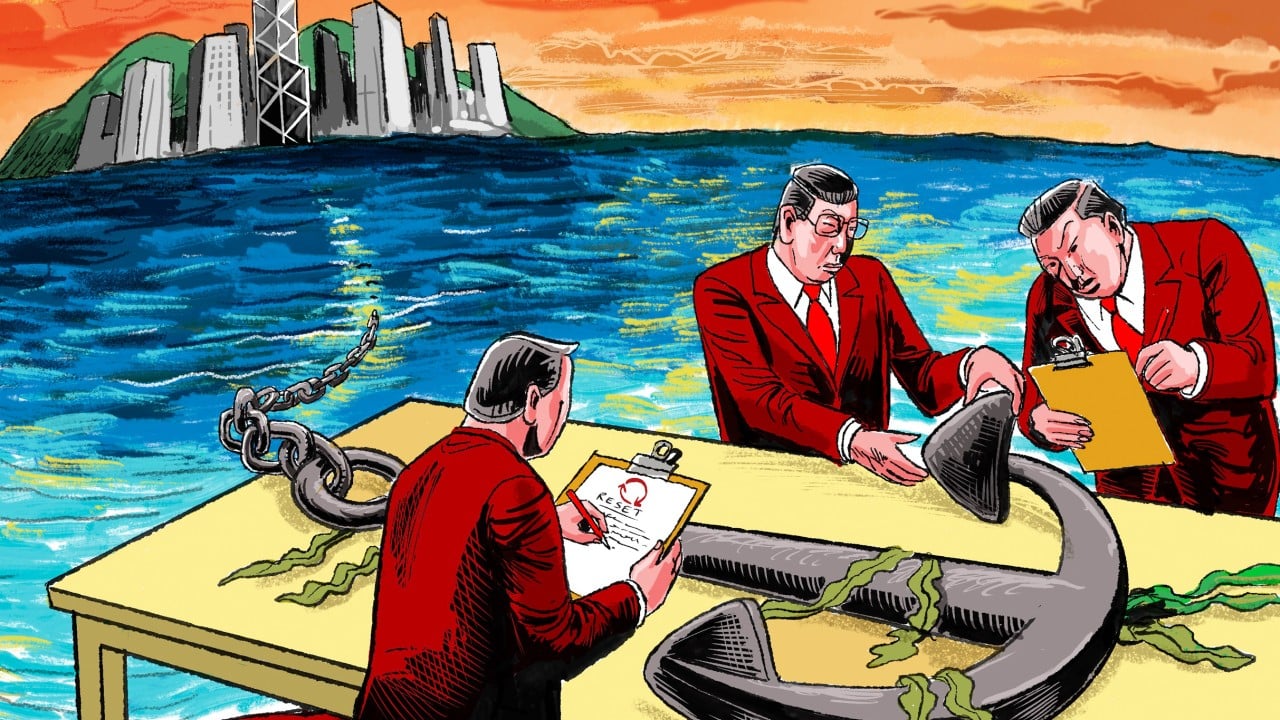
Hong Kong’s functional utility as a global financial center is predicated on a singular structural anomaly: its ability to operate as a high-transparency, rule-of-law enclave directly tethered to a high-growth, opaque command economy. As Beijing initiates a fundamental "economic reset"—shifting from debt-fueled property expansion to "new productive forces"—the friction between these two systems has moved from a manageable cost of doing business to a systemic risk. The credibility of the Hong Kong Special Administrative Region (HKSAR) is no longer being measured by its historical throughput of Initial Public Offerings (IPOs) but by its capacity to maintain institutional distance in an era of increasing political and economic convergence.
The Mechanistic Breakdown of the Gateway Function
Historically, Hong Kong functioned as a "dual-valve" system. It provided international investors with a protected legal environment (Common Law) to access Chinese assets, while providing Chinese firms with a hard-currency conduit to global liquidity. This mechanism relied on three specific pillars of differentiation that are currently under significant strain.
- Jurisdictional Arbitrage: Investors utilized Hong Kong because it provided a Western legal shell for Eastern economic activity.
- Currency Fungibility: The Linked Exchange Rate System (LERS) pegged to the USD ensures that capital can exit as easily as it enters, a feature the mainland's closed capital account lacks.
- Information Symmetry: A free press and independent regulatory bodies ensured that the "China risk" was priced accurately through transparent data.
The "economic reset" in Beijing disrupts this. As the mainland prioritizes national security and data sovereignty over pure GDP growth, the flow of information—the lifeblood of the third pillar—has constricted. When the cost of information rises, the risk premium demanded by international capital follows. If Hong Kong cannot guarantee information transparency that exceeds the mainland’s standards, its justification as a separate financial jurisdiction evaporates.
The Capital Displacement Equation
The current exodus of capital from Hong Kong is not merely a reaction to high interest rates in the United States; it is a fundamental repricing of the "Hong Kong Discount." We can quantify the stress on the city’s credibility through the lens of capital cost.
$$Cost\ of\ Capital_{HK} = Risk\ Free\ Rate_{US} + Equity\ Risk\ Premium + Systemic\ Convergence\ Risk$$
The Systemic Convergence Risk variable was effectively zero for two decades. It is now the dominant factor in long-term capital allocation. Global asset managers are transitioning from "Hong Kong as a Gateway" to "Hong Kong as a Proxy." If an asset in Hong Kong is perceived to have the same regulatory and political risk profile as an asset in Shanghai, the premium for the Hong Kong listing becomes a liability. This leads to a liquidity trap: lower valuations drive away high-quality issuers, which in turn reduces the ecosystem's attractiveness to institutional buyers.
The Property-Finance Feedback Loop
Hong Kong’s fiscal stability is inextricably linked to land value. The government’s reliance on land sales for revenue creates a feedback loop that is now malfunctioning. In the previous era, Chinese capital inflows inflated property prices, which funded infrastructure and kept taxes low, further attracting global talent.
With China’s internal property sector undergoing a "controlled deleveraging," the primary source of marginal demand for Hong Kong real estate has vanished. This creates a fiscal bottleneck:
- Revenue Compression: Falling land premiums force the government to look for alternative revenue streams or draw down reserves.
- Wealth Effect Contraction: As local property values stagnate, domestic consumption drops, weakening the retail and services sector.
- Talent Attrition: The high cost of living, once justified by hyper-growth and career upside, becomes unsustainable in a low-growth environment.
The Institutional Credibility Gap
The credibility test mentioned by market observers is specifically an enforcement test. Credibility in a financial hub is maintained not by the absence of crises, but by the predictability of the response to them.
The Hong Kong Monetary Authority (HKMA) and the Securities and Futures Commission (SFC) face a widening gap between their technical mandates and the geopolitical reality. When mainland firms face domestic regulatory crackdowns or debt restructuring, the Hong Kong regulators' ability to protect minority shareholders or enforce transparency is the ultimate benchmark. If the HKSAR government is perceived as prioritizing the mainland’s macro-stability over the city’s micro-regulatory integrity, the institutional "moat" disappears.
Evidence of this erosion is found in the shifting composition of the Hang Seng Index (HSI). The index has become increasingly dominated by mainland state-owned enterprises (SOEs) and technology firms subject to Beijing’s "Common Prosperity" guidelines. This shift has transformed the HSI from a global diversified index into a barometer of Chinese policy sentiment.
Strategic Vulnerabilities in the LERS
The Linked Exchange Rate System (LERS) remains the bedrock of Hong Kong's financial identity, yet it represents a growing tactical contradiction. To maintain the peg to the USD, the HKMA must import US monetary policy.
This creates a Monetary Policy Mismatch:
- The US Path: High interest rates to combat persistent inflation and manage a robust economy.
- The China Path: Lower interest rates and monetary easing to stimulate a flagging economy and manage the property reset.
Hong Kong is trapped in the middle. It is forced to tighten liquidity (matching the US) exactly when its primary economic engine (China) requires easing. This divergence exerts immense pressure on the local banking sector and mortgage holders. While the HKMA has the reserves to defend the peg indefinitely, the economic cost of doing so increases with every month that the US and Chinese cycles remain out of sync.
The Myth of the "Middle Man"
The strategy of being a bridge is only viable if the two shores want to connect. As the US and China pursue "de-risking" and "self-reliance" respectively, the need for a bridge diminishes. China is building its own internal financial architecture (CIPS, Digital Yuan) to bypass Western-led systems, while the West is diversifying supply chains away from Chinese dependence.
Hong Kong’s traditional "middle man" role is being disintermediated by technology and geopolitics. For the city to survive this reset, it must transition from a passive gateway to an active specialist. This involves moving beyond being a mere venue for Chinese IPOs and becoming a center for specialized services that the mainland cannot replicate:
- International Arbitration: Leveraging the Common Law system for cross-border disputes that do not involve Chinese entities.
- Deep-Tech Financing: Creating a regulatory sandbox for emerging technologies that require global standards of intellectual property protection.
- Green Finance Hub: Standardizing ESG metrics for Asian markets to meet European and North American institutional requirements.
Risk Assessment of the "Redirection" Strategy
The HKSAR government’s recent efforts to court capital from the Middle East and Southeast Asia (ASEAN) is a logical diversification tactic, but it contains a fundamental flaw in scale. The depth of liquidity in the NYSE and Nasdaq—and even the historical flows from London and Frankfurt—cannot be replaced by emerging market sovereign wealth funds alone.
Furthermore, Middle Eastern capital is often looking for the same thing Western capital seeks: stability, legal recourse, and an entry point to China that is distinct from the mainland’s volatility. If Hong Kong cannot provide that distinction, the origin of the capital becomes irrelevant; the money will simply flow to Singapore or Tokyo instead.
The institutional decay is most visible in the "Brain Drain" of compliance and legal professionals. These are the "system architects" who maintain the city's technical standards. Their replacement by mainland-trained professionals may maintain operational continuity, but it changes the institutional DNA of the city, making it more aligned with Shanghai’s "Civil Law with Chinese characteristics" than the traditional Common Law framework that global markets trust.
Strategic Recommendation for Market Participants
Investors and corporate strategists must abandon the "Mean Reversion" thesis. There is no return to the 2010–2019 status quo. The economic reset is a permanent re-architecting of the Chinese economy, and Hong Kong’s role is being downgraded from a "Global Financial Center" to a "Chinese Offshore Financial Center."
The strategic play is to treat Hong Kong as a specialized hedging outpost rather than a primary growth engine.
- Portfolio Rebalancing: Treat H-shares (Hong Kong-listed Chinese firms) as high-beta plays on Chinese policy rather than diversified international equities.
- Jurisdictional Ring-fencing: For entities using Hong Kong as a regional headquarters, ensure that intellectual property and global data silos are legally and technically decoupled from the HK-based infrastructure.
- Liquidity Monitoring: Closely watch the "Aggregate Balance" in the Hong Kong banking system. Any sustained contraction despite HKMA intervention will signal the point at which the LERS becomes a net-negative for the local economy.
The credibility of Hong Kong is not a binary state but a diminishing resource. The reset requires the city to prove it can say "no" to Beijing on matters of regulatory and legal standards. Until that happens, the market will continue to price Hong Kong not as a gateway, but as a suburb of the mainland's financial system, with all the accompanying risks and none of the previous premiums.