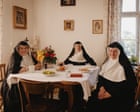
The iron gate didn't creak. It groaned with the weight of decades. When the sisters returned to the Monastery of Saint Joseph in the quiet Austrian town of Maria Enzersdorf, they didn't arrive with lawyers or press releases. They arrived with a bolt cutter and a conviction that the mortar between the stones belonged to God, not a real estate ledger.
For years, the story of the "Rebel Nuns" has been told through the sterile lens of property law and ecclesiastical disputes. But look closer. Beyond the headlines about unauthorized re-entry and canonical disobedience lies a visceral battle over what it means to belong to a place. It is a story about the stubborn, beautiful refusal to let a home be treated as a mere asset. If you liked this post, you might want to look at: this related article.
The Midnight Return
Imagine the cold. Not just the physical chill of an Alpine evening, but the emotional frost of being told your life's work is surplus to requirements. In 2023, the Vatican ordered the dissolution of this specific branch of the Carmelites. The reason? Shrinking numbers. Institutional consolidation. The math of the modern church simply didn't add up for a handful of aging women living in a sprawling, historic convent.
But the sisters—led by a woman of iron will named Sister Chirila—didn't see a spreadsheet. They saw the chapel where they had spent forty thousand hours in prayer. They saw the garden where the herbs they planted for decades continued to sprout, indifferent to Rome’s decrees. For another perspective on this story, refer to the recent coverage from Al Jazeera.
When the locks were changed and they were told to move to other houses, they left. Briefly. Then, in a move that felt more like a heist movie than a religious retreat, they broke back in. They didn't do it for the comfort. The heating was off. The pipes were dry. They did it because leaving felt like a betrayal of a sacred contract.
The Architecture of Belonging
We often talk about "real estate" as something external to our souls. We buy, we sell, we flip. But for these women, the monastery was a physical extension of their internal world. Every cracked floorboard was a memory; every drafty window was a familiar companion.
The legal battle that followed their "break-in" wasn't just about a deed. It was about the definition of occupancy. The Church claimed they were squatters. The sisters claimed they were stewards.
Think about the sheer audacity required for a woman who has spent her life in service of a hierarchy to suddenly say "No" to the highest level of that hierarchy. It is a terrifying kind of courage. It’s the kind of courage that comes only when you have nothing left to lose but the ground beneath your feet. For months, they lived in a state of siege. They relied on locals—neighbors who smuggled in food, blankets, and water. This wasn't just a religious spat; it became a community insurrection.
The Turning Tide
The latest developments suggest the sisters are a step closer to staying. This isn't because the Vatican suddenly found a stash of gold to fund the convent. It’s because the narrative shifted. The authorities realized that dragging elderly nuns out of a building by force is a visual that no institution can survive.
But there is a deeper logic at play. In a world that is becoming increasingly digital, nomadic, and untethered, the sisters represent a radical attachment to the physical. They are the antithesis of the "disposable" culture. Their presence in Maria Enzersdorf is a reminder that some things—history, devotion, the sanctity of a specific patch of earth—cannot be liquidated.
Consider the psychological weight of their victory. It isn't just about a roof. It’s about the validation of their life’s choice. If they were forced to leave, it would imply that their decades of prayer were only as valuable as the building’s market price. By staying, they prove that the value of the convent is generated by the souls within it, not the bricks themselves.
The Invisible Stakes
Why does this matter to someone who has never stepped foot in Austria, or even a church?
Because we are all fighting this battle in smaller ways. We fight it when our favorite neighborhood bookstore is replaced by a bank. We fight it when the park where we grew up is sold to a developer. We are constantly being told that efficiency is more important than intimacy. The sisters of Maria Enzersdorf are the front line of a war against the sterilization of our world.
Their "rebellion" was remarkably quiet. No picketing. No shouting. Just the steady, rhythmic presence of women who refused to be erased. They spent their days in the freezing halls, maintaining their liturgical hours as if the world hadn't tried to move on without them. That consistency is a form of power. It’s the power of the rooted against the gusting winds of change.
The Mercy of the Law
The legal path forward involves a complex restructuring of the convent's status. It likely means the sisters will be allowed to remain as a "private association of the faithful" rather than a formal Carmelite house under the direct thumb of the previous administrators. It’s a compromise of language that allows everyone to save face.
But the reality on the ground is simpler.
The heat is coming back on. The water is running. The sisters are no longer "breaking in"—they are just being. There is a profound irony in the fact that by breaking the law, they managed to preserve a sense of higher order. They chose the spirit over the letter.
The Garden in the Frost
Visit the monastery today and you won't see a fortress. You’ll see a place that looks exactly as it did five years ago, which is precisely the point. The victory isn't in a new wing or a renovated facade. The victory is in the absence of change.
The sisters are older now, their hands more gnarled, their gait a little slower. But when they walk through those halls, they do so as owners of their own destiny. They are a step closer to staying, but in truth, they never really left. They were always there, etched into the atmosphere of the place, waiting for the rest of the world to realize that you cannot evict a soul from its home.
The bell in the tower rings differently now. It doesn't just mark the hour; it marks a boundary. It tells anyone listening that some things are not for sale. It tells us that sometimes, to find your place in the world, you have to be willing to pick the lock and step back into the dark, trusting that the light will eventually find you there.
The altar is dusty, but the candles are lit.