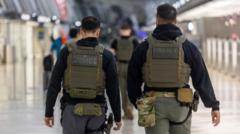
The silence of a functional airport is a miracle we only notice when it breaks.
You stand in the security line at O'Hare or JFK, checking your watch, shifting your weight, and complaining about the mundane indignity of removing your shoes. It is a ritual of modern life. But behind the plexiglass and the X-ray monitors, there is a frantic, invisible arithmetic occurring. For weeks, that arithmetic was failing. The United States Senate recently moved to fix the math, voting to fund the lion’s share of the Department of Homeland Security. They saved the spring break vacations. They kept the TSA agents at their posts. Yet, in the shadow of that success, they left a massive, gaping hole in the hull. You might also find this connected coverage useful: The $2 Billion Pause and the High Stakes of Silence.
The deal was a compromise born of exhaustion. By a lopsided margin, lawmakers decided that the chaos at the gates—the missed connections, the mounting piles of luggage, the fraying nerves of the American traveler—was a political price too high to pay. So, they signed the checks for the Coast Guard. They fueled the Secret Service. They ensured the scanners would keep humming.
But they cut Immigration and Customs Enforcement (ICE) out of the equation. As extensively documented in recent articles by Reuters, the implications are worth noting.
Imagine a ship where the captain chooses to repair the upper decks and polish the brass railings while the engine room is taking on water. That is the reality of this legislative "victory." We have secured the comfort of the traveler while stalling the machinery of the border. It is a tale of two securities: the one you see when you board a plane, and the one that actually holds the country together.
The Man at the Monitor
Consider a hypothetical TSA officer named Elias. He’s been working double shifts at a major hub. He hasn’t been sure if his next paycheck will clear. When the Senate voted, Elias felt a wave of relief that had nothing to do with politics and everything to do with his mortgage.
Because the Senate acted, Elias stays. The lines move. The "airport chaos" that headlines screamed about has been averted. For the average citizen, the crisis is over. You can fly to Orlando. You can make your business meeting in Seattle. The system looks, on the surface, entirely restored.
But Elias’s colleagues—the ones working the transport vans and the detention centers under the ICE banner—are living in a different reality. By excluding ICE from this funding surge, the Senate didn't just make a fiscal choice. They made a statement about which parts of the American infrastructure are allowed to fail and which are too loud to ignore.
The funding disparity creates a bizarre friction. While the TSA and the Border Patrol receive the resources to process people, the agency responsible for what happens after that processing is left to wither. It is a logistical bottleneck designed by committee. We are opening the front door and locking the internal exits.
The Ghost in the Machine
We often treat "funding" as a dry, ledger-based concept. It isn't. Funding is the gasoline in the engine of the state. When you starve ICE while feeding the TSA, you create a backlog that eventually poisons the entire system.
During the heated debates leading up to this vote, the rhetoric focused on "ending the chaos." But chaos is a shapeshifter. It moves from the airport terminal to the border town. It moves from the headline to the community center. By funding the visible parts of Homeland Security and neglecting the enforcement arm, the Senate hasn't solved the problem; they’ve simply moved it where you can't see it from the boarding gate.
The logic used by the dissenters was simple: leverage. In the halls of power, ICE has become a radioactive word. To some, it represents a necessary shield; to others, a broken sword. By carving it out of the main funding bill, politicians managed to keep the planes flying without having to answer the hard questions about the border. It was a tactical retreat disguised as a resolution.
The Invisible Stakes
Why does this matter to you, the person who just wants to get through security in under twenty minutes?
Safety is a chain. When one link is forged of titanium and the next is made of straw, the titanium doesn't matter. The Coast Guard is out there right now, intercepting vessels in the dark. The Secret Service is mapping out protection details for a high-stakes election year. The TSA is scanning millions of bags. These are the "funded" heroes of the moment.
But the enforcement of immigration law is the stabilizer. Without it, the pressure on the Border Patrol becomes unsustainable. Agents who should be in the field are instead turned into administrative clerks, drowned in a sea of paperwork because there is no one to take the handoff. The "chaos" at the airport was just a symptom. The disease is a systemic inability to agree on how a nation-state should function.
We are currently witnessing a grand experiment in selective governance. We want the benefits of a secure sky without the political discomfort of a managed border. It is a fantasy.
A House Divided by a Checkbook
The Senate vote was touted as a bipartisan breakthrough. In many ways, it was. In a town where agreement is a rare currency, seeing a majority come together to prevent a departmental shutdown is objectively a win for stability.
Yet, there is a lingering bitterness to this win.
Think of a small town where the fire department is fully funded, but the water treatment plant is left to rot. The fires get put out, but the water coming out of the tap is brown. Eventually, the fire trucks won't have anything to pump. This is the path we are walking. By isolating ICE, the Senate has ensured that the next crisis will be quieter, deeper, and much harder to fix with a last-minute vote.
The stakes are emotional because they involve the basic trust between a citizen and their government. We trust that when we pay our taxes, the entirety of our protection is being considered. Not just the parts that affect our vacation plans. Not just the parts that make for a good photo op.
The Last Gate
Tonight, the lights will stay on at the airports. The blue uniforms of the TSA will be there to greet you. You will put your liquids in a clear bag, you will walk through the metal detector, and you will head to your gate with a Cinnabon and a sense of normalcy.
But somewhere, a transport van is sitting idle because there’s no budget for fuel. A caseworker is looking at a stack of files that will never be processed. An enforcement officer is wondering if their job is a relic of a political era that no longer exists.
The Senate ended the airport chaos. They saved the schedule. They kept the planes on the tarmac and the passengers in their seats. But as the wheels lift off and the ground falls away, it's worth asking what we left behind on the runway. We have bought ourselves a temporary peace, paid for with the slow-motion collapse of the very system we claim to be protecting.
The sky is clear for now. The horizon, however, is beginning to flicker.
Would you like me to look into the specific budget allocations for the other agencies included in this bill to see how their roles are changing?