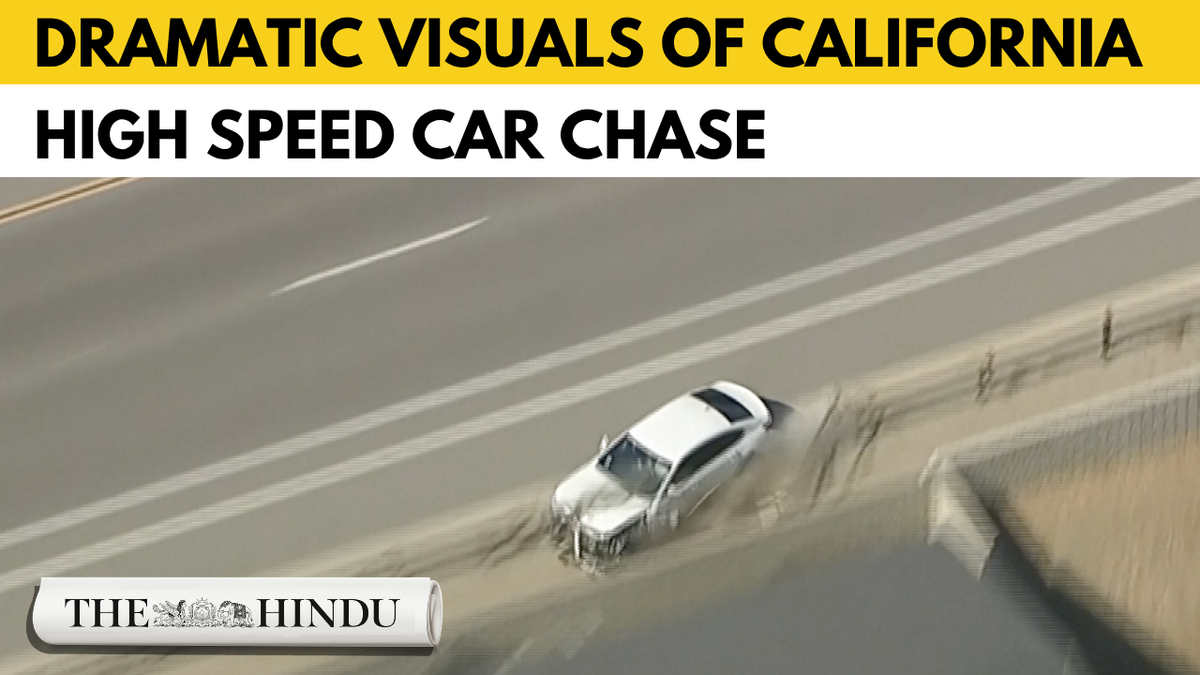
California is addicted to the flicker of a helicopter spotlight. Every few weeks, the news cycle halts. A stolen Honda Civic or a white panel van weaves through 405 traffic, and suddenly, millions of people are glued to a grainy livestream. The "dramatic visuals" the media peddles are always the same: screeching tires, a PIT maneuver that misses by an inch, and a breathless anchor whispering about public safety.
They tell you it’s a tragedy in motion. They tell you it’s a threat to the fabric of the city.
They are lying.
The high-speed chase isn't a crisis. It is the last bastion of authentic, unscripted reality in a world of curated algorithms and plastic PR. If you want to understand the soul of the modern American city, stop looking at the crime stats and start looking at the flight path of the news choppers.
The Myth of the Public Safety Hazard
The standard industry take is that these chases are a net negative for the community. The "experts" claim that police should back off to avoid "escalation." This is the lazy consensus of a risk-averse society.
Let’s look at the actual mechanics of the pursuit. In a typical California chase, the suspect isn't usually a mastermind; they are a desperate individual reacting to a system that has already failed them. When the LAPD or the CHP engages, they aren't just "chasing a car." They are performing a necessary, high-stakes ritual that enforces the social contract.
If we stop chasing, we concede the pavement.
The argument that pursuits cause more accidents than they prevent is a statistical shell game. It ignores the deterrence variable. Imagine a scenario where every criminal knew that once they hit 80 mph, the police were legally required to turn off their sirens and go get a donut. Crime wouldn't just rise; it would transform. The chase is the only thing keeping the freeway from becoming a literal Mad Max circuit. It is the friction that keeps the engine of law from spinning out of control.
The News Desk Hypocrisy
The media outlets that post "dramatic visuals" with somber warnings are the biggest beneficiaries of the chaos. They act like they are providing a public service, but they are actually selling adrenaline.
I have spent years in newsrooms. I have seen the "Chase Alert" banner trigger a dopamine hit in producers that no Pulitzer-winning investigation could ever match. They love the chase because it requires zero effort. You don't need to check sources. You don't need to verify facts. You just point a gimbal-mounted camera at a car and wait for the metal to crunch.
The hypocrisy is the most "dramatic" part of the visual. They condemn the "dangerous behavior" while praying the driver doesn't pull over for another twenty minutes so they can hit their ad-revenue targets for the 6 PM slot. It’s a symbiotic relationship between the fugitive, the police, and the broadcaster. The fugitive gets their fifteen minutes of infamy, the police get to look like heroes, and the news station gets a ratings spike that keeps the lights on.
The Architecture of the Chase
To understand why this happens in California specifically, you have to understand the geometry of the state. Our infrastructure is designed for the pursuit.
- The Grid: The massive, interlocking freeway system provides a literal stage.
- The Light: Southern California’s "golden hour" provides the perfect cinematic backdrop for a pursuit.
- The Isolation: In a car, you are alone. The chase is the ultimate expression of that isolation—one person against the collective might of the state.
When you watch a chase, you aren't just watching a crime. You are watching a technical breakdown of urban planning. You are seeing exactly where the bottlenecks are, where the pavement is crumbling, and how quickly a multi-billion dollar infrastructure can be brought to its knees by one guy in a 2004 Camry.
Stop Asking if Chases are Dangerous
The "People Also Ask" sections are filled with questions like, "Why do police continue high-speed chases?" or "Are car chases legal in California?"
These are the wrong questions. The real question is: Why can't we look away?
We can't look away because the car chase is the only time the "official" version of the city breaks down. In those moments, the zoning laws don't matter. The traffic signals are suggestions. The social hierarchy is inverted. For thirty minutes, a person with nothing to lose is the most important individual in a city of ten million.
The danger isn't the car hitting a pole. The danger is the realization that the system is incredibly fragile. One steering wheel twitch is all that separates a Tuesday commute from a televised fireball. That fragility is what we are actually tuning in to see. We aren't watching for the "safety updates." We are watching to see if the world still has consequences.
The PIT Maneuver as Performance Art
Let’s talk about the Precision Intervention Technique (PIT).
The media treats it like a surgical strike. In reality, it is a desperate, violent gamble. To execute a PIT, a patrol car has to match the speed of a fleeing vehicle, pull alongside, and use its own weight to induce a spin. It is $40,000 of taxpayer-funded equipment being used as a hammer.
When it works, it’s a masterclass in physics. When it fails, it’s a multi-car pileup. Yet, we demand it. We want the "dramatic conclusion." We have been conditioned by decades of Hollywood editing to expect a clean ending. We want the suspect pinned to the ground by six officers while the camera zooms in from 1,500 feet.
This isn't law enforcement; it’s a gladiator pit with a V8 engine.
The Inevitable Evolution
We are told that drones and GPS trackers will eventually make the high-speed chase obsolete. They say we can just "tag" a car and follow it from a distance.
This misses the psychological point of the pursuit. The chase is about dominance. It is about the state proving it can catch you in real-time, in front of your neighbors, while the whole world watches. A drone hovering silently over a house three hours later doesn't have the same cultural weight. It doesn't provide the "visuals" that justify the department's budget.
If we move to a purely technological pursuit model, we lose the last shred of transparency we have. In a high-speed chase, everything is on the table. You see the mistakes. You see the brutality. You see the sheer, unadulterated chaos of the human element. Technology hides the mess. The chase broadcasts it.
The Cost of Looking Away
The contrarian truth is that we need these chases. We need them to remind us that the city is alive, that the laws have teeth, and that despite our best efforts to sanitize everything into a "user experience," reality is still loud, fast, and incredibly dangerous.
Next time you see a "Breaking News" banner with a helicopter feed, don't pretend you're worried about the pedestrians. Don't act like you're analyzing the tactical efficiency of the CHP.
Acknowledge that you are watching the only honest thing on your screen. You are watching a human being try to outrun their own shadow on a six-lane highway. It is the ultimate American drama, and no amount of "public safety" lecturing will ever change the fact that it is the most compelling thing we have ever built.
The chase doesn't need to be "fixed." It needs to be understood for what it is: the heartbeat of a society that has forgotten how to feel anything else.
Pull over? Why would they? The whole world is watching.