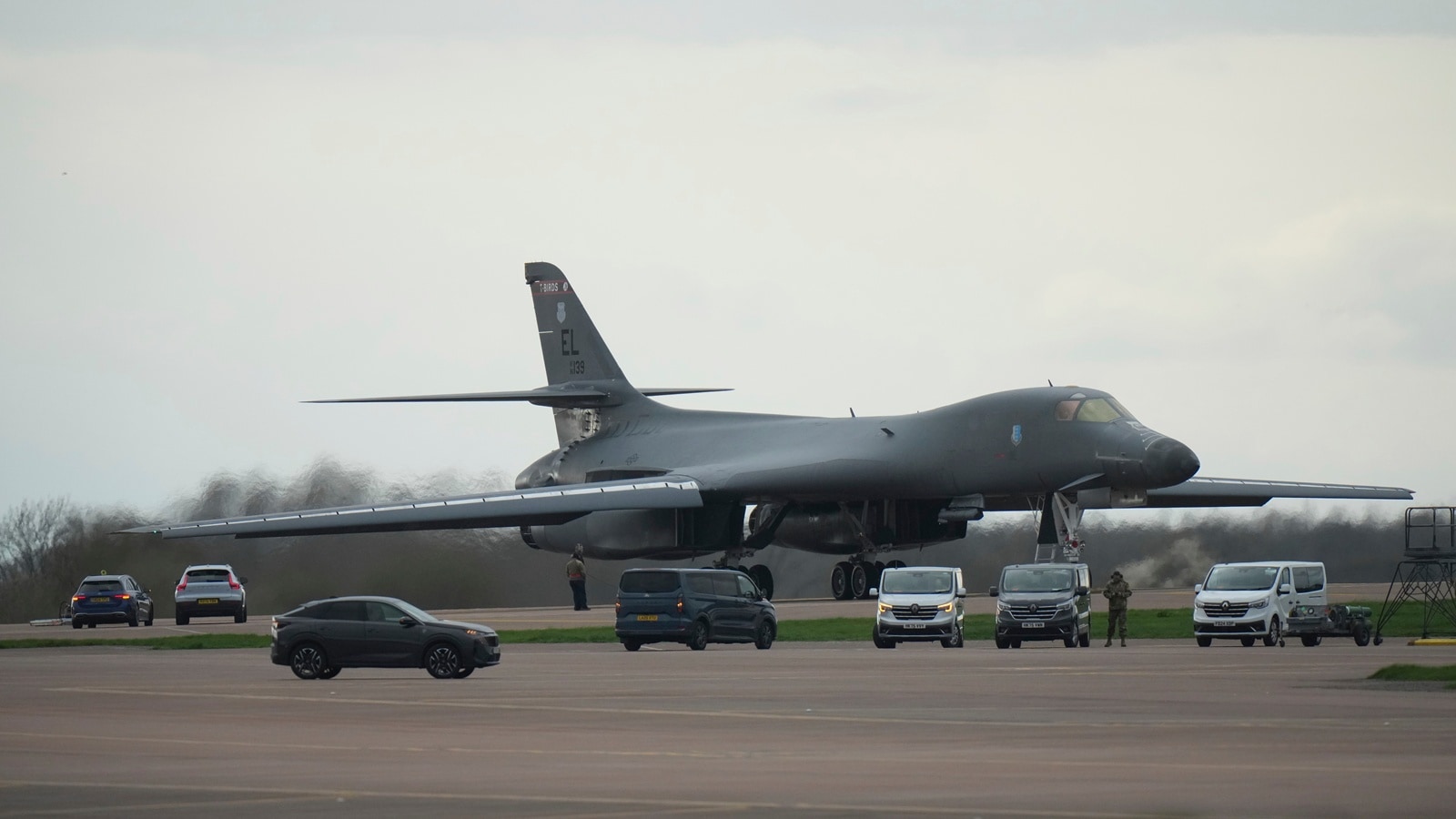
The arrival of B-1B Lancer bombers at RAF Fairford is not a routine training exercise, despite the carefully worded press releases from Global Strike Command. This movement of heavy hardware represents a calculated shift in the strategic architecture of the Northern Hemisphere. By placing "bunker busters" within a six-hour flight of critical regional flashpoints, the United States is shortening the kill chain and removing the luxury of time from its adversaries. This isn't just about showing the flag. It is about the physics of rapid response.
RAF Fairford has long served as the unsung cornerstone of American power projection in Europe. Unlike other bases, its unique infrastructure—specifically its massive taxiways and specialized fuel hydrants—allows it to support a high tempo of heavy bomber operations that most civilian or smaller military airfields simply cannot handle. When the B-1s touch down on British soil, they aren't just shifting coordinates. They are plugging into a pre-existing, highly sophisticated nervous system designed for sustained long-range strikes. You might also find this related article useful: Executive Power and the War Powers Resolution Structural Analysis of Legislative Gridlock regarding Iran.
The Bone and the Basement
The B-1B, affectionately known as the "Bone" by its crews, occupies a strange but vital niche in the American arsenal. It is no longer a nuclear-capable platform, a transition solidified by international treaties years ago. However, what it lost in atomic capability, it gained in conventional brutality. The aircraft can carry the largest internal payload of any bomber in the inventory, outstripping even the massive B-52.
The specific concern for any regional power currently in the crosshairs is the B-1’s ability to carry the GBU-31 Joint Direct Attack Munition (JDAM) and, more importantly, its integration with specialized penetrating weapons. While the B-2 Spirit often gets the headlines for "stealthy" deep-penetration missions, the B-1 provides the "mass" required for a sustained campaign. As extensively documented in recent reports by TIME, the effects are notable.
Penetrating hardened targets, often referred to as "bunker busting," is a game of kinetic energy and material science. To destroy a facility buried under fifty feet of reinforced concrete and granite, you cannot simply drop a large bomb and hope for the best. You need a weapon that can survive the initial impact without detonating, burrow through the shielding, and then trigger its payload once it reaches the hollow space inside. The B-1's speed and altitude capability provide the necessary "shove" to these munitions, ensuring they hit with the maximum possible velocity.
Logistics as a Weapon of War
Amateurs talk about strategy, while professionals talk about logistics. This old military adage is the real story behind the move to Britain. Flying a bomber from the continental United States (CONUS) to a target in the Middle East or Eastern Europe is a Herculean task. It requires multiple mid-air refuelings, dozens of crew rest rotations, and an immense amount of wear and tear on the airframes.
By staging out of Fairford, the Air Force cuts the mission time by more than half. This does three things:
- Increased Sortie Rate: A single aircraft can fly more missions in a 48-hour period because it spends less time transiting over the Atlantic.
- Reduced Tanker Dependency: The massive fleet of KC-135 and KC-46 tankers can be diverted to support fighter screens and electronic warfare aircraft rather than just keeping a bomber's tanks full for a ten-hour commute.
- Psychological Pressure: An adversary can track a bomber taking off from South Dakota and have twelve hours to move sensitive assets. When that bomber takes off from Gloucestershire, that window shrinks to a few hours.
The Precision Revolution and Moving Targets
It is a mistake to view this deployment through the lens of 20th-century carpet bombing. The modern B-1 is a sensor-rich platform. With the AN/APQ-164 Forward Looking Supply Radar and the integration of the Sniper XR targeting pod, the crew can identify and track moving targets from standoff distances.
In a hypothetical scenario involving coastal defenses or mobile missile launchers, the B-1 serves as a high-altitude sniper. It can loiter outside the range of most point-defense systems and wait for a target to emit a signal or move into the open. The moment a target is identified, a GPS-guided weapon is released. The bomb doesn't just fall; it glides, adjusting its fins based on real-time data to hit within meters of the coordinates.
This capability is particularly relevant when discussing the "bunker" aspect. Many modern command-and-control centers are not just static holes in the ground. They are networks of reinforced entrances, ventilation shafts, and communication arrays. To "kill" a bunker, you don't necessarily need to collapse the whole mountain. You just need to put a precision weapon down the elevator shaft or the air intake. The B-1’s avionics suite is tailored for exactly this kind of surgical demolition.
The Maintenance Burden and the Aging Fleet
We must be honest about the state of the B-1 fleet. These are old machines. The airframes are stressed from decades of flying "high-and-heavy" missions over Iraq and Afghanistan, where they were used as glorified flying batteries for ground troops. Moving them to Britain puts a massive strain on the maintainers who must keep these complex swing-wing bombers flight-ready in the damp, unpredictable English weather.
Each hour of flight time for a B-1 requires dozens of hours of maintenance on the ground. The swing-wing mechanism, which allows the plane to fly at high speeds at low altitudes, is a mechanical nightmare to maintain. Parts are becoming harder to find. When the US moves these planes to the UK, they aren't just sending pilots; they are sending a small city of technicians, engine experts, and specialized tools. If the maintenance tail doesn't follow the teeth, the deployment becomes a series of expensive static displays.
The Shift in Regional Posture
The geopolitical ripple effect of this move is immediate. For years, the US relied heavily on bases in the Persian Gulf. However, those bases are increasingly vulnerable to short-range ballistic missiles and drone swarms. Britain, by contrast, is a "sanctuary." It is far enough away to be difficult to hit with conventional regional weapons but close enough to remain relevant.
This shift suggests that the US is moving back toward a "hub and spoke" model of power projection. Use a secure, well-defended "hub" like the UK to launch missions, rather than keeping expensive assets within the easy striking distance of a regional adversary's "spokes."
Hardened Targets and the Physics of Destruction
The munitions these bombers carry, such as the BLU-109, are essentially thick-walled steel pipes filled with high explosives. They are designed to act as a kinetic punch.
- Impact: The hardened steel nose cone hits the surface.
- Penetration: A delayed-action fuse waits for the deceleration to hit a certain threshold, indicating the bomb has passed through the hard layers.
- Detonation: The explosion occurs inside the structure, using the bunker’s own walls to contain the blast and maximize the overpressure, which liquefies everything inside.
This isn't about clearing a battlefield. It is about decapitation—removing the leadership's ability to communicate with their forces or launch a counter-strike.
The Standoff Reality
The B-1 is also the primary platform for the AGM-158 JASSM (Joint Air-to-Surface Standoff Missile). This is a crucial distinction. A B-1 doesn't actually have to fly over a target country to destroy a bunker. It can release a cruise missile from hundreds of miles away. The missile then flies a low-altitude, terrain-following path, making it nearly invisible to traditional radar, before popping up at the last second to dive into its target.
When you see B-1s at Fairford, you are seeing the potential for a non-nuclear, "no-entry" strike capability. The US can hit targets without ever putting a pilot inside the enemy's air defense bubble.
Deterrence or Escalation
The line between deterring a conflict and provoking one is razor-thin. By moving these bombers, the US is betting that the visible threat of "bunker busting" will force an adversary to rethink their next move. It is a high-stakes game of chicken played with 180,000-pound aircraft.
The presence of the B-1 in Britain is a signal that the "peace dividend" of the last few decades is officially over. We have returned to an era where the positioning of heavy bombers is once again the primary language of international diplomacy. The planes are on the tarmac. The crews are on standby. The munitions are in the igloos. The only thing missing is the order, and the distance between that order and its execution has never been shorter.
Monitor the tanker flight paths out of Mildenhall and Brize Norton over the next few weeks. If the frequency of "heavy" refueling tracks increases over the Mediterranean or the North Sea, the deployment has moved from a show of force to active operational preparation.


