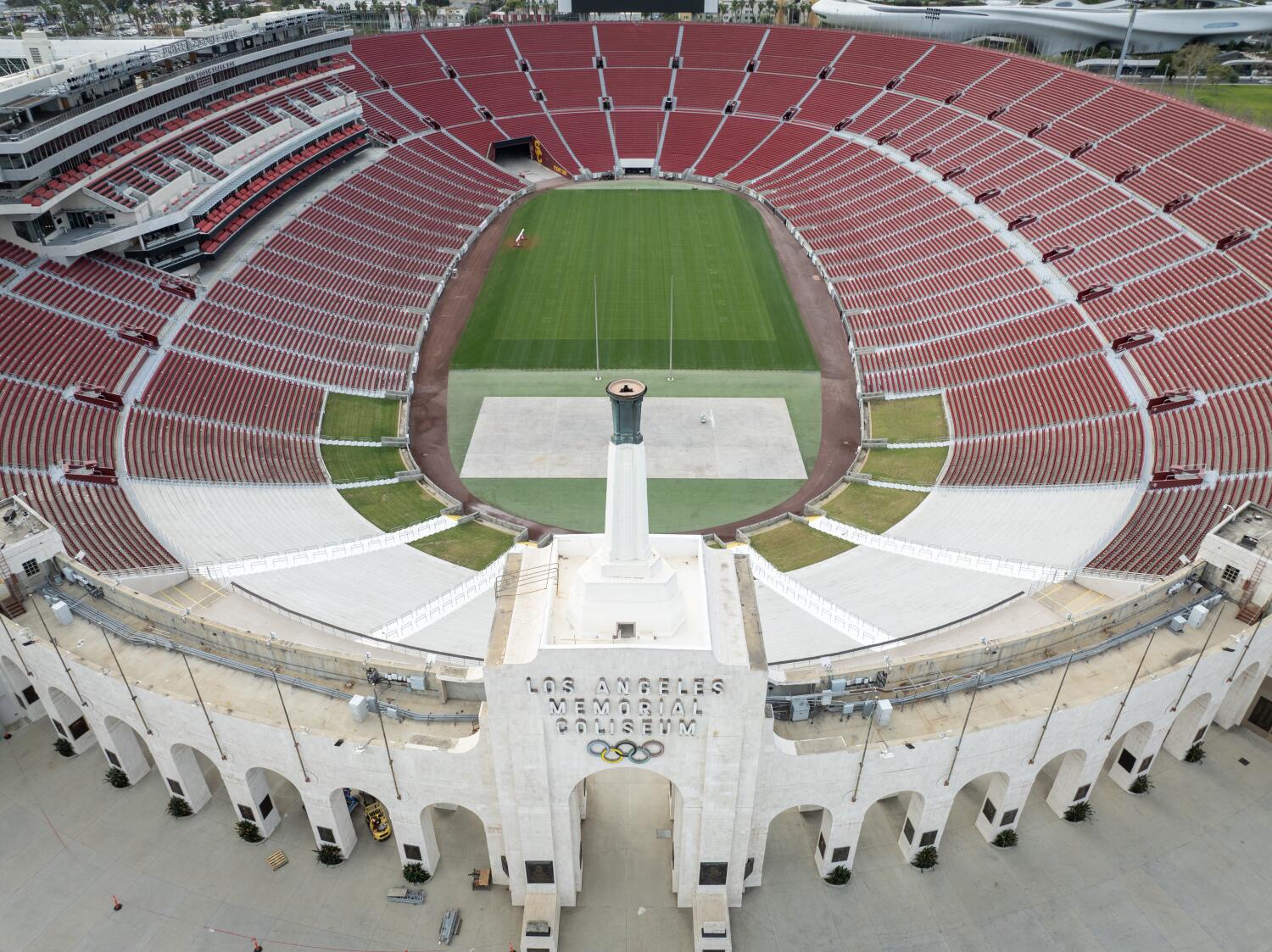
The dream was sold in soft focus. It was a vision of sun-drenched bleachers, the smell of jasmine on a Santa Ana breeze, and a promise that the 2028 Los Angeles Olympics would belong to the people. For years, the organizing committee whispered a seductive word into the ears of Southern Californians: affordability. They spoke of a "no-build" games, a recycled urban landscape where existing stadiums would open their gates to the masses without the crushing debt that usually follows the five-ring circus.
But dreams have a way of evaporating when the bill arrives.
Consider Maria. She is a hypothetical Angeleno, but her bank account is very real. She lives in an apartment in Echo Park, works in middle management, and has spent the last three years putting away fifty dollars a month into a "Games Fund." She wants to see the gymnastics finals. She wants to be in the room when gravity is defied. She expected, perhaps naively, that the "People’s Games" might offer a seat for the price of a decent steak dinner.
Then the price tiers leaked.
Maria’s three years of discipline—eighteen hundred dollars of hard-earned savings—might not even get her through the front door of the SoFi Stadium for the Opening Ceremony. If she wants a prime view of the balance beam, she isn't looking at a ticket price; she’s looking at a down payment on a used car. The sticker shock isn't just a financial hurdle. It is a betrayal of a civic pact.
The Mathematics of Exclusion
The organizers will tell you that the numbers have to work. They will point to the skyrocketing costs of security, the inflation of global logistics, and the simple reality that a multi-billion dollar spectacle cannot be funded by thirty-dollar nosebleeds alone. They aren't lying, but they are omitting the soul of the problem.
To bridge the gap, the L.A. 2028 committee has pivoted toward a "premium-first" strategy. This isn't just about selling a few luxury suites to tech moguls in Silicon Beach. It is an entire ecosystem designed to prioritize the high-net-worth individual. When a single ticket for a high-demand event climbs toward $2,000 or $5,000, the event ceases to be a sporting competition. It becomes an encrypted gala.
The data bears this out. Historical Olympic pricing usually follows a bell curve, with a large volume of accessible tickets buoyed by a thin layer of elite seating. In Los Angeles, that curve is flattening into a plateau of exclusivity. The "accessible" tickets—the ones priced at $35 or $50—are being relegated to sports with lower television draws or venues located hours away from the city center. If you want to see the icons, you have to pay the ransom.
The Ghost of 1984
There is a reason the anger feels so personal in Los Angeles. The city still lives in the shadow of the 1984 Games, the legendary "Profit Games" orchestrated by Peter Ueberroth. That summer is remembered as a miracle of efficiency and civic pride. It was the last time the Olympics felt like a neighborhood block party that just happened to have world-class athletes in the backyard.
Back then, the surplus was $225 million. The city felt rich, not just in money, but in spirit.
Today’s Los Angeles is a different beast. It is a city of staggering wealth gaps, where tents line the sidewalks beneath billboards advertising luxury watches. When the 2028 bid was first pitched, it was framed as a way to heal some of those rifts. It was supposed to be the "Green Games," the "Frugal Games." By using the Rose Bowl, the Coliseum, and the glistening new arenas in Inglewood, the city was supposed to avoid the "White Elephant" syndrome that rotted the infrastructure of Rio and Athens.
But the "no-build" philosophy has a hidden catch. If you aren't spending money on concrete, you are spending it on the experience. And in modern capitalism, "experience" is the most expensive commodity on earth. The cost of labor in California, the insurance premiums for a city on a fault line, and the sheer vanity of outdoing the previous host city have created a vacuum. That vacuum is being filled by the wallets of the 1%.
The Invisible Stakes
Why does this matter? It’s just a game, right?
Wrong. The Olympics are the only time the world agrees to pretend we are one tribe. For sixteen days, we suspend our cynicism and believe that a kid from a favela can outrun a kid from a penthouse. When you price out the local teacher, the bus driver, and the nurse—the very people whose taxes and patience make the city function—you break the spell.
You turn the citizen into a spectator of their own displacement.
Imagine the commute during those two weeks. The 405 freeway will be a parking lot. Public transit will be strained to its breaking point. The residents of Inglewood and South L.A. will navigate checkpoints and road closures. They will endure the noise, the crowds, and the inconvenience. And for what? To watch the lights of the stadium from their porches, knowing they couldn't afford to see what was happening inside?
That is how a "celebration" starts to feel like an occupation.
The psychological toll of being priced out of your own history is immense. There is a specific kind of resentment that grows when a global event uses your zip code as a backdrop but treats your presence as an entry-level nuisance. The organizers are betting that the "excitement" will drown out the "sticker shock," but they are miscalculating the memory of a city that feels it is being sold piece by piece.
The Architecture of a Paywall
The problem isn't just the face value of the ticket. It’s the "convenience fees," the "hospitality packages," and the "priority access" tiers that turn ticket buying into a high-stakes auction.
In previous decades, you stood in line or entered a lottery. There was a sense of cosmic luck involved. Now, the process is optimized by algorithms designed to extract the maximum possible dollar from every seat. Dynamic pricing—the same monster that makes concert tickets cost a month’s rent—is lurking in the wings.
Organizers argue that high-priced tickets "subsidize" the cheap ones. It sounds noble. It sounds like Robin Hood. In practice, it works more like a gated community. The "affordable" seats are so few, and the demand so high, that they disappear in milliseconds, snatched up by bots or diverted to corporate sponsors. The middle class is left in the "Death Zone"—too "rich" for the subsidized tickets, too "poor" for the ones that are actually available.
A City at a Crossroads
Los Angeles is currently engaged in a massive experiment. Can a modern, hyper-capitalist metropolis host a mega-event without losing its mind or its soul?
The answer depends on who the Games are actually for. If they are for the broadcast rights holders and the "Official Timekeepers," then the current pricing trajectory is a massive success. The revenue will be historic. The broadcast will be beautiful. The drone shots of the Pacific at sunset will look spectacular on a 4K screen in London or Tokyo.
But if the Games are for the people who actually live in the 310, 213, and 818 area codes, the project is teetering on the edge of failure.
The tragedy is that it didn't have to be this way. There are models of host cities that prioritized local access over maximum extraction. But those models require a courage that is rare in the boardroom: the courage to leave money on the table. It requires saying "no" to a fifth VIP lounge so that five thousand more families can afford a ticket to the track and field prelims.
Instead, we are watching the slow-motion transformation of a civic treasure into a luxury product.
Maria looks at her savings account. She looks at the price of a seat in the rafters of the swimming venue. She realizes that her fifty dollars a month wasn't an investment in a memory; it was a down payment on a disappointment. She will likely watch the Games from her couch, the same way someone in Maine or Moldova will. The only difference is that she will have to plan her grocery shopping around the road closures and the sirens.
The torch will arrive in Los Angeles with all the fanfare money can buy. It will be carried by celebrities and heroes. But as the flame rises over the Coliseum, it will cast a long, flickering shadow over the millions of people standing just outside the fence, holding their breath and clutching empty pockets.
A stadium full of people who can afford five thousand dollars for a seat is not a crowd. It is a demographic. And a demographic has never, in the history of the world, been able to create the roar of a true home-field advantage.
The roar is fading. In its place is the quiet, rhythmic clicking of a digital checkout counter, counting down the seconds until the "People's Games" are officially sold to the highest bidder.