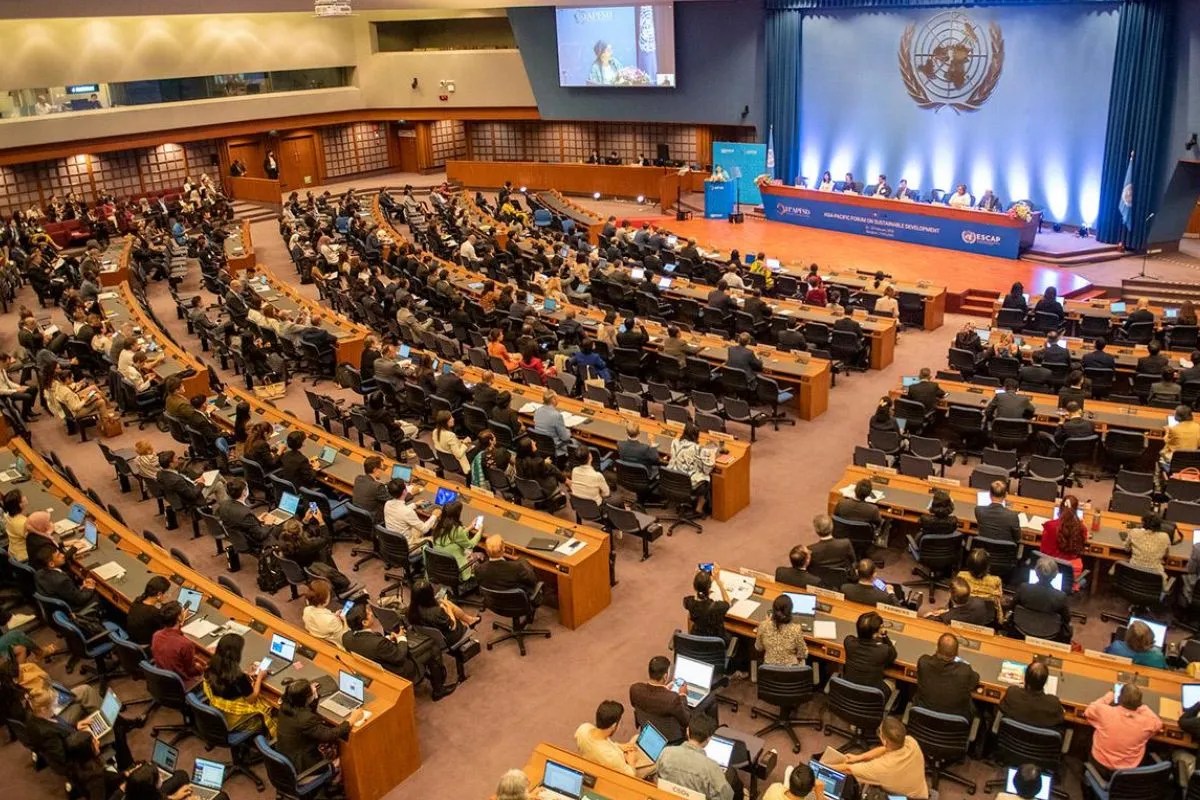
The hallways of the United Nations headquarters in New York are lined with the portraits of men. Since 1945, nine individuals have held the title of Secretary-General. They have come from Norway, Sweden, Burma, Austria, Peru, Egypt, Ghana, South Korea, and Portugal. They represent a vast spectrum of geography, culture, and ideology. Yet, they share one unvarying characteristic. Not a single one of them has been a woman.
For eight decades, the world’s most prominent diplomatic stage has operated under a predictable rhythm of succession. It is a process often described as "electing the Pope of the Secular World." Behind closed doors, the five permanent members of the Security Council trade favors and vetoes until a consensus emerges. It is a game of high-stakes chess played in hushed tones. But as the current selection cycle narrows down to three remaining candidates, the atmosphere inside those hushed rooms has shifted. If you enjoyed this post, you might want to look at: this related article.
The numbers are stark. Three contenders are left standing. Two are men. Only one is a woman.
This isn't just about a job title or a bureaucratic promotion. It is about whether the organization that drafts the world’s resolutions on gender equality can actually look in the mirror. For another perspective on this development, refer to the latest coverage from Associated Press.
The Invisible Weight of the Gavel
Consider a hypothetical diplomat named Elena. She has spent twenty years navigating the fallout of failed states and brokering peace deals in regions where the soil is soaked in history and blood. She knows the technicalities of Resolution 1325—the landmark UN document on Women, Peace, and Security—by heart. Elena has seen how peace treaties often crumble because the women who hold communities together were excluded from the negotiation table.
Now, imagine Elena standing in the General Assembly, looking up at the podium. She sees the weight of expectations. She sees the "boys' club" architecture that has defined global power for generations. For Elena, and millions like her, the absence of a female Secretary-General isn't an oversight. It's a loud, ringing silence. It suggests that while women are vital for the "soft" work of aid and education, the "hard" work of global security remains a male prerogative.
The current race is a crucible. The three remaining candidates are being scrutinized not just for their policy positions, but for what they represent. The lone woman in the race carries more than just her resume; she carries the symbolic burden of every woman who has ever been told that the highest office is "not quite ready" for them.
The Myth of the Neutral Candidate
The selection process is notoriously opaque. Traditionally, the Security Council conducts a series of "straw polls." These are informal votes where members indicate whether they "encourage," "discourage," or have "no opinion" on a candidate. It is a brutal process of elimination.
Critics of the status quo argue that the UN’s preference for "least objectionable" candidates inherently disadvantages women. To reach the top of a national government or an international agency as a woman, one often has to be exceptional—outspoken, transformative, and fiercely competent. Yet, the UN selection process frequently rewards the quietest voice in the room, the one who hasn't offended any of the major powers.
This creates a paradox. The world needs a bold leader to navigate the climate crisis, the rise of artificial intelligence, and the fracturing of global trade. But the system is designed to filter out anyone who might rock the boat. When you add the layer of gender, the barrier becomes a mountain. A woman who is assertive is often labeled "difficult" by the veto-wielding powers. A woman who is diplomatic is dismissed as "weak."
The facts of the current race suggest we are at a breaking point. The pressure from the "1 for 7 Billion" campaign and various global coalitions for a female leader has never been higher. They argue that the UN’s credibility is at stake. If the organization cannot practice what it preaches regarding representation, its moral authority to lecture member states on human rights begins to dissolve.
The Power of the Single Seat
Politics is often a matter of momentum. When the field narrowed to three, the stakes didn't just shrink; they intensified. Every meeting in a New York steakhouse, every phone call between Moscow and Washington, and every whisper in the delegates' lounge is now focused on these three names.
The lone female candidate faces a unique challenge. She is not just competing against two other qualified professionals. She is competing against eight decades of "that’s just how it’s done." She must be twice as prepared and half as controversial. She must navigate the geopolitical minefield of the Security Council while appearing "unifying."
If she wins, it won't just be a victory for her. It will be a structural shift in how the world perceives leadership. It would mean that a woman is finally at the helm of the only organization capable of convening the entire planet. It would mean that when a young girl in a refugee camp or a graduate student in a lecture hall looks at the UN, she sees a reflection of her own potential.
If she loses, the narrative will likely be that she "wasn't the right fit" or that "her timing was off." But those are often just polite euphemisms for a system that isn't ready to let go of its own traditions.
The Cost of Waiting
We often talk about the "first" woman to do something as if it is a natural evolution, like the turning of the seasons. It isn't. It is an act of friction. It is a deliberate choice to break a pattern.
The world in 2026 is not the world of 1945. The challenges are more interconnected, the threats are more decentralized, and the voices demanding a seat at the table are louder than ever. The UN was built on the ashes of a world that didn't value diverse perspectives. It was a tool for stability in a bipolar era. Today, stability requires more than just the absence of war; it requires the presence of justice.
The selection of the Secretary-General is the ultimate test of the UN’s relevance. Is it a museum of 20th-century power dynamics, or is it a living, breathing institution capable of evolution?
The two men and one woman remaining in the race are currently the most scrutinized people in diplomacy. They are being weighed, measured, and tested. But the real test isn't for the candidates. It's for the five permanent members of the Security Council. They hold the keys. They decide if the portrait gallery will finally change.
As the final rounds of voting approach, the air in New York grows heavy with anticipation. The facts are on the table. The candidates are ready. The world is watching. This isn't just about a job. It’s about whether the world is ready to see its own future.
The gavel is waiting. The question is whose hand will finally pick it up.