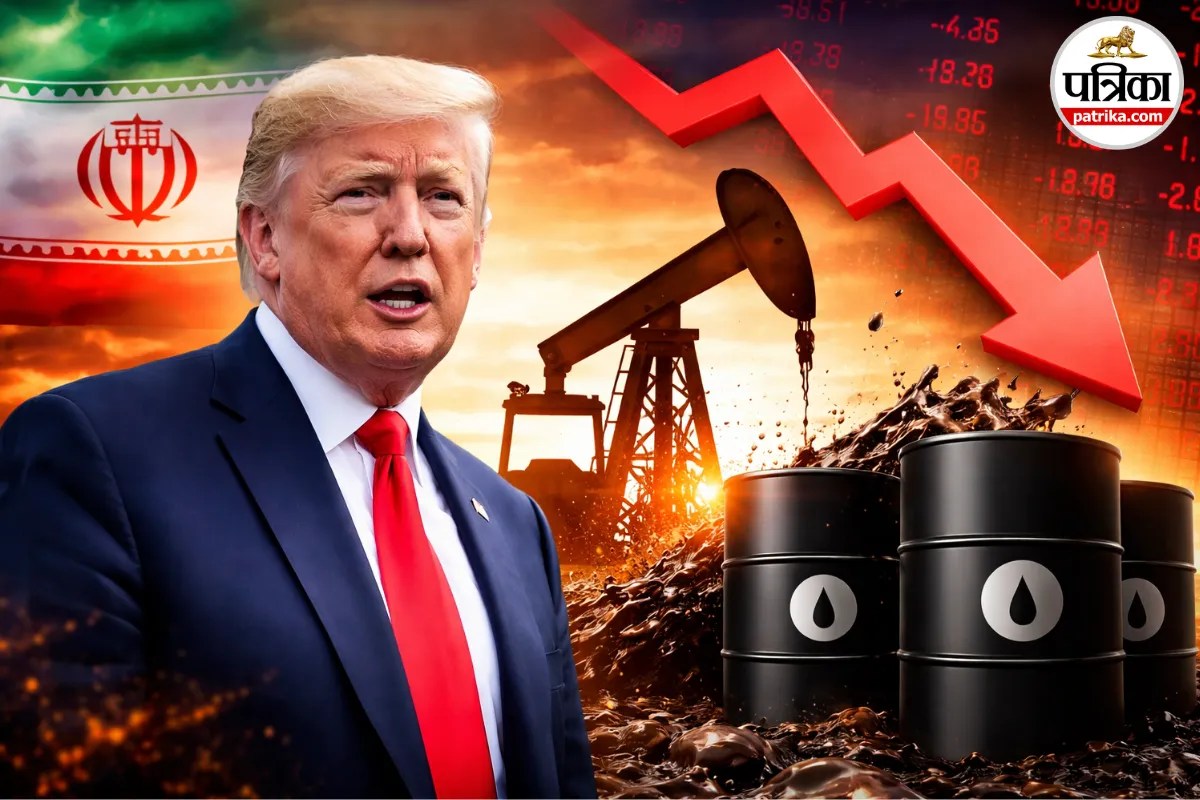
The immediate 6% to 8% retracement in Brent and WTI crude prices following the diplomatic pivot regarding Iranian energy infrastructure is not a market anomaly; it is a rational recalibration of the "Geopolitical Risk Premium." When military friction between major state actors shifts from active kinetic threats to diplomatic signaling, the Brent-WTI spread narrows and the "fear-buffer" integrated into futures contracts evaporates. This price collapse represents the market’s realization that the global supply chain—specifically the 17 million barrels per day (bpd) flowing through the Strait of Hormuz—is no longer under imminent blockade.
The Mechanics of the Geopolitical Risk Premium
Oil prices are rarely a pure reflection of current physical supply and demand. Instead, they function as a discounted projection of future availability. The recent volatility stems from three distinct layers of market pricing:
- The Kinetic Threat Layer: This includes the direct probability of missile strikes on refineries, storage tanks, or loading terminals. When the Trump administration signaled a shift away from direct strikes on Iranian oil sites, this layer was stripped from the price within a single trading session.
- The Logistics and Insurance Layer: Maritime insurance premiums for Suezmax and VLCC (Very Large Crude Carrier) tankers spike during periods of regional instability. A "de-escalation signal" lowers the cost of freight and insurance, which flows directly into a lower landed cost for crude.
- The Strategic Reserve Layer: In periods of high tension, nations increase their strategic stockpiling. When the threat of war recedes, the urgency to buy for storage slows, reducing the immediate buy-side pressure on the spot market.
The Supply-Demand Divergence
While headlines focus on the "Trump Decision," the underlying bearish trend in oil is rooted in a fundamental structural surplus. The decision to avoid striking Iran merely allowed these pre-existing market forces to reclaim control over the price action.
The Oversupply Vector
The United States is currently producing at record levels, exceeding 13 million bpd. This surge in non-OPEC+ supply creates a ceiling for price rallies. When a potential supply disruption in the Middle East is off the table, the market is forced to confront the fact that global production is outstripping consumption. OPEC+ currently holds significant spare capacity, which acts as a secondary downward pressure; the market knows that any gap left by a hypothetical Iranian exit could be filled by Saudi or Emirati taps within 90 days.
The Demand Deficit Vector
Global refining margins are tightening. Industrial slowdowns in major Asian economies have reduced the "call on crude." The reduction in prices following the Iran-Israel de-escalation is effectively a return to the mean, where the mean is defined by a world that currently has more oil than it needs for immediate industrial utility.
The Logistics of the Strait of Hormuz Bottleneck
The fear of an "Iranian strike" is specifically a fear of the closure of the Strait of Hormuz. To understand the price drop, one must understand the cost function of a maritime blockade.
- Throughput Volume: Approximately 20% of the world’s liquid petroleum passes through this 21-mile-wide chasm.
- The Substitution Problem: There are very few bypass pipelines capable of handling the volume required to keep global markets stable. The East-West Pipeline in Saudi Arabia and the Abu Dhabi Crude Oil Pipeline have limited capacity.
- The Escalation Ladder: If a strike had occurred, the move from $75 to $120 per barrel would have been instantaneous due to the "inelasticity of demand"—people and industries need oil regardless of the price in the short term. By removing the strike from the table, the administration removed the $40 "escalation tax" that traders had baked into the price.
Inflationary Feedback Loops
The correction in crude oil prices has a direct, inverse relationship with the Consumer Price Index (CPI). Energy is a primary input for almost all goods and services. A sustained $10 drop in the price of a barrel of oil typically translates to a significant reduction in transport costs and plastic feedstock prices.
The diplomatic pivot functions as a liquidity injection into the global economy without the need for central bank intervention. By lowering the cost of energy, the administration is effectively performing a "supply-side easing." This reduces the pressure on the Federal Reserve to maintain high interest rates, as energy-driven inflation is a core component of the "sticky inflation" narrative that has dominated the last 24 months.
Strategic Limitations of Diplomatic Signaling
While the immediate market reaction was a "U-turn" toward lower prices, this stability is fragile. The logic of the market dictates that the absence of a strike is not the same as the presence of long-term peace.
- Sanctions Leakage: Even without kinetic strikes, the enforcement of "Maximum Pressure" via sanctions remains a variable. If the administration shifts from military threats to aggressive naval interdiction of "ghost tankers," the supply could still tighten, albeit more slowly.
- OPEC+ Reaction Function: As prices dip toward the $70 mark, the probability of OPEC+ extending voluntary production cuts increases. The cartel requires a specific price floor (often cited near $80 for Saudi fiscal breakeven) to maintain national budgets.
- The SPR Variable: The U.S. Strategic Petroleum Reserve is at historically low levels. Any significant price dip provides an opportunity for the government to buy back oil to refill the reserve, creating a "government-mandated floor" for the price.
The Volatility Index of Energy Markets
Traders use the OVX (Oil Volatility Index) to measure the "uncertainty" in the market. The pivot in Iran policy caused a sharp contraction in the OVX. When uncertainty drops, institutional investors move from "long" positions (betting on a price rise) to "neutral" or "short" positions. This mass exodus from long positions creates a self-reinforcing downward spiral in price, which explains why the market fell so aggressively in such a short window.
The "Trump Effect" in this context is the reduction of the "Unknown-Unknowns." By clearly articulating a policy that avoids regional energy infrastructure destruction, the administration provided the market with a "Known-Known": the oil will continue to flow.
The Strategic Playbook for Energy Exposure
Market participants must now pivot from a "conflict-hedging" strategy to a "macro-fundamental" strategy. The immediate tactical move involves monitoring the $68–$72 support zone for WTI. If prices break below this level, it signals that the market is no longer just pricing out war, but is beginning to price in a global recession.
For industrial consumers, this window represents a critical opportunity to lock in long-term fuel hedges. The risk-reward ratio for oil at $70 is vastly different than at $85. While the threat of a strike has receded, the structural instability of the Middle East remains a latent variable. Smart capital will utilize this "diplomatic discount" to insulate against the next inevitable spike in the kinetic threat layer.
Monitor the weekly EIA (Energy Information Administration) inventory reports. If de-escalation coincides with a "build" in inventories (more oil in storage), the price will continue to decay. If inventories "draw" (less oil in storage) despite the lack of war, it indicates that global demand is stronger than the headlines suggest, and a price floor will be established regardless of diplomatic outcomes.
The next 30 days will determine if this is a temporary correction or a long-term shift into a lower-bound trading range. Focus on the rig count in the Permian Basin and the export volumes from the Kharg Island terminal in Iran as the two primary indicators of the new equilibrium.
Would you like me to analyze the specific impact of these oil price fluctuations on the upcoming quarterly earnings for the major airlines or logistics firms?