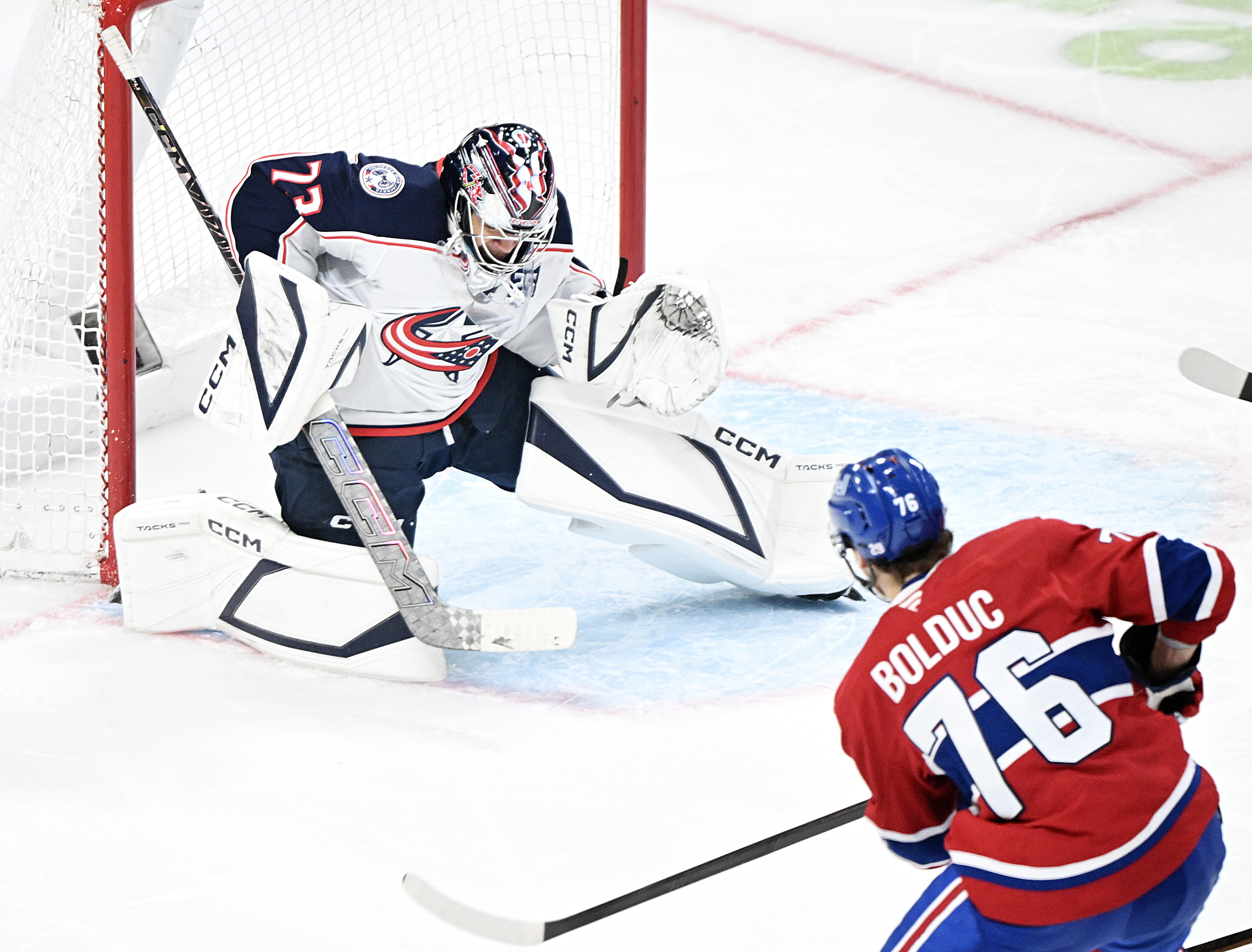
The air inside the Bell Centre doesn't just circulate; it breathes. It carries the scent of expensive beer, cold zinc from the ice, and the collective anxiety of twenty-one thousand people who treat a mid-season hockey game against a struggling opponent like a referendum on their cultural identity. When the Montreal Canadiens took the ice against the Columbus Blue Jackets on this particular night, the stakes weren't found in the league standings. Both teams were drifting in the purgatory of a rebuild, far from the glittering promise of a deep playoff run.
The real story lived in the creases of the players' faces and the desperate, lung-searing backchecks in the final three minutes. It was a 2-1 victory that felt less like a triumph and more like an exorcism.
To understand why a narrow win over Columbus matters, you have to look at the anatomy of a rebuild. It is a grueling, psychological slog. It is the sporting equivalent of sanding a floor by hand. You know there is beautiful wood underneath the grit, but for now, your knees hurt and your hands are raw. For the Canadiens, this season has been a series of "moral victories" that eventually start to taste like ash. Fans are told to be patient. They are told to watch the development of the youth. But eventually, the human soul demands a result. It demands a scoreboard that validates the effort.
The Guardian in the Blue Paint
Consider Cayden Primeau. For years, he has carried the burden of a famous last name and the impossible expectations of a city that views goaltenders as secular saints. He has spent more time on the highway between Montreal and their minor league affiliate in Laval than some long-haul truckers. On this night, he wasn't just stopping pucks; he was defending his right to exist in the NHL.
Every time the Blue Jackets buzzed around the net, Primeau looked remarkably still. In hockey, stillness is a superpower. When a goalie is frantic, the defense panics. When a goalie moves like he’s underwater—efficient, calm, deliberate—the entire team settles. He turned aside 29 shots, many of them coming in a frantic third-period push where Columbus desperate to justify their own existence, threw everything but the water bottles at him.
The lone goal he surrendered wasn't a failure of skill, but a reminder of the game’s inherent chaos. A bounce here, a screened sightline there. But he didn't crumble. In the past, a late goal might have signaled a collapse. Not tonight. Primeau stood his ground, a young man refusing to let the narrative of "backup goalie" define him for another day.
The Mechanics of Grinding
We often talk about "puck luck" as if it’s a mystical force, but in a 2-1 game, luck is actually just the byproduct of physical exhaustion. The Canadiens’ goals didn’t come from highlight-reel dekes or 100-mile-per-hour slap shots. They came from the dirty work.
Brendan Gallagher remains the patron saint of this specific brand of suffering. He plays the game as if he is perpetually trying to retrieve a lost wallet from under a moving car. He is undersized, battered by a decade of cross-checks, and possesses hands that have been broken more times than most people have had colds. Yet, there he was, parked in the blue paint, taking abuse from Columbus defenders twice his size.
When the puck finds the back of the net in these games, it’s rarely pretty. It’s a deflection off a shin guard. It’s a desperate poke-check during a goal-mouth scramble. The Canadiens managed to find two of those moments. They weren't masterpieces. They were blueprints of survival.
The Invisible Pressure of Columbus
It is easy to dismiss the Blue Jackets. They arrived in Montreal as a team searching for an identity, reeling from internal shifts and a season that has felt like a long walk through a thunderstorm. But a desperate team is a dangerous animal. They played with a heavy, physical style that forced Montreal to prove they could handle the "heavy" minutes.
In the second period, the momentum shifted. The ice seemed to tilt toward the Montreal end. You could hear the crowd grow quiet—that specific, North American hockey silence where everyone is holding their breath, waiting for the inevitable mistake. This is where the game is won or lost. Not on the power play, but in the neutral zone transitions where a tired defenseman has to decide between a safe chip-off-the-glass or a risky pass.
Montreal chose safety. They chose the boring, disciplined, grueling path. It is the hardest way to play hockey because it offers no individual glory. It only offers the collective relief of a win.
Why the Margin Matters
There is a temptation to look at a 2-1 scoreline and see a boring game. That is a failure of imagination. A 2-1 game is a tightrope walk over a canyon. One stumble, one mistimed line change, one broken stick, and the entire structure collapses.
For a young team like the Canadiens, winning these "ugly" games is more important than winning a 6-1 blowout. A blowout is a party. A 2-1 win is a graduation. It proves that when the pressure is highest and the margin for error is non-existent, they don't blink. It validates the coaching staff's obsession with "the process."
The fans felt it too. As the final seconds ticked down and Columbus pulled their goalie for an extra attacker, the Bell Centre transformed. The anxiety curdled into a roar. When the final horn sounded, the celebration on the ice wasn't the exuberant jumping of a championship win. It was a collective exhale.
The Quiet Long Game
We live in an era of sports defined by advanced analytics. We track "expected goals" and "high-danger chances" and "zone entries." But numbers can't capture the feeling of a puck hitting a goalie's ribs and the dull thud it makes against the chest protector. It can't quantify the courage it takes for a rookie defenseman to block a shot with his ankle in the dying seconds of a Wednesday night game that "doesn't matter" in the standings.
These games are the foundation. You don't build a contender out of draft picks alone; you build it out of the callouses earned in February against teams like Columbus. You build it by learning how to hold a lead when your legs feel like lead and your lungs are screaming for oxygen.
As the lights dimmed and the Zambonis began their lonely circles to repair the scarred ice, the significance of the night lingered. The Canadiens walked away with two points, but more importantly, they walked away with a piece of their identity intact. They held off the surge. They protected their house. They survived.
In the grand arc of a franchise’s history, this game will be a footnote. But for the men in that locker room, it was a reminder that they are capable of winning the hard way. And in the cold, unforgiving world of professional hockey, the hard way is the only way that lasts.
The stadium emptied into the biting Montreal night, the fans pulling their scarves tighter against the wind, carrying with them the small, flickering warmth of a narrow victory that meant everything and nothing all at once.