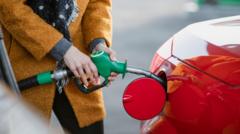
The digits on the tall, glowing totem outside the Asda Superstore don’t just represent a price anymore. They represent a choice. For a nurse named Sarah—a hypothetical but statistically certain composite of the thousands currently idling in London’s gridlock—that flickering "150.9p" is the sound of a mental calculator resetting. It is the sound of a weekend trip to see parents being quietly canceled. It is the sound of a grocery list being pruned of its luxuries.
When the price of unleaded petrol crests the 150p mark, something psychological happens to the British public. It isn’t just about the extra five pounds at the pump. It is the feeling of being trapped in a system where the levers of power are held by people who don't have to check their bank balance before they turn the ignition. You might also find this connected story insightful: The Middle Power Myth and Why Mark Carney Is Chasing Ghosts in Asia.
The Man in the Glass Office
Lord Stuart Rose, the chairman of Asda, recently sat before the glare of cameras to defend his empire. The accusations were blunt: profiteering. The suggestion was that while the average family was drowning in the cost-of-living crisis, the retail giants were keeping their margins artificially high, squeezing every last penny out of the desperate need for mobility.
Rose didn’t flinch. He spoke of "extremely competitive" pricing. He pointed to the thinness of retail margins. He rejected the idea that Asda—traditionally the price-leader that kept the "Big Four" supermarkets in check—was abandoning its post as the champion of the budget shopper. As highlighted in recent coverage by Bloomberg, the effects are widespread.
But the reality on the asphalt tells a different story. For decades, the "Asda Price" was a shield. When Asda dropped its prices, Tesco, Sainsbury’s, and Morrisons were forced to follow suit or lose the school-run crowd. That shield is thinning. When the gap between the supermarket pump and the branded motorway service station narrows, the consumer feels the heat.
The Invisible Math of the Tank
To understand why 150p feels like a betrayal, we have to look at the anatomy of a liter of fuel. It is a cocktail of global geopolitics, currency fluctuations, and a massive, unmoving slab of taxation.
When you pay £1.50 for a liter of petrol, roughly 53 pence of that is Fuel Duty. Another 25 pence is VAT. Before the fuel even reaches the tanker, the government has already taken its lion's share. Then comes the wholesale cost—the price of refined Brent Crude—which dances to the tune of OPEC+ production cuts and conflicts in the Middle East.
The retailer, the Asdas of the world, usually operates on a margin that looks like pennies. But when you multiply those pennies by billions of liters, the numbers become staggering. The Competition and Markets Authority (CMA) has been watching this play out like a hawk over a field. Their previous findings suggested that a "weakening of competition" had led to supermarkets padding their margins.
Lord Rose argues that they are simply reflecting the volatility of the market. He claims Asda is still the cheapest. Yet, for Sarah at the pump, "the cheapest" is starting to look a lot like "unaffordable."
The Ghost of the Commute
The British economy is built on the assumption of fluid movement. We are a nation of commuters, of delivery drivers, of parents juggling three different drop-offs before 9:00 AM. When fuel prices spike, the friction of daily life increases.
Consider the "poverty premium." If you live in a rural area with no reliable bus service—a common reality after years of local council cuts—a car isn't a luxury. It is a prosthetic limb. Without it, you cannot work. Without it, you cannot shop. When the price of fuel rises, it acts as a regressive tax on the people who can least afford to pay it.
The anger directed at supermarket bosses isn't just about the math. It’s about the breach of a social contract. We have traded the vibrant high street for the convenience of the out-of-town superstore. We gave them our loyalty and our data in exchange for the promise of the lowest possible prices. When those prices rise while the parent companies report billion-pound earnings, that contract feels like it’s being shredded in real-time.
The Friction of the Forecourt
There is a specific kind of tension that exists at a petrol station during a price surge. It’s in the way people move. They don't linger. They don't browse the aisles for a celebratory chocolate bar. They stare at the rolling numbers on the pump with a grim intensity.
Click.
The nozzle shuts off. £80.00 exactly. Or £80.01 if the trigger finger slipped.
That extra penny feels like a taunt.
Lord Rose’s defense is anchored in the logic of the boardroom. He talks about "reinvesting in value" and "absorbing costs." But value is a subjective experience. Value is being able to drive to a job interview without wondering if the fuel light will come on halfway there.
The wholesale price of oil might drop on the global markets on a Tuesday morning, but it often takes weeks for that "feather" to float down to the forecourt. Conversely, when oil prices rise, the pump prices shot up like a rocket. This "rockets and feathers" phenomenon is the primary source of the public's cynicism. We are told the market is fair, but we experience it as a one-way street.
Beyond the Supermarket Totem
What happens if 150p becomes the new floor rather than the ceiling?
We are seeing the beginning of a forced evolution. The transition to Electric Vehicles (EVs) is often touted as the escape hatch, but for the family buying a ten-year-old diesel hatchback because it’s all they can afford, the EV revolution is a distant planet. They are stuck in the internal combustion age, paying the premium for a technology that the world is trying to leave behind.
The government’s decision to freeze fuel duty for another year was a political necessity. To raise it would have been electoral suicide. But a freeze isn't a cut. It’s a holding pattern.
Asda and its competitors are now operating in a world where every move is scrutinized by a public that is better informed and more frustrated than ever before. Apps that track local fuel prices have turned the hunt for cheap petrol into a digital blood sport. People will drive five miles out of their way to save two pence a liter, often burning more fuel in the process than they save in cash. It isn’t logical. It’s a protest.
The Heavy Weight of the Nozzle
There was a time when the petrol station was a symbol of freedom. The open road. The full tank. The possibility of going anywhere.
Now, the petrol station is a place of accounting. It is where the macro-economic failures of the decade meet the micro-economic reality of the kitchen table. Lord Rose can reject the claims of profiteering all he wants, and he might even have the spreadsheets to prove it. But spreadsheets don't buy school shoes. They don't pay the heating bill.
The real price of petrol isn't 150p. The real price is the anxiety that settles in the chest of the driver as they watch the silver numbers spin. It is the quiet calculation of what must be sacrificed to keep the wheels turning.
As Sarah replaces the nozzle and clicks the petrol cap shut, she isn't thinking about wholesale margins or global supply chains. She is thinking about the three days left until payday and the twenty miles left in the tank. She climbs back into the driver’s seat, shifts into gear, and merges into the flow of traffic, another flickering light in a sea of people just trying to find a way to afford the journey home.
The engine hums, a thirsty, expensive beast that demands to be fed, indifferent to the fact that its owner is running on empty.
Would you like me to analyze the specific regional variations in UK fuel pricing to see which areas are being hit hardest by these margins?