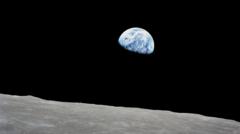
You’ve seen the "Earthrise" photo. Everyone has. It’s that stunning shot of our blue marble peeking over the lunar horizon, taken by the Apollo 8 crew in 1968. But here’s the thing. That wasn’t the first color photo of Earth taken from the vicinity of the Moon.
While Apollo 8 gets the glory and the postage stamps, a robotic precursor actually beat the astronauts to the punch. On August 23, 1966, the Lunar Orbiter 1 spacecraft captured the first-ever image of Earth from the Moon's perspective. It was grainy. It was black and white. It looked like a smudge in a sea of static. However, it proved we could look back.
The real shift happened when we finally saw ourselves in high-definition color. That moment didn't just provide a cool desktop wallpaper for the future. It fundamentally rewired how humans perceive their place in the universe. We stopped being the center of everything and started being passengers on a very small, very fragile boat.
The Secret History of the 1967 DODGE Image
Most people assume NASA’s Apollo program held a monopoly on space photography. It didn't. Before the famous "Blue Marble" or the Apollo 8 "Earthrise," a military satellite called DODGE (Department of Defense Gravity Experiment) snatched the title for the first full-color image of the entire Earth.
Launched in July 1967, DODGE wasn't designed to be an artist. It was a testbed for satellite stabilization. To check if the satellite was pointing the right way, engineers bolted on a few cameras. On August 8, 1967, DODGE sent back a composite color image of the Earth.
It wasn't perfect. The colors were slightly off because the satellite used red, green, and blue filters that had to be layered together on the ground. But there it was. For the first time, we saw the disk of the planet in color from roughly 20,000 miles out. It looked lonely. It looked real.
The DODGE photos are often forgotten because they lack the "human" element of a grainy voice transmission from an astronaut. But they laid the technical groundwork. They proved that transmitting color data across the vacuum of space was possible without losing the essence of the scene.
Why Apollo 8 Stole the Spotlight
If DODGE did it first, why does Apollo 8 get all the credit? Because humans are suckers for a good story.
On Christmas Eve, 1968, Frank Borman, Jim Lovell, and Bill Anders were orbiting the Moon. They were busy. They were looking at the lunar surface, scouting landing sites for the upcoming Apollo 11 mission. Suddenly, the Earth appeared.
"Oh my God! Look at that picture over there!" Anders shouted.
He scrambled for his Hasselblad camera. He asked for a color film magazine. Borman joked about it not being on the flight plan. It was chaotic, spontaneous, and utterly human. Anders snapped the shutter, and the world changed.
The technical specs of that camera mattered. It was a Hasselblad 500EL with a 250mm lens. They used custom Kodak Ektachrome film. Because there was no atmosphere to distort the light, the clarity was unlike anything seen before. When that film was processed back on Earth, the vibrant blues of the oceans and the brilliant whites of the cloud swirls made the planet look like a gemstone.
It wasn't just a photo. It was a mirror.
The Technological Hurdles of Lunar Photography
Taking a photo from the Moon isn't like snapping a selfie at the beach. In the 1960s, it was a nightmare.
First, you have the dynamic range problem. The Moon is actually quite dark—roughly the color of asphalt. The Earth, however, is incredibly bright because of the clouds and ice. If you expose for the Moon, the Earth becomes a white blob. If you expose for the Earth, the Moon turns into a black void.
The Apollo astronauts had to guess. They had light meters, sure, but they were working in an environment with lighting conditions no human had ever experienced. They also had to deal with radiation. High-speed film is sensitive to cosmic rays. If the film stayed in space too long without shielding, it would fog up and ruin the images.
NASA worked closely with Kodak to develop thin-base films that allowed more frames per roll while maintaining high resolution. They used special lubricants for the camera gears because normal oil would boil away in the vacuum of space, seizing the mechanism.
The Environmental Movement’s Secret Weapon
You can trace the birth of the modern environmental movement directly back to these first color images.
Before 1968, "the environment" was a local issue. You worried about your local river or the smog in your specific city. The color photos of Earth from the Moon changed the scale. They showed that the atmosphere is a thin, translucent skin. It doesn't look tough. It looks like it could blow away with a stiff breeze.
Within two years of the "Earthrise" photo, the first Earth Day was held in 1970. The Environmental Protection Agency (EPA) was formed shortly after. Seeing the planet as a single, isolated unit made the concept of "global" problems real. You couldn't unsee the fact that we're all on the same rock.
Common Misconceptions About These Photos
People get a lot of things wrong about these early images.
Many think the "Earthrise" photo shows the Earth rising like the sun does on Earth. It doesn't. Because the Moon is tidally locked, the Earth stays in basically the same spot in the lunar sky. You only see an "earthrise" if you’re in a spacecraft moving around the Moon. If you stood on the lunar surface, the Earth would just hang there, wobbling slightly but never "setting."
Another myth is that the photos were colorized later. They weren't. The Apollo 8 shots were taken on native color transparency film. What you see is what the astronauts saw through the window of the Command Module.
Some conspiracy theorists point to the lack of stars in these photos as "proof" they were faked. That’s just basic photography. To capture the bright Earth, you need a fast shutter speed. Stars are dim. They don't have enough time to register on the film during a daylight exposure. It’s the same reason you don't see stars in photos of a football stadium at night.
The Evolution to the 1972 Blue Marble
While Apollo 8 gave us the horizon shot, the 1972 Apollo 17 "Blue Marble" gave us the full circle.
This is arguably the most reproduced image in human history. The sun was directly behind the spacecraft, illuminating the entire disk of the Earth. You can see Africa, Antarctica, and the Arabian Peninsula with staggering detail.
It’s the gold standard. Even today, with our 8K cameras and sophisticated satellites, we struggle to produce an image that carries the same weight. Modern "Blue Marble" images from NASA are often composites—stitched together from thousands of strips of data collected by polar-orbiting satellites. They’re technically superior, but they feel "manufactured." The 1972 shot was a single frame. A guy with a camera looking out a window.
How to View These Images Today
If you want to see these properly, don't just look at low-res JPEGs on social media.
NASA has digitized the original flight films at incredibly high resolutions. You can find the Project Apollo Archive on platforms like Flickr, where you can zoom in until you see the grain of the film.
- Go to the Project Apollo Archive.
- Search for Magazine 14/C (for Apollo 8) or Magazine 148/NN (for Apollo 17).
- Look for the "accidental" shots. The frames where the astronauts were just testing the light or missed the framing.
Those "mistakes" make the history feel more tangible. You see the reflections on the glass. You see the smudges on the lens. It reminds you that this wasn't a CGI production. It was three people in a metal can, 240,000 miles from home, trying to capture something they knew was bigger than themselves.
Check out the raw scans of Apollo 8's Magazine 14. You'll see the sequence of black and white shots of the lunar surface, then suddenly, that burst of blue. It’s the most dramatic transition in the history of photography. Stop looking at the "cleaned up" versions and find the raw files. They're much more powerful.