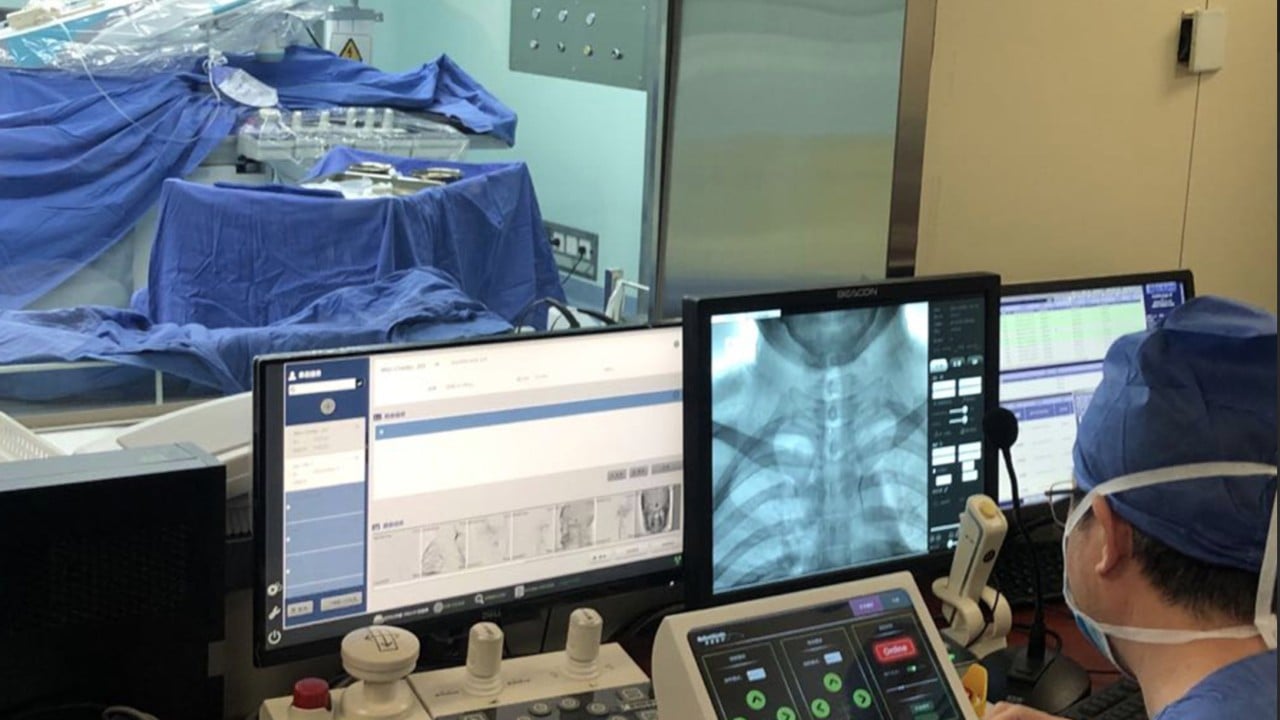
The integration of specialized robotics into neurosurgical workflows is not merely an incremental improvement in tool dexterity; it represents a fundamental shift in the temporal and spatial economics of the operating room. Recent performance data from Chinese-developed surgical robotic systems indicate a 29% reduction in brain imaging time compared to manual human execution. While media narratives focus on "robots outperforming humans," a rigorous strategic analysis reveals that this gain is the result of three specific structural optimizations: the elimination of hand-eye latency, the standardization of catheter trajectory through fluid dynamics modeling, and the reduction of radiation exposure cycles through predictive positioning.
The Triad of Robotic Advantage in Neuro-Intervention
To understand why a 29% reduction in imaging time is statistically significant, one must first define the bottlenecks of manual neuro-imaging. In a standard digital subtraction angiography (DSA) or thrombectomy procedure, the human surgeon navigates a microcatheter through the femoral artery to the brain's vasculature. The delays are not caused by slow physical movement, but by the "Confirm and Adjust" loop.
- Iterative Positioning Latency: Humans move the catheter, pause to initiate a fluoroscopy X-ray, analyze the 2D image, and then adjust. Each "pause" adds seconds that aggregate into minutes.
- Vascular Resistance Miscalculation: The human hand lacks the high-frequency haptic feedback to perfectly gauge the friction of the vessel wall in real-time. This leads to over-correction or cautious under-correction.
- Visualization Overhead: Manual imaging requires constant recalibration of the C-arm (the X-ray imaging device) to ensure the catheter tip remains in the center of the frame.
The robotic system replaces these variables with a deterministic model. By using a remote-controlled drive system with sub-millimeter precision, the robot maintains a constant velocity that is synchronized with the imaging capture rate.
The Physics of Catheter Kinematics
The 29% efficiency gain is primarily located in the "navigation-to-target" phase. Manual navigation is stochastic; robotic navigation is algorithmic.
The robot utilizes a Force-Velocity Control Loop. In this framework, the system measures the axial force applied to the wire $F_a$ and the resistance of the vessel $F_r$.
$$F_{net} = F_a - F_r$$
A human surgeon operates on a feedback loop of approximately 150-200 milliseconds. A robotic controller operates at a frequency of 1,000Hz (1 millisecond). This allows the robot to maintain a higher average velocity through the aortic arch and into the carotid arteries without exceeding the safety threshold of the vessel wall tension. Because the robot does not "over-probe," it requires fewer imaging bursts to verify its location.
Radiographic Economic Impact
Imaging time is a direct proxy for radiation dose. In neuro-interventional radiology, the "As Low As Reasonably Achievable" (ALARA) principle governs the procedure. The 29% reduction in imaging time translates directly to a reduction in the Gray (Gy) units of radiation absorbed by both the patient and the surgical staff.
The structural advantage here is the Decoupling of Operator and Radiation Source. By allowing the surgeon to operate from a lead-shielded cockpit, the robot removes the physical fatigue associated with wearing 10-15kg lead aprons. Fatigue is a primary driver of procedural drift—the phenomenon where a surgeon’s movements become less precise over the duration of a multi-hour case. By maintaining a flat precision curve, the robot ensures that the last 10% of the procedure is as efficient as the first 10%.
Addressing the Autonomy Spectrum
It is a misnomer to suggest these robots are "autonomous" in the sense of making independent clinical decisions. Instead, they function as High-Fidelity Tele-Operative Systems with automated sub-routines. The current Chinese models, such as those developed by firms like MicroPort or Perlove, utilize automated "docking" and "vessel-centering" functions.
The "Search Intent" of medical facilities adopting this technology is rarely about replacing the surgeon; it is about extending the surgeon’s reach. In a manual setting, a surgeon might perform 3-4 complex cases before cognitive and physical exhaustion sets in. By compressing the imaging and navigation time, the robot increases the "Throughput Capacity" of the neuro-interventional suite. If a procedure that typically takes 60 minutes is reduced to 42 minutes, a hospital can theoretically increase its daily caseload by 25% without adding additional staff or rooms.
The Bottleneck Shift: From Execution to Prep
As the robot compresses the time spent inside the vessel, the new bottleneck in neurovascular surgery shifts to the Pre-Surgical Registration Phase.
Before the 29% time saving can be realized, the system must be calibrated to the patient's specific anatomy. This requires high-resolution CT or MRI data to be fused with the live fluoroscopic feed. If the registration process is cumbersome, the time saved during imaging is surrendered during setup. The competitive advantage in the next five years will not go to the company with the fastest robot, but to the company with the most efficient "Data-to-Drive" pipeline.
The Limits of the 29 Percent Metric
Statistical gains in controlled environments often face "Entropy Decay" in real-world clinical settings. Several factors can degrade the 29% efficiency advantage:
- Anatomical Variance: In patients with "tortuous" anatomy (extremely twisted blood vessels), the robot's algorithmic pathing may fail, requiring the surgeon to revert to manual tactile feel.
- Haptic Transparency: Early robotic models lacked the ability to transmit the "feel" of a wire snagging. While sensors have improved, there is still a "Sensory Gap" that can lead to conservative (slower) movement in high-risk zones like the Circle of Willis.
- System Latency: In remote surgery (tele-surgery), network jitter can introduce a new form of lag that cancels out the robot's mechanical speed.
Strategic Capital Allocation for Medical Institutions
For hospital administrators and health systems, the decision to invest in this robotic infrastructure should be viewed through the lens of Cost per Saved Minute.
Calculate the total cost of the robotic system ($C_s$), the annual maintenance ($M_a$), and the expected lifespan ($L$). Compare this to the increased revenue generated by the 29% reduction in procedure time ($R_{\Delta}$).
$$ROI = \frac{(R_{\Delta} \times Cases) - (C_s + M_a)}{C_s}$$
If the increase in throughput does not exceed the amortization of the hardware, the "29% faster" metric is a clinical success but a financial failure. However, in high-volume stroke centers, the reduction in imaging time also reduces the "Time to Recanalization"—the most critical metric in stroke outcomes. Every minute saved in a stroke procedure saves approximately 1.9 million neurons. Here, the robot's value is measured in "Quality Adjusted Life Years" (QALY) rather than just procedural efficiency.
The strategic play for manufacturers is the development of Universal Endovascular Platforms. Currently, most robots are specialized for either cardiac, peripheral, or neurovascular applications. The firm that can provide a single robotic drive capable of handling the distinct catheter geometries of all three domains will capture the market. This requires a modular "Cassette" system where the robot’s software profile shifts based on the loaded hardware.
Institutions must move beyond the "Robot vs. Human" narrative and begin optimizing for the Human-in-the-Loop Efficiency. The immediate tactical requirement is the training of a new class of "Robotic Technicians" who handle the setup and registration, allowing the surgeon to focus exclusively on the high-level navigation and stent deployment where the robot provides the most leverage.