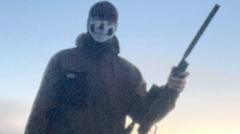
The bedroom door stayed shut for hours. To any parent in the mid-2020s, that silence is a familiar, if slightly unsettling, background noise. It is the sound of a teenager supposedly doing homework, or perhaps losing themselves in the frantic, neon-lit world of a first-person shooter. But for one family in a quiet corner of the UK, that silence was rotting. Behind that door, a seventeen-year-old boy wasn't just playing games. He was being reconstructed, piece by piece, into a foot soldier for a ghost.
The headlines called him a criminal. They used words like "banned organization" and "terrorist intent." But if you looked at the police photos of his room, you didn’t see a hardened insurgent. You saw the remnants of a childhood—unmade beds, scattered electronics, and the blue light of a monitor that had become his only window to a world he felt had abandoned him. In other updates, we also covered: The Sabotage of the Sultans.
This isn't just a story about a court case. It is a biopsy of a modern plague.
The Architecture of the Descent
Nobody wakes up and decides to join a neo-Nazi cell. It doesn't work like that. Radicalization is a slow-motion car crash. It starts with a flicker of loneliness. Maybe a breakup, or a bad grade, or the crushing realization that the economy feels like a rigged game where the house always wins. Then comes the algorithm. BBC News has also covered this important subject in extensive detail.
The boy—whose name is protected by law but whose story is universal—didn't go looking for hate. He went looking for a community. He found a forum. He found a Discord server. He found people who told him that his failures weren't his fault. They told him he was part of something bigger, something ancient and powerful. They gave him a mask to wear so he didn't have to look at his own face in the mirror.
The group was National Action. It had been banned years prior, designated as a terrorist organization by the government. To the boy, that ban wasn't a warning; it was a badge of authenticity. It made the group feel dangerous, clandestine, and real. In a world of filtered Instagram posts and empty corporate slogans, the raw, ugly edges of extremism felt like the only "truth" left.
The Language of the Void
The recruitment didn't happen with leaflets on a street corner. It happened through memes. This is the part that older generations struggle to grasp. The most toxic ideologies of our time are currently being delivered via irony.
"It was just a joke," is the universal shield. If you call out the racism, you're told you don't get the humor. If you point out the violence, you're told it's just "edgy" aesthetic. But eventually, the irony thins out. The jokes stop being jokes. The boy began downloading manuals. Not for chemistry or coding, but for the assembly of weapons. He started printing manifestos. The digital ghost was beginning to take on a physical weight.
The police found 15,000 images on his devices. Imagine that number for a second. If you looked at one image every ten seconds without sleeping, it would take you nearly two days to see what he had seen. Thousands of hours of gore, propaganda, and vitriol. That much hate changes the wiring of a brain. It desensitizes the heart until the idea of a "race war" feels as casual as a weather report.
The Invisible Stakes
When the sentencing judge looked down from the bench, he saw a boy who had barely begun his life. He saw someone who had traded his entire future for the approval of strangers on a dark-web forum. The boy was sentenced to three and a half years in a young offender institution.
Some will say the sentence was too light. Others will say it was too harsh for a "kid who just got lost online." But the real tragedy isn't the length of the jail time. It’s the vacuum that existed in his life long before the police knocked on his door.
We are living through a crisis of belonging. When we stop providing young people with a sense of purpose, a sense of identity, and a clear path toward a meaningful life, the monsters will step in to fill the gap. They are very good at it. They are patient. They have 24-7 access to our children's pockets.
Consider the mechanics of the arrest. It wasn't a dramatic shootout. It was a knock. A search. A sobbing mother in the hallway who had no idea that while she was making dinner, her son was plotting the end of the world as she knew it. The betrayal felt by the family is a silent, searing pain that no court transcript can truly capture.
The Ghost in the Machine
The banned group he joined thrived on the idea of "accelerationism." They believe that modern society is so corrupt that it must be pushed into a total collapse so that a new, ethno-centric order can rise from the ashes. It is a nihilistic fantasy.
But for a teenager with no job prospects and a dwindling social circle, the idea of "starting over" is intoxicating. The group didn't just give him hate; they gave him a script. They told him he was a protagonist. For the first time in his life, he felt like he mattered.
This is the hidden cost of our digital age. We have built a world where it is easier to talk to a neo-Nazi in another country than it is to talk to the neighbor across the street. We have outsourced our mentorship to algorithms that prioritize engagement over humanity. And hate is the most engaging emotion we have.
The Long Walk Back
Now, the boy sits in a cell. The monitor is gone. The memes are gone. The "brothers" he thought he had are nowhere to be found—most of them were likely undercover agents or other lonely teenagers halfway across the globe. He is left with the cold reality of stone walls and the weight of a criminal record that will follow him until the day he dies.
The court heard that he is now "remorseful." Perhaps he is. Or perhaps he is just terrified. It is hard to tell where the indoctrination ends and the person begins once the poison has been flowing for so long.
We often treat these cases as anomalies. We see a headline about a "terror teen" and we turn the page, glad it wasn't our kid. But the conditions that created him haven't changed. The forums are still active. The manifestos are still a click away. The loneliness is still there, humming in the background of a million bedrooms.
As the van pulled away from the courthouse, the boy looked out the window at a world he had been taught to despise. It was a world of ordinary people walking to work, buying coffee, and living lives of quiet, unglamorous complexity. It was the world he had tried to burn down. And now, it was a world he was no longer allowed to be a part of.
The silence in his bedroom is now permanent. The posters are torn down. The computer is in an evidence locker. But the question remains: who is entering that digital rabbit hole tonight, and who will be there to catch them before they hit the bottom?
The tragedy of the "terror teen" isn't just that he was caught. It's that he was ever looking for a home in the dark to begin with.
One day, he will walk out of those prison gates. He will be twenty-one years old. He will have to learn how to be a human being again in a world that remembers everything and forgives very little. He will have to find a way to live with the ghost of the person he almost became.
The door is locked, but the light under it never really goes out.