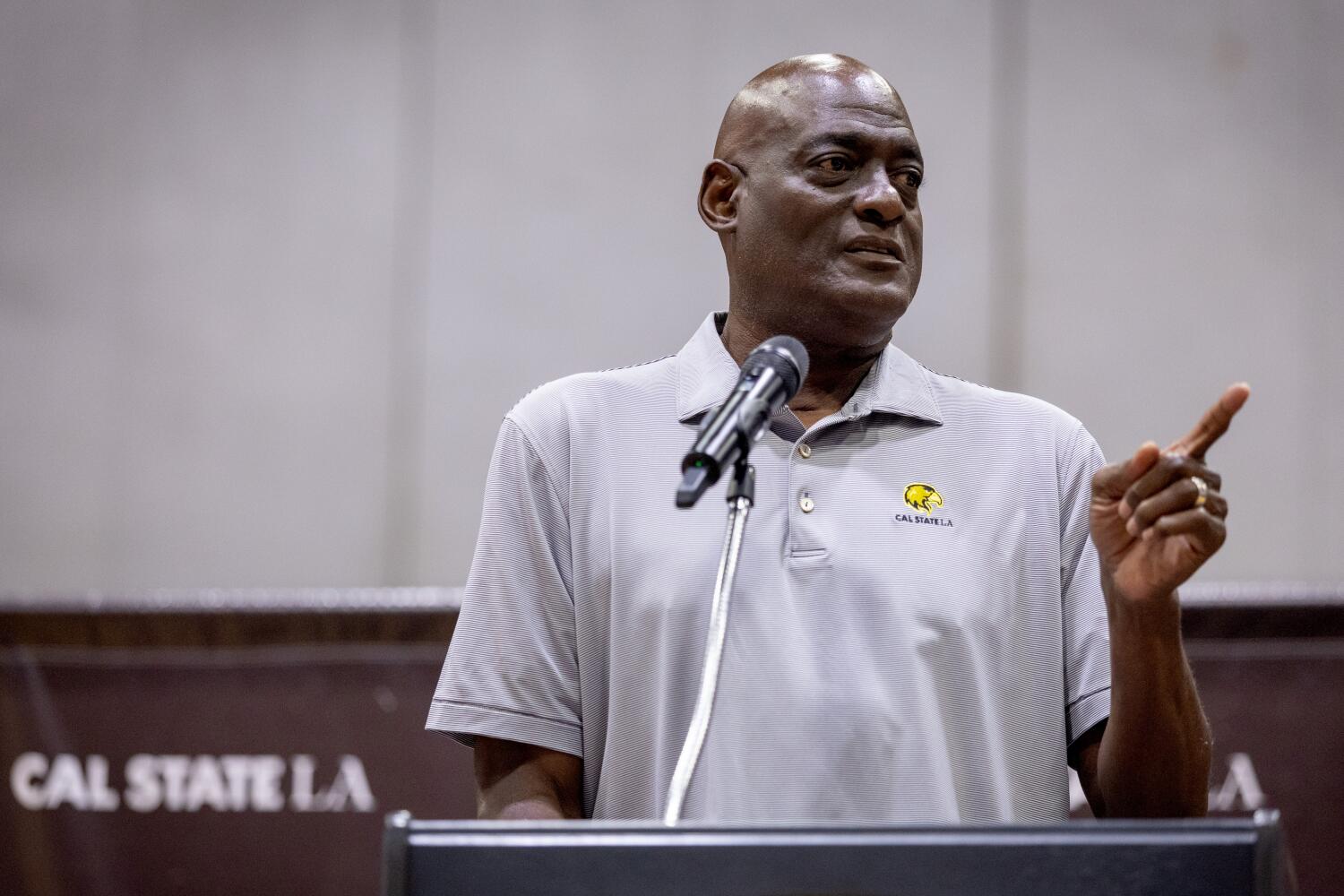
The air inside the gym at Cal State L.A. carries a specific, heavy scent. It is the smell of floor wax, old sweat, and the claustrophobic weight of untapped potential. In the middle of it stands a man who once shared a court with Magic Johnson and Kareem Abdul-Jabbar, a man who knows exactly what it feels like to have the golden lights of the Great Western Forum blinding him after a championship win.
Michael Cooper is sixty-seven years old. His knees have survived decades of the most brutal defensive assignments in the history of the NBA. He spent his career shadowing Larry Bird, haunting the perimeter like a ghost that refused to be exorcised. Now, he is the head coach of the Golden Eagles.
To the casual observer, this looks like a step down. To the cynical, it looks like a legend looking for a paycheck in the twilight of his career. But look closer at the way Cooper paces the sideline. Notice the way his eyes narrow when a young player misses a rotation. This isn't a retirement tour. It’s an act of defiance.
The Long Shadow of the Forum
Basketball at the highest level is a game of ghosts. You carry the memory of every missed shot, every blown defensive assignment, and every roar of the crowd. For Michael Cooper, the ghosts wear purple and gold. He was the "Coop," the lanky, five-time NBA champion who defined the "Showtime" era not through flashy dunks—though he had his share—but through a relentless, suffocating brand of defense that made superstars wish they were anywhere else.
When the news broke that he was taking the reins at a Division II program in East Los Angeles, the basketball world blinked. Why here? Why now?
The answer lies in the invisible stakes of the game. At the professional level, the stakes are financial and legacy-driven. In the concrete corridors of Cal State L.A., the stakes are existential. For many of the young men on this roster, basketball is the only lever they have to move the world. They aren't playing for shoe deals or global branding. They are playing for a degree, for a sense of belonging, and for the slim, shimmering hope that someone, somewhere, is watching.
Cooper knows this. He grew up in Pasadena. He knows the geography of these streets and the specific kind of hunger that comes from being overlooked. He isn't just teaching them how to play a 2-3 zone. He is teaching them how to survive.
The Art of the Stopper
Consider a hypothetical player. Let’s call him Marcus. Marcus is six-foot-four, possesses a vertical leap that defies gravity, and has spent his entire life being told he is the "next big thing." But Marcus doesn't know how to move his feet on defense. He doesn't understand that a championship isn't won in the highlight reel; it’s won in the grit of the fourth quarter when your lungs are screaming and the opponent’s best player is trying to drive past you.
This is where the legend of Michael Cooper becomes a curriculum.
Cooper was never the primary scoring option. He didn't need to be. He understood a fundamental truth about the sport that most young players ignore: you can control your effort even when you can't control your shot. He is bringing that philosophy to a program that has spent years searching for an identity.
The Golden Eagles have been a team in the middle of the pack, a squad that exists in the periphery of the massive Los Angeles sports market. Bringing in a name like Cooper changes the gravity of the room. It demands a higher level of scrutiny. It forces the players to look in the mirror and ask if they are truly as good as they think they are.
The transition from the glitz of the NBA and the WNBA—where Cooper coached the Los Angeles Sparks to two titles—to the modest facilities of a CCAA school is jarring. There are no private jets here. There are no catered meals or five-star hotels. There is only the work.
The Geography of Hope
Cal State L.A. sits on a hilltop overlooking the 10 and 710 freeways. It is a commuter school, a place of transition. The students here are often the first in their families to attend college. They are grinding through night shifts and long bus rides.
When Cooper walked into his introductory press conference, he didn't talk about his rings. He didn't bring up his Defensive Player of the Year award. He talked about the community. He talked about "the Hill."
There is a specific kind of pressure that comes with being a legend in a small room. You can't hide. Every word you say carries the weight of those five NBA championships. If Cooper tells a nineteen-year-old kid to stay low in his stance, that kid doesn't just hear a coach; he hears the voice of a man who stopped the greatest players in the history of the world.
But the real magic isn't in the technical advice. It’s in the presence.
Imagine the first practice. The sun is setting over the San Gabriel Mountains, casting long, orange shadows across the court. Cooper is standing at mid-court, his frame still lean, his voice carrying that familiar rasp. He isn't yelling. He doesn't have to. The silence in the gym is absolute.
"You think this is about basketball," he might say, though he’s really talking about life. "It’s not. It’s about whether or not you’re willing to do the things that nobody else wants to do."
The Invisible Stakes
Why does a man who has reached the pinnacle of his profession return to the grassroots?
Critics might suggest it's a lack of other options. They might point to his recent years coaching at the high school level or his time in the BIG3 league. But that perspective misses the soul of the man. Michael Cooper is a teacher. Some people are built to perform, and some are built to pass the torch.
In the high-stakes world of NCAA Division I, the pressure to win is often toxic. It turns coaches into CEOs and players into assets. But in Division II, there is a rawness to the game. It is basketball in its most honest form.
Cooper’s arrival at Cal State L.A. isn't a demotion. It is a homecoming. He is returning to the roots of the Southern California basketball scene that birthed him. He is looking for the next kid who has been told he’s too skinny, or too slow, or too defensive-minded to make it.
He is looking for himself.
The challenge is immense. The Golden Eagles play in a tough conference against teams that don't care about Cooper’s pedigree. They want to beat the Lakers legend. They want to be the ones who say they outcoached a Hall of Famer. Every game will be a target on his back. Every loss will be a headline.
But Cooper has spent his life being the target. He spent his life being the one who had to stop the momentum of a superstar. He knows how to handle the heat.
The Long Game
Success at this level isn't measured solely by the win-loss column. It’s measured by the graduation rate. It’s measured by the number of young men who leave the program with a sense of purpose they didn't have when they arrived.
Cooper understands that his biggest contribution to Cal State L.A. won't be a trophy in a glass case. it will be the culture he leaves behind. It will be the "Coop" DNA—a mixture of relentless work ethic, tactical brilliance, and a refusal to back down from a challenge.
The first home game will be a spectacle. The stands will be packed with people who haven't thought about Cal State L.A. basketball in years. They will come to see the man in the sharp suit on the sideline. They will come to catch a glimpse of the Showtime magic.
But as the game goes on, and the initial novelty wears off, they will see something else. They will see a group of young men playing with a desperate, disciplined intensity. They will see a team that refuses to let the ball go uncontested. They will see the reflection of a coach who never learned how to take a play off.
The gym at Cal State L.A. is small. The lights aren't as bright as they were at the Forum. The jerseys aren't made of the same expensive fabric.
But when the whistle blows and the ball is tossed into the air, none of that matters. The hardwood is the same. The rim is still ten feet high. And Michael Cooper is exactly where he is supposed to be.
He stands on the sideline, his hands on his hips, watching a freshman guard dive for a loose ball. The kid comes up with the rock, bruised and gasping for air, and for a split second, his eyes meet Cooper’s. There is no applause from a crowd of eighteen thousand. There is only a sharp, knowing nod from the man who has seen it all.
The work continues.
The ghost of Showtime isn't haunting this gym. It’s being put to work, one defensive slide at a time, in the shadow of the freeway, where the real game begins.