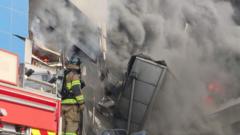
The sky over Hwaseong didn't just turn gray; it turned a bruised, oily purple. It started at the vents of a car parts manufacturing plant, a facility that most people in South Korea drive past without a second thought. We don't think about the radiator fans, the brake assemblies, or the plastic moldings that keep our lives moving at sixty miles per hour. We only think about them when they stop. Or when they burn.
On this particular Tuesday, the air tasted like scorched rubber and chemical bitterness.
Witnesses blocks away described a sound like a low, rhythmic thrumming that suddenly snapped into a roar. Then came the smoke. It wasn't the airy, white mist of a wood fire. This was heavy. Oppressive. It was the physical manifestation of thousand-degree plastics and industrial solvents vaporizing into the atmosphere. For the workers inside, that smoke wasn't just a visual signal of danger; it was a wall.
The Human Geometry of an Industrial Floor
Think of a factory floor as a living organism. It has a pulse—the steady clack-whir of CNC machines and assembly lines. It has a nervous system of electrical conduits. But when a fire breaks out in a facility packed with automotive components, the geometry of that organism changes instantly. Paths that were clear yesterday become death traps.
Consider a worker we will call Min-jun. He represents the hundreds who found themselves squinting through the stinging haze. In a standard safety briefing, you are told to find the illuminated exit signs. But in a high-intensity industrial fire, the soot is so thick it swallows light. You can’t see your own hand three inches from your face. You navigate by touch, feeling the heat radiate off the corrugated metal walls, hoping the door handle isn't already fused shut by the rising temperature.
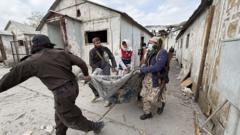
The tragedy of the Hwaseong fire isn't found in the charred ruins of the building itself. It is found in the silence of the people who didn't make it out. Early reports confirmed fatalities—lives extinguished in the time it takes to process a "system failure" alarm. These weren't just "units of labor." They were parents who had packed lunches that morning, neighbors who were planning for the Chuseok holiday, and individuals who understood the mechanical soul of the cars we drive every day.
Why Plastic Burns Differently
The sheer intensity of a car parts plant fire is a terrifying engineering reality. We aren't dealing with paper or wood. Modern vehicles are marvels of polymers and synthetic composites. When these materials reach their flashpoint, they don't just burn; they liquefy.
Imagine a river of molten plastic flowing across a concrete floor.
This creates a feedback loop of heat that standard sprinkler systems often struggle to contain. While water can douse a trash can fire, it sometimes does little more than create boiling steam when faced with a chemical blaze of this magnitude. The firefighters on the scene weren't just fighting flames; they were fighting a chemistry experiment gone wrong. They stood against a wall of heat that could melt the visors on their helmets, pumping thousands of gallons of water into a black maw that seemed to breathe out more toxicity with every second.
The smoke was visible from miles away, a towering pillar that looked like a scar on the horizon. To the onlookers with their smartphones, it was a spectacle. To the families waiting at the police perimeter, it was a countdown.
The Invisible Stakes of the Supply Chain
We live in a world of "Just-in-Time" manufacturing. This philosophy suggests that having excess inventory is a waste of money. Everything should arrive exactly when it is needed. It is a beautiful, efficient system until a link in the chain snaps.
When a major South Korean parts plant goes dark, the ripples are felt in showrooms in Los Angeles, repair shops in London, and assembly lines in Germany. We are more connected to the soot over Hwaseong than we realize. This isn't just a local disaster; it is a fracture in the global mechanical ego. We assume the parts will always be there. We assume the machine will always run.
But the real cost isn't measured in delayed shipping or quarterly earnings reports. The real cost is the psychological weight of industrial vulnerability. We have built a world that is incredibly fast but incredibly fragile. When a fire like this happens, it exposes the thin margin of error we live within. One faulty wire, one overheated bearing, one lapse in a safety protocol, and the entire narrative of "efficiency" goes up in smoke.
The Weight of the Aftermath
Standing in the shadow of a burned-out industrial complex is a humbling experience. The silence is heavy. The smell of the fire lingers in the clothes of the survivors for weeks, a persistent reminder of the day the world turned black.
Investigators will spend months picking through the debris. They will look for the "why." They will cite electrical shorts or improper storage of flammable liquids. They will produce a report that is hundreds of pages long, filled with technical jargon and recommendations for "enhanced safety mitigation."
But the report won't capture the feeling of the floor shaking. It won't capture the sound of the sirens cutting through the suburban quiet of Hwaseong. It won't explain the look on a survivor's face when they realize their teammate, the one they shared coffee with at 7:00 AM, isn't standing at the muster point.
We often treat news like this as a fleeting data point. We see the headline, we see the video of the billowing smoke, and we move on to the next notification. We forget that every "deadly fire" leaves a permanent hole in a community. The factory can be rebuilt. The steel beams can be replaced. The machines can be reordered from a catalog.
The people cannot.
As the sun sets over the charred remains of the plant, the smoke finally begins to dissipate, leaving behind a skeletal frame of twisted metal. The bruised purple sky fades into a hollow, dark blue. The world continues to turn, and the cars continue to roll off assembly lines elsewhere, but for a few families in South Korea, the machine has stopped forever.
The gears of our modern lives are greased with the sweat of people we will never meet, and sometimes, those gears demand a price that no insurance policy can ever truly cover.