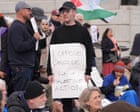
The air outside the Elbit Systems factory in Bristol doesn't smell like progress. It smells of wet asphalt, exhaust, and the sharp, metallic tang of industrial resolve. On a Tuesday that should have been unremarkable, the silence of the business park was shattered not by a bomb, but by the collective breathing of hundreds of people who decided that standing still was no longer an option. Among them was Robert Del Naja.
You might know him as 3D. You might know his music as the brooding, atmospheric heartbeat of Massive Attack, a sound that defined an era of trip-hop and urban anxiety. But as the zip-ties tightened around his wrists, he wasn't a rock star. He was a statistic. One of five hundred.
The Sound of Breaking Silence
For decades, Del Naja has operated in the shadows of the spotlight. His art has always been a weapon—stenciled graffiti on crumbling walls, basslines that felt like warnings, and visual shows that bombarded audiences with data points about drone strikes and government surveillance. But there is a limit to what a screen can convey. Eventually, the data points require skin in the game.
The protest wasn't a sudden whim. It was the culmination of a slow-boiling pressure. Palestine Action, the group behind the blockade, had been targeting Elbit Systems—an Israeli-owned defense contractor—for years. They claim the technology birthed in these nondescript British warehouses is used to facilitate the surveillance and bombardment of civilians in Gaza. For the activists, these buildings aren't just workplaces; they are the gears of a machine they can no longer tolerate.
Imagine a man who has spent his life meticulousy crafting soundscapes of dissent finally deciding that the loudest thing he can do is say nothing at all while being led into a police van. The irony is thick. The artist, known for his anonymity and his rumored connection to the elusive Banksy, was forced into the most public, most documented position possible: the back of a squad car.
The Invisible Stakeholders
Consider a hypothetical worker at that factory. Let's call him David. David wakes up, kisses his kids, and drives to work to calibrate high-end optical sensors. He sees himself as an engineer, a provider, a man of science. To him, the five hundred people blocking the gates are a nuisance, a disruption to his mortgage payments and his morning coffee.
Then consider Sarah, a woman three thousand miles away, who recognizes the hum of a drone before she sees it. To her, the sensors David calibrates aren't "technology." They are the eyes of an invisible predator.
The distance between David’s workbench and Sarah’s ceiling is bridged by the five hundred people sitting on the cold Bristol pavement. This isn't just a news story about an arrest; it's a story about the collapse of distance. Robert Del Naja and his fellow protesters are attempting to pull those two worlds together until they touch, forcing a friction that the state eventually decides to resolve with handcuffs.
The Weight of Five Hundred
Five hundred is a sterile number when written in a headline. It's a small village. It's a packed concert hall. When five hundred people are arrested in a single action, it ceases to be a legal procedure and becomes a logistical crisis. The police stations around the region groaned under the weight. Cells were filled. Corridors became waiting rooms for the defiant.
The sheer scale of the mass arrest points to a shift in the temperature of British activism. This wasn't a "fringe" element. It was a cross-section of society. Teachers, students, retirees, and world-famous musicians sat shoulder-to-shoulder. When the law encounters five hundred people willing to lose their liberty for a cause, the law starts to look less like a shield and more like a dam holding back a flood.
Del Naja’s presence adds a layer of cultural gravity, but the real story is the anonymity of the other 499. They don't have Wikipedia pages. They don't have platinum records to retreat to when the bail is paid. They chose to become "arrestable," a term used in activist circles to describe the moment you decide your physical freedom is less valuable than your message.
The Architecture of Dissent
British law has been tightening its grip on protest for years. New legislation has turned "annoyance" into a potential felony. The threshold for what constitutes a legal gathering has been lowered until it’s practically a tripwire.
In this environment, the act of protest becomes a piece of performance art in itself. By showing up, Del Naja and the others were baiting the system to show its teeth. They wanted the arrests. They wanted the optics of a massive police presence protecting a weapons factory while the public watches from their phones.
The "Palestine Action" movement operates on the principle of direct action. They aren't interested in petitions or polite marches through London’s parks. They want to stop the gears from turning. If you break a window, you can be ignored as a vandal. If you bring five hundred people to stay until the police are forced to carry you away, you become a narrative.
Beyond the Headline
Why does a man who has achieved everything—fame, fortune, a legacy that will outlive him—risk a criminal record at this stage of his life?
It's tempting to dismiss it as "celebrity virtue signaling." But that’s a lazy critique. Virtue signaling is a tweet; sitting in a police cell for twenty hours is a commitment. For Del Naja, the "invisible stakes" are the loss of our collective humanity through the sanitization of warfare. We live in a world where death is delivered via a fiber-optic cable, managed by someone in a climate-controlled office.
By physically obstructing the factory, the protesters are trying to re-introduce the "human element" into a process that has been designed to be as bloodless and bureaucratic as possible for the people on the manufacturing end. They are making the war tangible in Bristol so it can perhaps be less tangible in Gaza.
The police cleared the gates eventually. The vans drove away. The factory lights flickered back to full strength, and the sensors continued to be calibrated. But something shifted in the dirt.
The image that remains isn't the red paint on the walls or the banners held high. It’s the sight of an artist who spent thirty years singing about the "Protection" of the soul, finally standing in the one place where protection was guaranteed to be stripped away.
He didn't need to say a word. The silence of five hundred people being carried off into the night spoke more clearly than any lyric he ever wrote. The machine still hums, but for one day, the ghosts in the machine were given names, faces, and fingerprints.
The paint will be power-washed off the brickwork by morning. The zip-ties will be tossed into the bin. But you cannot un-ring a bell of that magnitude. When five hundred people decide that the walls of a cell are more comfortable than the comfort of their own silence, the foundation of the status quo begins to crack, just a little, right where everyone can see it.
The city of Bristol breathed out. The vans turned the corner. The rain kept falling, washing the street clean for the next shift to arrive, but the air stayed heavy with the scent of a choice that had finally been made.