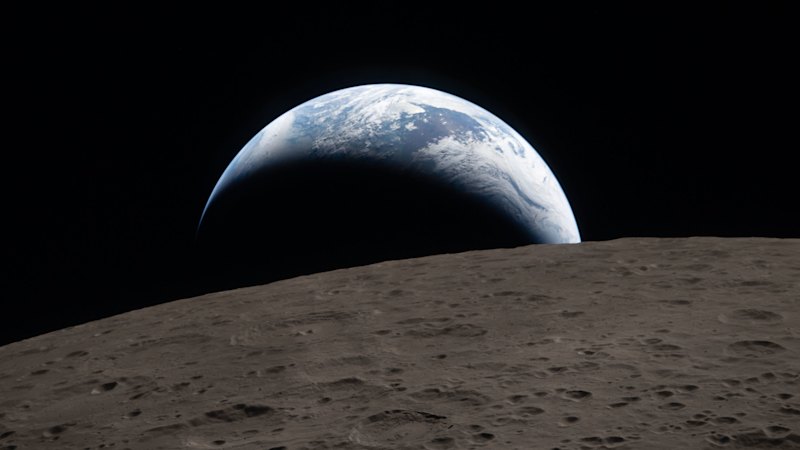
The "Overview Effect" is the most expensive psychological delusion in human history.
For decades, we have been sold a specific brand of orbital sedative: the idea that if only our world leaders could float 400 kilometers above the surface, they would see a world without borders, realize our petty squabbles are meaningless, and usher in an era of planetary peace. It is a poetic sentiment. It is also provably false.
As Artemis II prepares to sling humans around the Moon, the "borderless Earth" narrative is being polished for a new generation of dreamers. The competitor rags are already churning out the same tired prose about how "from space, you can’t see the lines on a map."
Stop.
Looking at a map without lines doesn't make the lines disappear; it just makes you blind to the reality of the people living within them. The Artemis II mission isn't a testament to global unity. It is the opening salvo in a new era of high-stakes, nationalist competition. If you want to understand the future of the species, stop looking for what's missing from the view and start looking at who is paying for the ticket.
The Cognitive Trap of Low Earth Orbit
The premise of the "borderless world" relies on a fundamental misunderstanding of human geography. Astronomers and astronauts often claim that because political boundaries aren't etched into the crust of the Earth in neon ink, they are "artificial."
This is an intellectual lazy-river.
Language is artificial. Currency is artificial. The rule of law is artificial. These "artificial" constructs are exactly what allow eight billion primates to coexist without constant tribal warfare. When an astronaut looks down and sees "no borders," they aren't seeing the truth. They are seeing a lack of data.
Imagine a scenario where a CEO looks at a factory floor from a mezzanine and says, "I don't see any departmental budgets or HR policies from up here, so they must not matter." That CEO would be bankrupt in a month. Borders are the containers of culture, policy, and safety. To suggest they are irrelevant because they don't show up on a spectrograph is a Hallmark-card level of analysis.
Artemis is a Nationalistic Weapon
Let’s talk about the hardware. NASA’s Space Launch System (SLS) and the Orion capsule aren't "vessels for humanity." They are American exports.
The Artemis program is a strategic maneuver designed to establish a "rules-based order" on the lunar surface before the China National Space Administration (CNSA) can set its own. This is not a collective hike into the woods; it is a land grab.
- The Artemis Accords: While framed as a cooperative framework, the Accords are a unilateral US interpretation of the 1967 Outer Space Treaty.
- The Logistics: Every bolt, sensor, and heat shield tile on Artemis II represents a domestic supply chain intended to maintain American industrial dominance.
- The Geopolitics: Notice who isn't invited? The exclusion of China from the International Space Station—and by extension, the primary Artemis workflow—proves that borders have never been more visible.
I’ve spent years analyzing aerospace procurement cycles. I’ve seen the "global cooperation" mask slip the moment a contract is actually on the table. When the stakes are high, the "one world" rhetoric is the first thing to be jettisoned to save weight.
The Brutal Reality of Resource Scarcity
The "borderless" crowd loves to talk about the fragility of our "blue marble." They argue that seeing Earth from deep space will force us to protect our resources.
Wrong again.
The reality is that Artemis II is the scouting mission for the ultimate resource extraction play. The Moon’s South Pole contains water ice—fuel for the next leg of expansion. Helium-3 and rare earth metals are the prizes. If Earth were truly borderless, we wouldn't see a race to claim "safety zones" around lunar landing sites.
We aren't going to the Moon to realize how small we are. We are going there to decide who owns the "smallness."
Why the Overview Effect Fails
The Overview Effect—that supposed cognitive shift in awareness—is a luxury of the elite. It is easy to feel a sense of global kinship when you are breathing $5,000-per-hour recycled air and your every caloric need is managed by a ground crew of thousands.
For the person living in a border-disputed region in the Sudans or the Donbas, the "invisible lines" are the most tangible things in their lives. They define whether you get water, whether you can trade, and whether you live through the night. Telling those people that "borders aren't visible from the Moon" isn't profound. It's an insult. It's the ultimate form of "space-splaining."
The Danger of Ignoring the Lines
By pretending borders don't exist, we ignore the very real friction required to fix planetary problems.
Take climate change. The "borderless Earth" advocates say, "The atmosphere has no borders!" True. But the solutions do. Carbon taxes, manufacturing regulations, and energy transitions are enacted by sovereign states. When we indulge in the fantasy that we are one big, borderless family, we stop doing the hard work of diplomatic negotiation between distinct, often clashing, national interests.
We don't need astronauts to tell us the world is one ecosystem. We've known that since the first atmospheric models. We need leaders who understand that the world is a collection of 195+ different operating systems that need to be networked, not ignored.
The Artemis II Reality Check
When the crew of Artemis II—Reid Wiseman, Victor Glover, Christina Koch, and Jeremy Hansen—look back at the Earth from 10,000 kilometers away, they will see a beautiful, glowing sphere. They will likely give the standard interviews about how fragile it looks.
But look at their flight suits.
The flags are there. The patches of the sponsoring agencies are there. The mission is controlled from Houston. The recovery will be handled by the US Navy.
If the Earth were truly borderless, we wouldn't need a Canadian on the flight to satisfy a diplomatic trade agreement for the Canadarm3. We wouldn't have "International Partners" who are only partners as long as they follow the lead agency's manifest.
Stop Asking the Wrong Question
The media keeps asking: "How will Artemis II change our perspective of Earth?"
That is the wrong question. It assumes we need a new perspective to solve our problems. We don't. We have plenty of perspectives. What we lack is the courage to deal with the world as it actually exists—divided, competitive, and fiercely protective of territory.
The right question is: "How will the Artemis missions codify the new borders of the solar system?"
Because make no mistake, the lines are being drawn right now. They are being drawn in the clean rooms of Florida and the testing bays of Starbase. They are being drawn in the fine print of the Artemis Accords.
The Unconventional Advice for the 21st Century
Stop waiting for a "shift in consciousness" to save the planet. Space exploration will not make us kinder or more unified. It will only make us more of what we already are.
If you want to protect the "blue marble," don't look to the Moon. Look at the tax codes, the trade agreements, and the border policies that actually govern human behavior. The "Overview Effect" is a vacation from reality. Real progress happens on the ground, within the lines, in the messy, violent, beautiful friction of sovereign states trying to not kill each other.
The Earth has borders. They are visible in every war, every trade deal, and every rocket launch. Artemis II isn't the end of those borders; it’s their expansion into the vacuum.
Accept the lines. Only then can you start to bridge them.