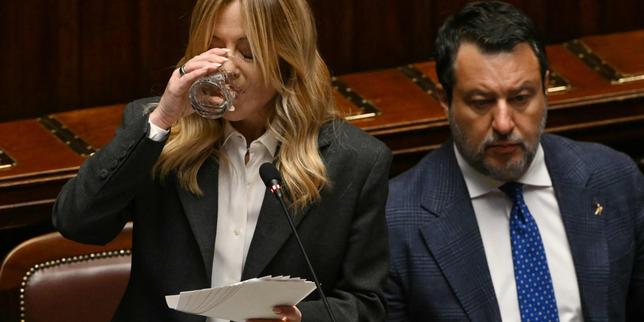
Giorgia Meloni’s assertion that she will remain in power "until the last day" of her mandate in 2027—following a significant setback in a regional or constitutional referendum—is not a statement of stubbornness but an execution of a structural defensive strategy. When a populist leader loses the momentum of "the people’s will," the governing logic must shift from charismatic authority to institutional entrenchment. This transition involves three specific vectors: the stabilization of the parliamentary majority through patronage, the re-alignment of foreign policy as a hedge against domestic weakness, and the calculated use of the 2027 deadline as a tool to paralyze internal rivals.
The Mathematics of Majority Cohesion
The primary constraint on any Italian Prime Minister is the fragility of a multi-party coalition. In Meloni’s case, the Fratelli d’Italia (FdI) must balance the interests of the Lega and Forza Italia. A referendum defeat usually acts as a "de-cohesion event," where junior partners calculate that the cost of staying in the coalition exceeds the benefits of early elections.
To govern until 2027, Meloni must recalibrate the Coalition Utility Function. This is achieved by:
- Portfolio Reallocation: Shift control over high-spending ministries or critical legislative agendas toward disgruntled partners. If the Lega loses ground in the north, Meloni must provide them with "legislative wins" on autonomy or infrastructure to prevent them from triggering a government collapse.
- The Deadlock Premium: By committing to 2027, Meloni increases the "sunk cost" for her partners. If a partner leaves now, they forfeit three years of influence for an uncertain electoral outcome.
- Threshold Management: The current electoral law disincentivizes small parties from running alone. Meloni utilizes this structural barrier to remind her allies that while she may be weakened, they are non-viable without her umbrella.
Institutional Insulation and the Quirinale Factor
A Prime Minister in a parliamentary system does not exist in a vacuum; they operate under the shadow of the President of the Republic (the Quirinale). Sergio Mattarella’s primary objective is institutional stability and the fulfillment of international obligations, particularly the National Recovery and Resilience Plan (PNRR).
Meloni’s strategy of "governing until the last day" aligns her interests with the President’s desire to avoid the volatility of a technocratic transition. By framing her stay in power as a matter of constitutional duty rather than political ambition, she gains a shield against parliamentary ambushes. This insulation is critical because it changes the narrative from "a leader who lost a vote" to "a leader who ensures the state continues to function."
The Geopolitical Hedge
When domestic legitimacy is challenged, successful leaders seek "external validation" to offset internal deficits. Meloni’s foreign policy is an exercise in Strategic Orthodoxy. By remaining the most pro-Atlanticist and pro-Ukraine voice in the Mediterranean, she makes herself indispensable to Washington and Brussels.
This creates a feedback loop:
- International markets (the BTP-Bund spread) remain stable because Meloni is perceived as a "known quantity" by the EU.
- Market stability prevents a fiscal crisis.
- The absence of a fiscal crisis denies the domestic opposition a "breaking point" to force her resignation.
The cost of this strategy is the dilution of her original populist brand. To maintain the 2027 timeline, she must trade ideological purity for market confidence. This is the Paradox of Populist Governance: to keep power, the populist must eventually govern like a centrist.
Resource Allocation under the PNRR
The 2027 deadline is not arbitrary; it coincides with the final disbursement and evaluation phases of the EU’s post-pandemic recovery funds. Italy is the largest beneficiary of this scheme, and the technical requirements for these funds act as a "legislative straitjacket."
Meloni’s administration has shifted from a policy-driven agenda to an execution-driven agenda. The focus is no longer on "reforming Italy" according to a right-wing vision, but on meeting the 100+ milestones required by the European Commission. This creates a bureaucratic momentum that is difficult for an opposition to stop. If the opposition brings down the government, they risk being blamed for the loss of billions in EU funding. Meloni is essentially "holding the funds hostage" to her own political survival.
The Opposition’s Coordination Failure
A critical component of Meloni’s 2027 roadmap is the fragmented state of the Italian Left. The "Campo Largo" (Broad Field) between the Partito Democratico (PD) and the Five Star Movement (M5S) lacks a unified economic theory.
Meloni’s "until the last day" pledge exploits this by:
- Time-Dilution: By extending the horizon to 2027, she allows internal friction within the opposition to fester.
- Policy Pre-emption: By adopting moderate fiscal stances, she leaves the opposition with no "center-ground" to occupy, forcing them into more radical—and less electable—positions.
The referendum defeat, while a blow to her prestige, did not provide the opposition with a clear alternative Prime Minister. Without a "Shadow PM," the opposition’s calls for resignation remain purely performative.
Strategic Risks and the Elasticity of Public Opinion
There is a limit to how long a leader can govern against the current of public sentiment. The Elasticity of Mandate refers to the gap between a leader's legal right to rule and their perceived right to rule.
Several variables could snap this elasticity before 2027:
- The Inflation Tax: If real wages continue to stagnate, the "stability" Meloni offers will be seen as "stagnation."
- Justice Reform Backlash: Her attempts to reform the judiciary are high-risk. If she loses the support of the legal establishment, she opens a front that she cannot win through parliamentary voting alone.
- The Lega’s Breaking Point: Matteo Salvini is a high-variance actor. If his party’s polling drops below a critical threshold (e.g., 5%), his rational move may be to "burn the house down" to radicalize his base, regardless of the 2027 pledge.
The Roadmap to 2027
To navigate the next three years, the administration must move from a defensive posture to an Incremental Gain Strategy. This involves abandoning "grand constitutional designs"—which are prone to referendum failures—and focusing on "micro-legislative shifts."
- Fiscal Consolidation: Prioritize the reduction of the deficit to keep the ECB’s "Transmission Protection Instrument" (TPI) active, ensuring low borrowing costs.
- Demographic Engineering: Introduce targeted tax breaks for families, a core FdI tenet that is difficult for the opposition to vote against without looking anti-family.
- Media Consolidation: Strengthen influence over state broadcaster RAI to control the narrative of the "inevitability" of her term.
The strategic play is to make the 2027 election a choice between "The Stability of Meloni" and "The Chaos of a Multi-Party Leftist Experiment." By refusing to quit after a referendum loss, she is betting that the Italian electorate’s fear of instability is greater than its desire for change. Her survival depends on her ability to transform from a "firebrand" into a "pillar of the status quo." The 2027 mandate is her fortress; every day she remains in office, the walls of that fortress are reinforced by the sheer weight of bureaucratic inertia.