The air over the Persian Gulf thickens until it feels like a damp wool blanket. High above the street-level humidity, at the silver-tipped apex of the Burj Khalifa, the atmosphere is doing something far more violent. It is building a grudge. Billions of tiny ice crystals and water droplets are rubbing together in the churning dark of a desert supercell, stripping electrons and separating the sky into a massive, invisible battery.
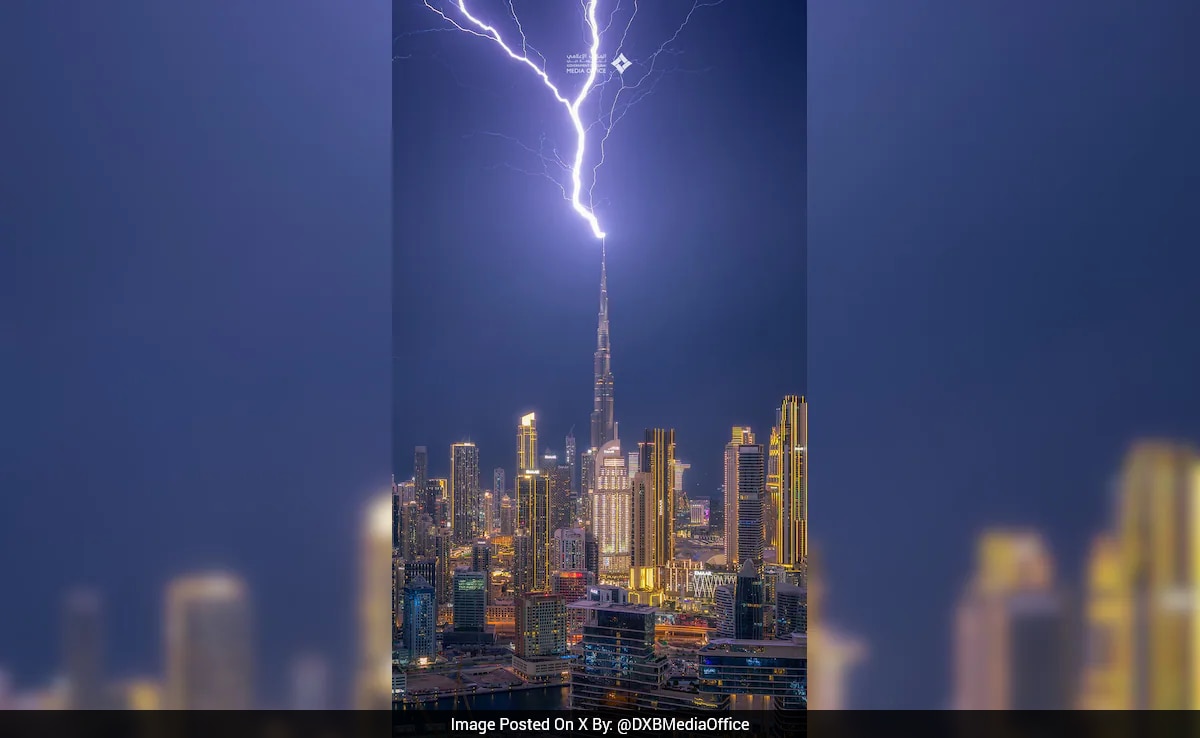
Down on the ground, a tourist named Elias is trying to capture the perfect slow-motion video. He’s standing near the base of the tower, his neck craned back at an impossible angle. He sees the clouds turn a bruised, sickly purple. Then, the sky snaps.
A jagged river of white-hot plasma, five times hotter than the surface of the sun, tears through the air. It doesn't just fall; it leaps. It seeks the path of least resistance, and the Burj Khalifa, standing 2,717 feet into the heavens, is the ultimate invitation. The thunder doesn't roll—it cracks like a whip the size of a mountain. Elias flinches, the light burning a temporary ghost into his retinas.
He expects the lights to flicker. He expects the screams of people trapped in elevators. He expects a smell of ozone and burning silicon. Instead, there is nothing but the fading rumble of the sky. The world’s tallest building just took a direct hit from a literal bolt of god-like energy, and it didn't even blink.
The Invisible Shield
To understand why the Burj Khalifa doesn't melt, you have to look past the glitz of the glass facade. You have to look at the "skin."
Every skyscraper is a target, but a building of this scale is a magnet. Because of its height, it actually triggers lightning. This isn't just a passive victim of a storm; the tower’s sharp point concentrates the electric field so intensely that it sends "streamers" of ionized air upward to meet the descending "leaders" from the clouds. They shake hands in the middle of the sky, and the circuit is complete.
The Burj Khalifa is wrapped in a sophisticated Faraday Cage. This isn't a physical cage you can see, but a concept of physics. Think of it like a suit of armor that never touches the skin. The building is clad in aluminum and stainless steel panels, all of which are interconnected. When that bolt hits the spire, the electricity doesn't want to dive into the center of the building where the servers, the luxury suites, and the thousands of people are located. It wants the outside.
Electricity is lazy. It takes the path of least resistance. The exterior of the tower is designed to be that path. The current screams down the building’s structural steel and its lightning protection system, bypassing the delicate human cargo inside.
A River of Fire in the Walls
Imagine a massive surge of water being poured into a tiny funnel. That is what the spire handles during a strike. A single bolt of lightning can carry 30,000 amperes—enough juice to power a small town for a brief, blinding moment. If that energy stayed in the spire, the metal would simply vaporize.
Instead, the engineering team designed a series of heavy-duty copper and structural steel conductors. These are the building's veins. They are hidden behind the walls, running from the very tip of the needle all the way down into the foundations.
But where does all that energy go? It can't just stop. If it stopped at the ground floor, it would explode the pavement and fry every person nearby. The solution is buried deep in the desert sand.
The Burj Khalifa sits on a massive "earthing" system. The conductors lead the lightning strike down into the pile foundations—hundreds of massive concrete and steel pillars driven deep into the earth. There, the energy is dissipated into the ground. The desert absorbs the violence of the sky and turns it into a harmless dissipation of heat.
The Human Cost of a Split Second
Now, consider the people inside. Inside the Atmosphere restaurant on the 122nd floor, a waiter is pouring a glass of expensive vintage. A few hundred feet above him, the sky is being torn apart. Does the wine spill? Does the waiter feel a tingle in his fingertips?
No.
The brilliance of modern engineering is that it renders the terrifying mundane. We have built a world where we can sit in a glass box half a mile in the air and watch a prehistoric force of nature try to destroy us, and our primary reaction is to reach for a smartphone.
However, this safety isn't accidental. It is the result of thousands of hours of simulation and a deep, healthy fear of the elements. Engineers had to account for the "Skin Effect." This is a phenomenon where high-frequency electricity, like lightning, tends to travel on the surface of a conductor rather than through its core. By ensuring the outer skin of the tower was perfectly bonded, they turned the entire building into a shield.
The Spire's Secret Life
The very tip of the Burj Khalifa isn't just a decorative needle. It's a high-tech lightning rod, often referred to as a "Finial." In most buildings, this is a simple rod. In the Burj, it's an instrument of precision. It is designed to be the sacrificial point.
During a storm, the sensors in the building are screaming. While Elias is on the ground filming, the building's management systems are monitoring the surge. They track the hits. They inspect the spire for "pitting"—small craters where the intense heat of the lightning has actually melted the metal.
Maintenance crews, the true unsung heroes of the Dubai skyline, eventually have to go up there. Imagine being the technician tasked with inspecting the spire. You are standing on a platform so high that the wind doesn't just blow; it screams. You are looking for the scars left by the sky. You see the tiny burns on the steel, the evidence of a battle that the building won while everyone inside was sleeping.
Why We Build This Way
We have an obsession with the sky. From the Tower of Babel to the skyscrapers of Manhattan and Dubai, we have always tried to touch the clouds. But the clouds don't like to be touched. They are chaotic, energetic, and unpredictable.
The Burj Khalifa is a testament to the idea that we don't have to conquer nature; we just have to understand its rules. We know lightning wants the ground. We know it loves metal. So, we give it what it wants. We provide it a VIP lane to the earth, a red carpet of copper and steel that lets it bypass our lives.
The tower stands there, year after year, through sandstorms and thunderstorms, acting as a giant lightning rod for the entire city. In a way, it protects more than just its occupants. By attracting the strikes to its reinforced frame, it likely prevents lightning from hitting smaller, less protected structures nearby.
Elias finishes his video. He watches the playback—the white flash, the majestic stillness of the tower, the roar of the thunder. He looks up at the Burj Khalifa, now glowing peacefully against the dark clouds. It looks delicate, like a needle made of glass and light.
He doesn't see the copper veins. He doesn't see the Faraday Cage. He doesn't see the energy being bled into the deep piles beneath the sand. He just sees a building that stood its ground against a bolt from the blue and didn't flinch.
The storm moves on towards the sea. The desert air begins to cool. High above, the spire remains cold and silent, waiting for the next time the sky decides to strike. It is ready. It has been built to be the lightning’s favorite target, so that we don't have to be.
The sky is a battery, the building is a wire, and the earth is a sink. In that simple equation, we find the margin between a catastrophe and a beautiful video on a tourist's phone.
Would you like me to generate an image of the Burj Khalifa's internal grounding system to show how that energy reaches the earth?