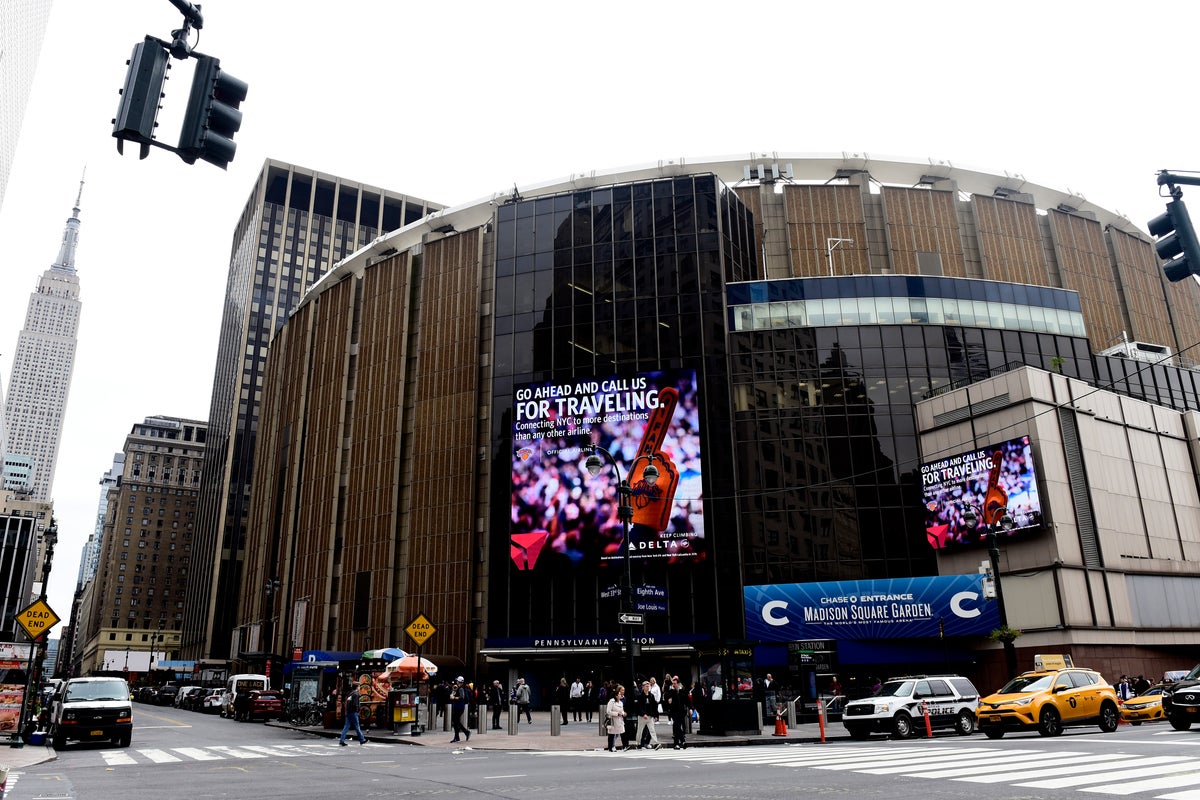
Donald Trump says he is "open" to moving Madison Square Garden to fix Penn Station. The media is salivating over the quote. City planners are dusting off decades-old blueprints. The public is once again being sold the fantasy of a sun-drenched, "world-class" transit hub that looks like a cathedral and functions like a Swiss watch.
It is a lie.
Moving Madison Square Garden (MSG) to accommodate a Penn Station renovation is the single most expensive distraction in the history of urban planning. It is a vanity project masquerading as infrastructure. Whether it’s Trump, the Governor, or a choir of urban theorists calling for the wrecking ball, the premise remains flawed. We are obsessing over the "lid" of the pot while the stove is melting the floor.
The "lazy consensus" suggests that Penn Station is a hellscape because the World’s Most Famous Arena sits on top of it. The logic follows that if we evict James Dolan and the Knicks, we can peel back the concrete, let in the light, and magically solve the transit woes of 600,000 daily commuters.
This ignores the brutal reality of subterranean engineering and the actual bottlenecks that make Penn Station a nightmare.
The Glass Ceiling Fallacy
The obsession with "natural light" in transit hubs is a modern pathology. Proponents of moving MSG argue that commuters need to see the sky to feel human. This is aesthetic cope.
The primary failure of Penn Station isn't a lack of Vitamin D; it’s a lack of throughput. The station is a victim of its own geography—constrained by the Hudson River tunnels to the west and the East River tunnels to the east. You could replace Madison Square Garden with a giant glass pyramid, and the trains would still be delayed because the tracks are a century-old bottleneck.
I have watched cities burn billions on "architectural statements" that do nothing for the passenger experience beyond the first five minutes of arrival. Look at the World Trade Center Oculus. It cost $4 billion. It is a stunning ribcage of white marble and light. It is also a glorified shopping mall that serves fewer passengers than a single major subway line.
If we move MSG, we are committing to a $7 billion to $10 billion spend just to change the ceiling height. That is capital that should be spent on the Gateway Program—actual tunnels—rather than playing Tetris with real estate.
The Impossible Economics of the "Move"
Let’s talk about the money, because the "Insider" reports always gloss over the math.
James Dolan doesn't just own the team; he owns the dirt. MSG is a private property. For the city or state to move it, they have to:
- Buy out the most valuable arena in the world.
- Build a new arena for the owner (estimated at $3 billion minimum).
- Pay for the demolition of the current site.
- Pay for the structural reconstruction of the station underneath.
The numbers don't add up. We are talking about a project that would likely eclipse the $11 billion spent on Grand Central Madison—a project that was finished years late and serves a fraction of the projected ridership.
When Trump says he’s "open" to it, he’s talking like a developer who loves a grand gesture. But developers aren't the ones paying the tax bill. The "nuance" the media misses is that any deal to move MSG would require a massive public subsidy to a billionaire sports owner. It’s a wealth transfer disguised as a civic improvement.
The Capacity Myth
People ask: "Won't clearing the Garden allow for more tracks?"
No. It won't.
The track level at Penn Station is fixed. It is encased in Manhattan schist and surrounded by the foundations of the surrounding skyscrapers. You cannot simply "add tracks" by removing the building above. The support pillars for MSG are woven into the station platform. Removing them requires a surgical engineering feat that would shut down the busiest transit hub in North America for years.
Imagine a scenario where the LIRR, NJ Transit, and Amtrak are all disrupted simultaneously for a decade so we can have a prettier waiting room. That isn't progress; it’s a regional heart attack.
The real issue is the "stub-end" vs. "through-running" debate.
Currently, Penn Station operates largely as a terminal. Trains come in, empty out, and then sit there or head to a yard. True "through-running"—where trains from New Jersey continue on to Long Island and vice versa—would increase capacity by 40% without moving a single brick of Madison Square Garden.
But through-running is boring. It involves boring meetings between warring transit agencies (Amtrak vs. MTA vs. NJ Transit). It doesn't look good in a campaign brochure. A shiny new glass station where MSG used to be? That gets votes.
The High Cost of Aesthetic Elitism
There is a certain class of New Yorker—the kind who hasn't stepped foot in a Penn Station bathroom in a decade—who believes the demolition of the original Pennsylvania Station in 1963 was the greatest architectural crime of the century.
They are right. It was a tragedy.
But trying to "undo" that crime sixty years later by moving MSG is a form of architectural revanchism. We are trying to build a monument to the past instead of a utility for the future.
The current MSG/Penn complex is ugly. It’s cramped. It smells like stale pretzels and desperation. I’ve spent twenty years navigating that labyrinth, and I hate it as much as anyone. But I would rather have a cramped station that runs on time than a beautiful station where I'm stuck on a platform for forty minutes because we spent the "tunnel money" on a skylight.
The Real Estate Shell Game
Why is this talk resurfacing now? Follow the air rights.
The real play isn't about the commuters. It’s about the surrounding blocks. By moving MSG, you unlock the ability to rezoning the entire 7th and 8th Avenue corridor for massive office towers.
We are currently in the middle of a commercial real estate crisis. Manhattan is struggling with 15%+ vacancy rates in "Class A" office space. The last thing the city needs is another 5 million square feet of office space that no one wants to rent. Yet, that is the "economic engine" that supposedly pays for the MSG move.
It’s a house of cards.
We are being told that we need to move a functioning, profitable, iconic arena to build office towers we don't need, to pay for a station renovation that doesn't increase train capacity.
Stop Asking if We Should Move It
The question "Should we move MSG?" is the wrong question. It’s a trap. It forces you to choose between a billionaire's arena and a "dream" station.
The right question is: Why are we willing to spend $7 billion on a ceiling before we’ve fixed the signals, the tunnels, and the inter-agency bickering that actually causes the delays?
If you want to fix Penn Station, you don't need a wrecking ball. You need:
- Unified Governance: Stop the "Three Kingdoms" war between Amtrak, the MTA, and NJ Transit.
- Through-Running: Convert the station from a terminal to a pass-through.
- Internal Wayfinding: You can fix the "dungeon" feel with better lighting (LEDs are cheap), wider stairs, and removing the useless retail clutter that chokes the concourses.
The "Insider" consensus loves the MSG move because it represents a "Big Project." Big projects mean big contracts, big headlines, and big legacy-building.
But real infrastructure is often invisible. It’s the boring stuff under the water and inside the walls.
Moving Madison Square Garden is the ultimate "influencer" move of urban planning: all aesthetic, no substance, and someone else is paying for it. If Trump or any other politician wants to be a "disruptor," they should stop trying to move the arena and start trying to move the bureaucracy.
Anything else is just rearranging the deck chairs on a sinking ship—except the chairs cost $10 billion and the ship is stuck in a tunnel under the Hudson.
Fix the tunnels. Leave the Knicks where they are. Stop building cathedrals for trains that aren't coming.