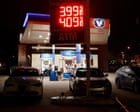
The breach of the $4.00 per gallon average for U.S. retail gasoline represents more than a psychological milestone for consumers; it is a structural repricing of energy risk driven by the convergence of depleted inventories and a localized conflict in the Middle East. When energy markets price in a war involving a major producer like Iran, the "Geopolitical Risk Premium" (GRP) decouples from the immediate physical supply-and-death balance. Current pricing reflects a market anticipating a high-probability disruption to the Strait of Hormuz, a chokepoint responsible for the transit of approximately 21 million barrels of oil per day.
Standard economic models often fail to capture the velocity of these price spikes because they treat gasoline as a linear commodity. In reality, the U.S. fuel market operates on a highly inelastic demand curve in the short term. Because most American infrastructure necessitates personal vehicle use for labor participation, consumers cannot immediately reduce consumption in response to price increases. This creates a vertical demand shift where price discovery is driven entirely by the marginal cost of the next available barrel of global Brent crude, plus the widening crack spread of domestic refiners.
The Mechanics of the Global Oil Supply Chain
To understand why a conflict in the Middle East dictates the price at a pump in Ohio, one must analyze the three distinct layers of the global petroleum value chain.
1. The Upstream Extraction Constraint
Iran produces roughly 3 million barrels of crude oil per day (mb/d). While U.S. domestic production has reached record highs, the global oil market is a fungible pool. When Iranian supply is threatened—either through direct kinetic damage to infrastructure or through the enforcement of secondary sanctions—global buyers pivot to alternative grades. This triggers a bidding war for North Sea Brent and West Texas Intermediate (WTI). Even if not a single drop of Iranian oil enters the U.S. refining system, the price of WTI tracks Brent due to arbitrage opportunities for U.S. exporters.
2. The Midstream Transit Bottleneck
The Strait of Hormuz is the most significant vulnerability in the global energy apparatus. It is only 21 miles wide at its narrowest point. If the conflict escalates to a maritime blockade, the "lost volume" cannot be easily redirected. Unlike pipeline disruptions, which can sometimes be bypassed via trucking or rail, there is no existing infrastructure capable of moving 20% of the world's daily oil consumption around the Persian Gulf. The market is currently pricing in a "probability-weighted loss" of this volume, which accounts for the $4.00 breach despite domestic inventories being within their five-year historical range.
3. The Downstream Refining Crack Spread
Gasoline is a manufactured product. The "crack spread" is the difference between the price of a barrel of crude oil and the petroleum products extracted from it. In a high-volatility environment, refiners face increased input costs and higher insurance premiums for shipping. Furthermore, the U.S. refining capacity has remained largely stagnant over the last decade. When crude prices rise rapidly, refiners often pass these costs—plus a buffer for future price uncertainty—directly to the retail level within 48 to 72 hours.
Quantifying the Geopolitical Risk Premium
The current price of fuel can be expressed as a function of three variables:
$$P_{gas} = (P_{crude} + C_{refine} + T_{dist}) + GRP$$
Where:
- $P_{crude}$ is the spot price of WTI or Brent.
- $C_{refine}$ represents the refining margin.
- $T_{dist}$ covers taxes and logistics.
- GRP is the Geopolitical Risk Premium.
Under normal market conditions, the GRP is near zero. In the current climate, analysts estimate the GRP at $15 to $25 per barrel of crude. This premium acts as a "fear tax." It is not based on barrels actually lost, but on the cost of replacing those barrels if a worst-case scenario—such as a direct strike on the Abadan refinery or the Kharg Island terminal—occurs.
The relationship between crude oil and retail gasoline is generally calculated at a ratio of $0.024 per gallon for every $1.00 increase in a barrel of oil. Therefore, a $20 GRP adds approximately $0.48 to every gallon of gas at the pump. This explains how the national average can exceed $4.00 even when domestic demand is softening.
The Inelasticity of the American Commuter
The primary reason gasoline prices can sustain levels above $4.00 without triggering an immediate economic collapse is the "Sunk Cost of Suburbanization." The American labor market is geographically decoupled from residential hubs.
This creates a specific economic phenomenon:
- Stage 1: Absorption. Initially, households absorb the cost by reducing discretionary spending (dining out, entertainment).
- Stage 2: Debt Loading. If prices remain above $4.00 for more than 90 days, low-to-middle income tiers begin utilizing revolving credit to fund essential transit.
- Stage 3: Destruction. Demand destruction only occurs when the cost of commuting exceeds the marginal utility of the shift worked.
The $4.00 mark is the "Absorption" threshold. It is the point where the psychological impact begins to alter consumer sentiment indices, which in turn affects broader market volatility and capital investment.
Inventory Levels and Strategic Reserve Limitations
A common misconception is that the Strategic Petroleum Reserve (SPR) can permanently suppress prices. The SPR is designed for physical supply disruptions, not for price management.
The limitations of using the SPR as a buffer against Iranian-related price spikes are twofold:
- Refining Compatibility: Much of the SPR consists of "sour" crude (high sulfur content). Many modern U.S. refineries are optimized for "sweet" crude. Releasing the wrong grade into the system creates a processing bottleneck that keeps retail prices high despite the increase in raw volume.
- The Depletion Trap: Repeated draws on the reserve for price control reduce the government's leverage during a true kinetic emergency. Markets recognize a depleted SPR as a sign of future vulnerability, which ironically can keep the GRP high.
The Fertilizer and Food Correlation
The impact of $4.00 fuel extends beyond the gas station. Petroleum and natural gas are foundational inputs for the agricultural sector.
- Diesel is the engine of logistics. Class 8 trucks, which move 70% of all freight in the U.S., rely on ultra-low sulfur diesel (ULSD). Diesel prices typically lead gasoline prices. High fuel costs increase the "last-mile" delivery expense for every consumer good.
- Petrochemical feedstocks. Oil is a primary component in the production of plastics, synthetic rubbers, and certain fertilizers.
The second-order effect of this fuel spike is a delayed inflationary wave in the Consumer Price Index (CPI), specifically in the "Food at Home" category. As harvesting and transport costs rise, these expenses are baked into the wholesale price of commodities six to nine months in advance.
Strategic Forecast and Exposure Mitigation
The current trajectory suggests that the $4.00 floor will remain until one of two conditions is met: a formal de-escalation in the Middle East or a significant global recession that forces demand destruction.
For organizations and individuals looking to manage this exposure, the focus must shift from "waiting for lower prices" to structural adaptation.
- Logistical Route Optimization: Firms must transition from "Just-in-Time" to "Just-in-Case" inventory management to reduce the frequency of high-cost freight movements.
- Energy Hedging: Commercial entities with high fuel exposure should utilize "collar" strategies in the futures market—buying call options to protect against spikes while selling put options to offset the premium cost.
- Capital Allocation: Investment must prioritize efficiency over expansion. In a $4.00+ environment, the ROI on fuel-efficient fleet upgrades or localized micro-fulfillment centers shifts from a five-year payback to a three-year payback.
The era of cheap energy as a baseline assumption for American economic growth has encountered a hard geopolitical ceiling. Survival in this environment requires a transition from reactive budgeting to proactive energy risk management.